
3G made mobile data a more capable part of everyday communication. It connected voice, messaging, web access and emerging multimedia through several related—but distinct—network families. Understanding those families explains both the ambitions of the early mobile internet and the compatibility problems left by network retirement.
Use this collection to learn the technology, interpret an old specification or investigate a handset. Ten explanatory guides lead into 49 dated reports from the period. Historical product claims, prices and rollout announcements describe their own time; they do not establish present availability.
Start with the question you have
- What does 3G mean? Start with UMTS, then compare the CDMA family. Separate a complete system from its radio-access method.
- Why do the names and speeds vary? Read EDGE and its classification, then HSDPA and HSPA. Try the file-transfer example to connect a rate to a task.
- Can this old phone still work? Go to the phone compatibility guide. Record the exact model, country, operator and required services before drawing a conclusion.
- What is inside the connection? Follow the network infrastructure, then locate the baseband modem. Separate radio coverage from transport and processing limits.
- What shaped calls and applications? Explore speech codecs and Mobile Java. Work through packet overhead and a fictional app descriptor.
- What happens when a network retires? Read the Verizon lifecycle case study, from laptop broadband to completed CDMA retirement.
3G is a family of standards, not one radio
The ITU's IMT-2000 framework recognized multiple radio interfaces. The two widely encountered branches below provide an entry point, while the standards also include other modes. ITU-R M.2038, Table 3, is a useful historical reference for the classification.
The GSM and UMTS story
GSM → GPRS → EDGE develops GSM access and its data services.
UMTS / WCDMA → HSPA is a different radio-access branch with later packet-data improvements. Multimode equipment and shared network functions connected the evolution.
The CDMA2000 story
IS-95 / cdmaOne → CDMA2000 1X develops an earlier code-based cellular system.
1xEV-DO emphasizes packet data. A historical handset could combine EV-DO data with 1X voice. This family is distinct from WCDMA despite the common code-access principle.
These arrows summarize relationships, not interchangeable radios or a required sequence for every operator. EDGE is commonly called 2.75G; ITU's broader historical IMT-2000 classification also includes UWC-136/EDGE. The exact technology tells you more than the generation shorthand.
Scroll the table sideways to read all columns. Keyboard: focus the table, then use the arrow keys.
| Term | What to ask | What it does not establish |
|---|---|---|
| Radio access | Which system carries information over the air? | Whether the device supports the operator's bands. |
| Band | Which frequency range and duplex arrangement are supported? | Whether the operator accepts the device or supplies a service. |
| Throughput | How much useful data arrives per second? | How quickly a small request receives its first response. |
| Latency | How long does a defined exchange take? | How fast a large file transfers once delivery is underway. |
A working connection depends on several layers
- DeviceRadio, software and subscriber identity
- Access networkBase stations and radio control
- Core and transportMobility, service control and onward connection
- ServiceA call, message or application
The names and paths differ by technology and release. This functional sketch omits signaling detail; the UMTS guide supplies a more specific map.
Consider a photograph sent from a train. The camera creates a file; software prepares the message; the network authorizes service and carries data; a remote system receives it. Radio coverage matters, but so do the subscription, server and software. A stronger signal alone cannot repair an unsupported application or restore a retired network.
What 3G changed—and what still limited it
3G's role becomes clearer through tasks: sending a richer message, opening a web page away from a desk, connecting a laptop, or attempting a mobile video call. Packet-data improvements expanded what could be practical, while handset processors, displays, batteries, software and service pricing shaped the experience.
The historical directory records that wider ecosystem. Chip announcements show integration and power concerns; testing reports reveal interoperability work; messaging and Java articles capture software dependencies; regional rollout reports show that deployment happened operator by operator.
- Release 1999: an early UMTS specification baseline, alongside work on GSM data evolution.
- Releases 5 and 6: HSDPA and enhanced uplink develop high-speed packet access.
- Later HSPA releases: additional radio techniques extend capability; support varies by implementation.
- Network retirement: operators repurpose resources and users must verify replacement services locally.
The Release 1999 UTRAN description, Release 5 HSDPA specification and Release 6 enhanced-uplink specification document these steps; its HSPA evolution study describes further development. A standards release date, first demonstration and commercial availability are different milestones. Read the dates in old reports accordingly.
Retirement changes availability, not the value of understanding
There is no single worldwide 3G shutdown date. Consult the operator and regulator for the country, device and service involved. As a dated example, Ofcom's UK guidance, updated August 10, 2026, reports that UK 3G networks are switched off. That statement applies to the UK, not every country.
A phone supporting LTE can still have a voice-service dependency on an older network. Verizon's retirement documentation identifies affected non-VoLTE devices; ACMA's Australian guidance explains emergency-call compatibility concerns. Use the phone guide's worksheet and the intended operator's official device check. Do not test an emergency number.
For historical reading, the enduring lesson is to ask which layer made a capability possible—and which dependency limited it. For an actual device, the useful outcome is a documented answer about today's required service.
Explore the 3G collection
All 59 original destinations remain available. The ten guides explain the technology and its use; the 49 historical reports retain their original coverage. Dates below identify publication of those reports, not a fresh endorsement of their claims.
No pages match. Try a broader word or clear the filters.
Explanatory guides
Guide · Updated October 12, 2026
UMTS explained: the system behind 3G
Understand UMTS, WCDMA and HSPA, follow a connection through a classic 3G network, and interpret device specifications.

Guide · Updated October 12, 2026
CDMA explained: codes, spectrum and network families
See how code-based radio access works, try a small arithmetic example, and distinguish CDMA2000 from WCDMA.
Guide · Updated October 12, 2026
HSDPA and HSPA: how 3G became faster
Understand HSDPA scheduling, adaptive transmission and retransmissions, then estimate a file transfer using sustained throughput.
Guide · Updated October 12, 2026
EDGE and 3G: GSM data and the generation labels
Learn how EDGE improves GSM data, why 2.75G and historical 3G classifications differ, and what the distinction means for a device.
Guide · Updated October 12, 2026
3G phones: compatibility, shutdowns and useful reuse
Check an old phone by exact model, country, operator and required services, with a downloadable compatibility worksheet.

Guide · Updated October 12, 2026
Inside a 3G network: radios, backhaul and core
Follow voice and data through classic UMTS and CDMA2000 networks, and distinguish radio coverage, capacity and backhaul bottlenecks.
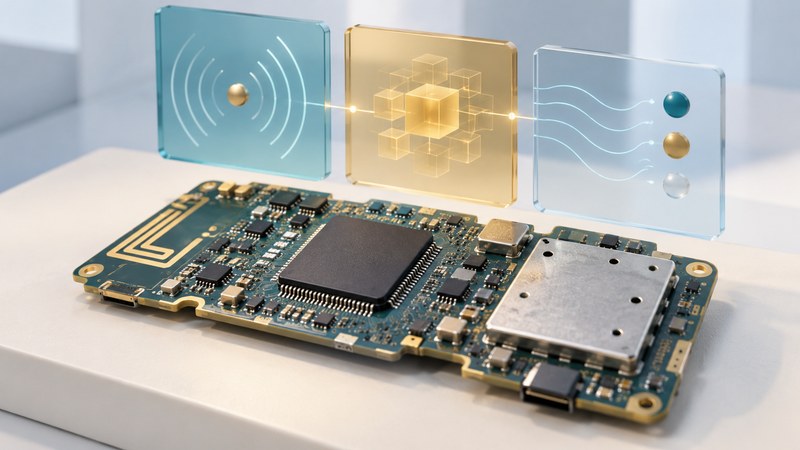
Guide · Updated October 12, 2026
What a 3G baseband modem does
Locate baseband processing between the RF circuitry and application processor, and understand modem integration and compatibility limits.

Guide · Updated October 12, 2026
Speech codecs: why phone-call quality changes
Understand speech bandwidth, compression, packet overhead and the complete call path, with AMR-WB, VMR-WB and EVS examples.
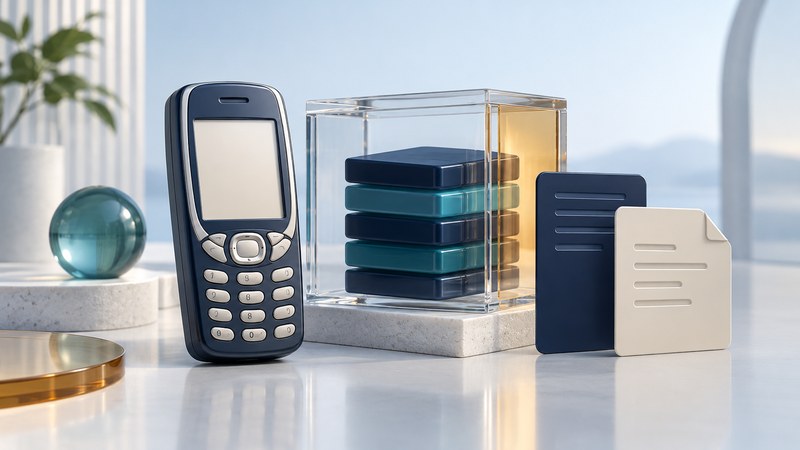
Guide · Updated October 12, 2026
Mobile Java: how downloadable phone apps worked
Decode Java ME, CLDC, MIDP, MIDlets and JAR/JAD packaging, with an original descriptor-reading exercise and compatibility checklist.
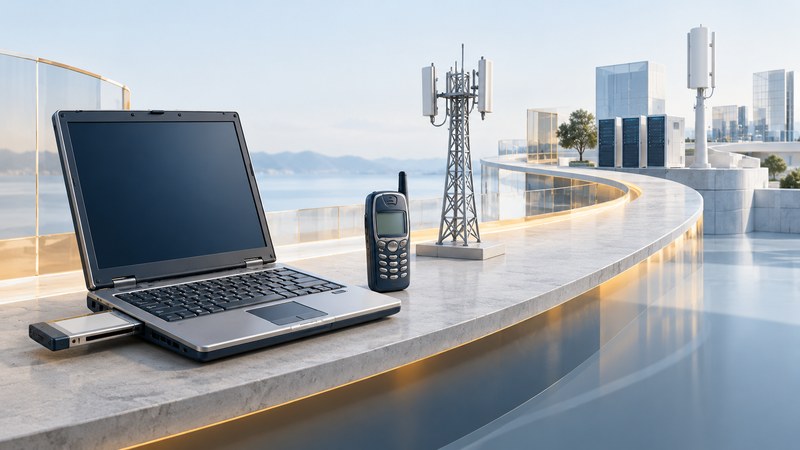
Guide · Updated October 12, 2026
Verizon 3G: EV-DO rollout, retirement and legacy
Trace Verizon mobile broadband from EV-DO laptop cards through LTE and CDMA retirement, then check the dependencies of an old device.
Historical reports: devices and components
Historical report · October 14, 2017
Cell Phone Signal Booster Phone Cradle with Outside Antenna
A weBoost Drive Sleek vehicle-cradle booster announcement, with then-current specifications and pricing.
Historical report · February 7, 2006
Multi-Band Radio Module
Sirific’s EM3200 evaluation module and its multi-band WCDMA/GSM/EDGE radio components.
Historical report · January 4, 2006
HSDPA Phone
Samsung’s HSDPA handset demonstration and its announced 3.6 Mbps capability.
Historical report · June 1, 2005
WiFi Phones
An announcement about combining cellular and Wi-Fi access in mobile handsets.
Historical report · February 1, 2005
MXC Mobile Extreme Convergence
The MXC platform’s proposed integration of cellular communications into mobile products.
Historical report · October 25, 2004
Nokia Video Phone
Nokia’s Series 60 platform work for person-to-person video communication.
Historical report · September 20, 2004
Mobile CPU
A mobile processor announcement emphasizing multimedia processing and pipeline design.
Historical report · September 15, 2004
Cell Phone Features
Contemporary analysis of camera, navigation and other features influencing handset demand.
Historical report · May 20, 2004
Advanced Mobile Multimedia
A mobile multimedia processor and software-based application implementation.
Historical report · May 11, 2004
Multi-Chip Memory
Toshiba multi-chip memory packaging and burst-mode support for handsets.
Historical report · April 21, 2004
EDGE Phones
An EDGE handset announcement from the period of GSM data expansion.
Historical report · March 9, 2004
Low Power Wireless Modem
A wireless modem design announcement emphasizing power and component integration.
Historical report · February 16, 2004
Digital RF Architecture
A radio chip architecture intended to reduce wireless transmission cost and power use.
Historical report · February 8, 2004
GSM Phones
A CMOS power-amplifier announcement for GSM/GPRS handsets.
Historical report · September 25, 2003
GSM GPRS Cellular System Solutions
GSM/GPRS chipset and system solutions for digital handsets.
Historical report · October 16, 2003
NEC 3 3G e616 Handsets
NEC’s e616 handset announcement, including video, location and internet features.
Historical report · December 11, 2003
3G CDMA Infrared
Infrared communication support for CDMA handsets, separate from the cellular radio link.
Historical report · August 28, 2003
3G Video Mobile Phone
The Motorola A920 multimedia handset announcement.
Historical reports: networks and deployment
Historical report · July 5, 2005
3G Cellular Infrastructure
Radio-frequency mixer and synthesizer components for cellular infrastructure.
Historical report · January 31, 2005
Indoor Wireless Coverage
An in-building wireless coverage system intended to support 3G services.
Historical report · June 16, 2004
3G Singapore
A Singapore network expansion involving radio controllers, core equipment and base stations.
Historical report · May 27, 2004
3G Pakistan
A CDMA network expansion and upgrade announcement in Pakistan.
Historical report · May 24, 2004
3G Price
Contemporary market expectations about costs of 3G base stations and other network equipment.
Historical report · May 19, 2004
3G China
A CDMA expansion announcement covering several Chinese provinces and regions.
Historical report · May 17, 2004
Inverse Multiplexing over ATM
Inverse Multiplexing over ATM devices for wireless base-station controllers.
Historical report · May 13, 2004
3G Greece
A Greek mobile-service announcement involving games, information and location-based applications.
Historical report · May 10, 2004
3G Australia
A Vodafone Australia infrastructure, planning and operations agreement with Nokia.
Historical report · May 7, 2004
3G Norway
NetCom’s Norwegian GSM and UMTS network equipment agreement with Siemens.
Historical report · May 6, 2004
3G Malaysia
A Malaysian broadband rollout announcement beginning in the Klang Valley.
Historical report · October 11, 2003
Universal Navigation Switch
A mobile-network switch announcement addressing 3G, WLAN and packet transport.
Historical report · September 29, 2003
GSM : Global System for Mobile Communications
A GSM network-upgrade announcement from the early mobile-data period.
Historical report · January 30, 2004
GSM GPRS Network
Cellular One’s announced Nokia GSM/GPRS network upgrade.
Historical reports: radio families and modes
Historical reports: software, voice and multimedia
Historical report · June 25, 2004
Open Mobile Terminal Platform
The Open Mobile Terminal Platform initiative and common device application interfaces.
Historical report · June 18, 2004
Mobile Entertainment
WAP 2.0, content management and delivery of multimedia across mobile devices.
Historical report · May 31, 2004
Mobile Phone Wallets
An identification-system announcement involving several mobile handset platforms.
Historical report · May 12, 2004
Multimedia Messaging
Packaging sound and text for multimedia playback on wireless handsets.
Historical report · March 16, 2004
WiFi UMTS Video Conferencing
A demonstration of voice and video communication across Wi-Fi and UMTS access.
Historical report · March 16, 2004
Pocket Cinema
Mobile video software and the pocket-cinema idea of the early handset era.
Historical report · February 24, 2004
Secure Content Delivery
Secure content delivery in the context of expanding SMS and MMS services.
Historical report · February 19, 2002
3G Application Services
Symbian platform development for 2.5G and 3G applications and services.
Historical report · November 10, 2003
3G Video Call Speed
Protocol software intended to reduce video-call setup time and memory requirements.
Historical report · December 22, 2003
Mobile Messaging
An announcement about global text-messaging connectivity.
Historical report · February 24, 2004
.NET Wireless
Baseband processors and .NET software infrastructure for wireless enterprise applications.
Historical reports: testing and interoperability
Historical report · July 6, 2004
3G Testing
Laboratory simulation of wireless-network conditions and controlled testing under load.
Historical report · May 6, 2004
MMS Interoperability
Cooperation on multimedia-message exchange between different mobile network families.
Historical report · April 28, 2004
UMTS Network
Network-engineering software for visualizing radio coverage and locating problems.
Historical report · October 1, 2003
GSM EDGE WCDMA UMTS Mobile Phone Wireless Testing
A PXI-based system for testing multiple cellular radio technologies.
Sources and further reading
Standards describe capabilities; current operator and regulator guidance determines local service availability. Sources reviewed October 12, 2026.
- ITU: Report M.2038 (2004), IMT-2000 radio-interface families
- 3GPP TS 25.401 V3.4.0: UTRAN overall description, Release 1999
- 3GPP TS 25.308 V5.4.0: HSDPA, Release 5
- 3GPP TS 25.309 V6.3.0: enhanced uplink, Release 6
- 3GPP TR 25.999 V7.1.0: HSPA evolution study
- Ofcom: UK network switch-off guidance (updated August 10, 2026)
- Verizon: CDMA network retirement and affected device types
- ACMA: 3G switch-off and emergency-call compatibility