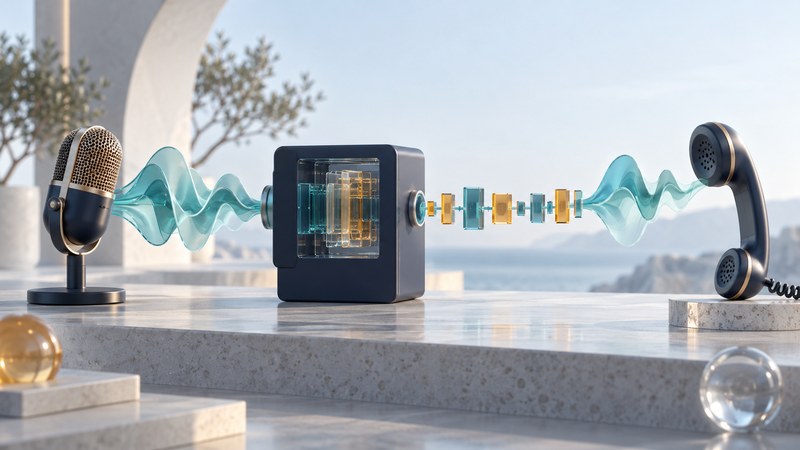
A speech codec converts sampled voice into a compact representation and reconstructs audio at the receiving end. Its design influences clarity, delay and data use. The sound you hear also depends on microphones, speakers, the selected codec mode, network delivery and any conversion along the call path.
Use this guide to separate audio bandwidth from bit rate, understand the relationship between VMR-WB, AMR-WB and later EVS, and interpret a voice-quality claim without reducing it to one number.
From microphone to reconstructed speech
- CaptureMicrophone and audio processing
- EncodeRepresent short blocks of speech
- TransportCarry coded information across the call path
- Decode and playReconstruct audio for the listener
Some paths also convert between codecs. Packet loss, buffering and acoustic conditions add effects of their own.
Speech codecs exploit structure in speech to use fewer bits than a straightforward sequence of uncompressed samples. Lossy coding preserves useful perceptual information while discarding or approximating other detail. A codec's operating mode determines a particular tradeoff; its name alone leaves that mode unspecified.
Radio channel coding serves another purpose: it adds structured protection against transmission errors. Keep the voice representation separate from the modem's delivery mechanisms. The baseband guide locates those functions in the handset.
Sampling rate, audio bandwidth and bit rate
Scroll the table sideways to read all columns. Keyboard: focus the table, then use the arrow keys.
| Quantity | What it measures | Example |
|---|---|---|
| Sampling rate | Audio samples taken each second, in Hz or kHz. | AMR-WB uses 16,000 samples per second. |
| Audio bandwidth | The range of audio frequencies represented by the system. | Wideband speech preserves a broader frequency range than conventional narrowband speech. |
| Codec bit rate | Bits used per second for the coded audio representation. | AMR-WB defines modes from 6.6 to 23.85 kbit/s. |
| Network bit rate | Bits carried at a specified transport boundary. | Packet headers and other overhead add to audio payload. |
RFC 4867 specifies the AMR/AMR-WB framing and transport context: AMR uses 8 kHz sampling, AMR-WB uses 16 kHz, and both represent 20 milliseconds of speech per codec frame. That means 160 input samples for AMR and 320 for AMR-WB in each frame.
VMR-WB, AMR-WB and EVS in context
Scroll the table sideways to read all columns. Keyboard: focus the table, then use the arrow keys.
| Family | Useful context | Interoperability question |
|---|---|---|
| AMR-WB | Adaptive Multi-Rate Wideband speech, standardized by 3GPP. | Which mode is selected, and can the path carry it end to end? |
| VMR-WB | Variable-Rate Multimode Wideband, developed for the CDMA2000 ecosystem. | Is its AMR-WB-compatible mode in use, with the relevant rates and transport mapping? |
| EVS | Enhanced Voice Services, a later 3GPP codec family supporting several bandwidths and modes. | Are EVS primary modes supported, or is an AMR-WB interoperable mode negotiated? |
RFC 4348 describes VMR-WB's modes and its interoperability with AMR-WB at specified rates. Its mode 3 can interoperate with AMR-WB modes 0, 1 and 2 through the specified arrangements. This is a bounded technical capability: the networks and endpoints must actually support the required mode and path.
The later 3GPP EVS performance-characterization report distinguishes narrowband, wideband, super-wideband and fullband operation, with different supported bit-rate combinations. It also identifies AMR-WB interoperable modes. The report's controlled test conditions help readers evaluate results; an EVS label by itself does not establish what bandwidth an individual call used.
Transcoding decodes one representation and encodes another. It can add delay and coding effects. If a path passes through a narrower-band representation, selecting a wider-band codec later in that path cannot recreate all the original information that was discarded.
Why a low-rate codec still needs network capacity
Real-time packet delivery carries timing and sequence information as well as audio. RTP, defined in RFC 3550, supports that transport. Payload formats specify additional details for each codec.
The numbers illustrate a tradeoff rather than an actual operator configuration. Header compression, silence handling, redundancy and variable-rate operation can change the calculation. Always state the measurement boundary.
Investigate the whole call
- Identify what sounds wrong. Muffled speech, dropouts, echo, background noise and conversational delay suggest different questions.
- Check the audio endpoints. Compare the same ordinary call with a supported headset or speaker mode when useful. Microphone placement and the room can dominate the experience.
- Record the path. Note the two devices, operators, location and whether cellular or Wi-Fi calling is involved.
- Separate advertised support from a selected mode. Use manufacturer/operator diagnostics where available; avoid inferring a precise codec from signal bars.
- Describe repeatable observations. Compare similar calls and report the conditions to the provider. A download-speed test alone does not measure speech quality.
Packet delivery introduces jitter, the variation in arrival timing. A receiving buffer can smooth some variation at the cost of delay; loss concealment can hide some missing audio with imperfect reconstruction. Good conversation therefore needs more than a high nominal codec rate.
Read Verizon's transition from CDMA to LTE voice for a concrete example of why voice support needed attention during network retirement.
Sources and further reading
Sources reviewed October 12, 2026. Standards and historical releases establish technical and period context; use current operator documentation for present service support.