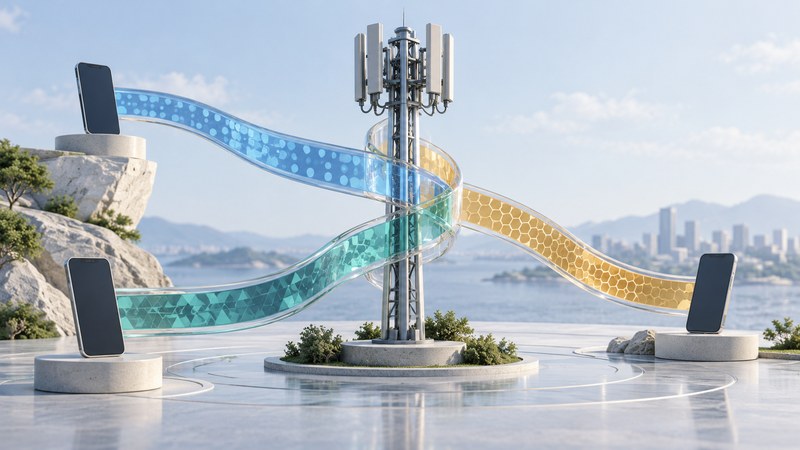
CDMA means Code Division Multiple Access: a way for multiple signals to share radio resources while receivers use codes to recover the wanted information. The same acronym also became shorthand for a particular mobile-network lineage—cdmaOne, CDMA2000 and EV-DO. Keeping the technique and the network family separate makes older phone specifications much easier to read.
How a receiver finds one signal in a shared channel
In direct-sequence spread spectrum, a data symbol is combined with a faster sequence of code elements, often called chips. A receiver correlates the received signal with the expected sequence. The wanted contribution builds up; other contributions can be reduced according to their code relationships and timing.
A useful analogy is recognizing one familiar pattern within a mixture. The pattern helps the receiver separate signals, but the radio still has finite power, bandwidth and tolerance for interference. Codes are part of an engineered system, not an unlimited set of perfectly isolated lanes.
Both CDMA2000 and WCDMA use spread-spectrum methods. Qualcomm's technical comparison of the two families discusses their shared mechanisms, including power control, multipath reception and handover. Shared mechanisms do not make their air interfaces interchangeable.
A four-chip example you can check
This deliberately simplified arithmetic model uses perfectly aligned, equal-power, orthogonal sequences. It is a teaching example, not a real cellular code assignment, capacity estimate or radio waveform.
Scroll the table sideways to read all columns. Keyboard: focus the table, then use the arrow keys.
| Sequence | Chip 1 | Chip 2 | Chip 3 | Chip 4 |
|---|---|---|---|---|
| Code A | +1 | +1 | −1 | −1 |
| Code B | +1 | −1 | +1 | −1 |
| A sends +1 | +1 | +1 | −1 | −1 |
| B sends −1 | −1 | +1 | −1 | +1 |
| Received sum | 0 | +2 | −2 | 0 |
Real links involve noise, different arrival times and reflected paths. These break the simplicity of the exercise. Error-control coding, receiver design and network control are what make a practical system work in that environment.
Power control and mobility make the radio practical
A nearby transmitter can arrive much more strongly than a distant one. This near–far problem is especially important on the uplink. Power control adjusts transmission toward a level that permits reliable reception while limiting interference to other users. Maximum transmit power is therefore a limit, not a target to use continuously.
Reflections can deliver delayed copies of a signal. A rake receiver can combine suitably resolved components. In applicable CDMA modes, soft handover supports a connection through more than one cell during a transition. These are distinct mechanisms: one addresses propagation paths, another mobility between cells. Their details vary across channels and systems. The technical comparison's radio sections give the implementation context.
For a reader interpreting a network claim, ask what is being measured: coverage, call reliability, traffic capacity or data throughput. An improvement in one does not specify the others. A count of available codes alone is particularly poor evidence for the number of useful simultaneous connections.
CDMA2000 and WCDMA are separate branches
Scroll the table sideways to read all columns. Keyboard: focus the table, then use the arrow keys.
| Name | Place in the story | How to read it |
|---|---|---|
| cdmaOne / IS-95 | An earlier digital cellular family. | The predecessor to CDMA2000, not a synonym for every CDMA technique. |
| CDMA2000 1X / 1xRTT | Voice and data evolution of that lineage. | Look for the exact implementation and services, rather than inferring a speed from “1X.” |
| 1xEV-DO / HRPD | A packet-data-oriented development. | Device and network revision matter; operator voice often used a separate 1X capability. |
| WCDMA / UMTS | A different 3G system using wideband code-based access. | Typically described in the GSM-to-UMTS evolution, despite “CDMA” being part of WCDMA's name. |
The ITU's IMT-2000 table places UTRA/WCDMA and CDMA2000 in distinct radio-interface categories. Use that distinction when comparing technology families. See UMTS explained for the other branch and HSPA for its packet-data evolution.
What a “CDMA phone” label tells you
In a historical sales listing, “CDMA phone” often identifies the operator ecosystem for which the device was sold. A useful current assessment needs the model variant, supported radio technologies and bands, software, operator acceptance and required services.
A multimode device may include both an older CDMA2000 radio and LTE. Whether calls continue after retirement depends on supported and provisioned voice service as well as the newer radio. Verizon's CDMA retirement documentation specifically identifies older CDMA equipment and 4G devices without its supported HD Voice capability as affected. That is an operator-specific example, not a worldwide retirement date.
A replacement SIM or a menu setting cannot add a missing radio system. Start with the device compatibility worksheet and use the intended carrier's official check. For historical study, record the network and year alongside the label so the meaning remains clear.
Sources and further reading
Standards describe capabilities; current operator and regulator guidance determines local service availability. Sources reviewed October 12, 2026.