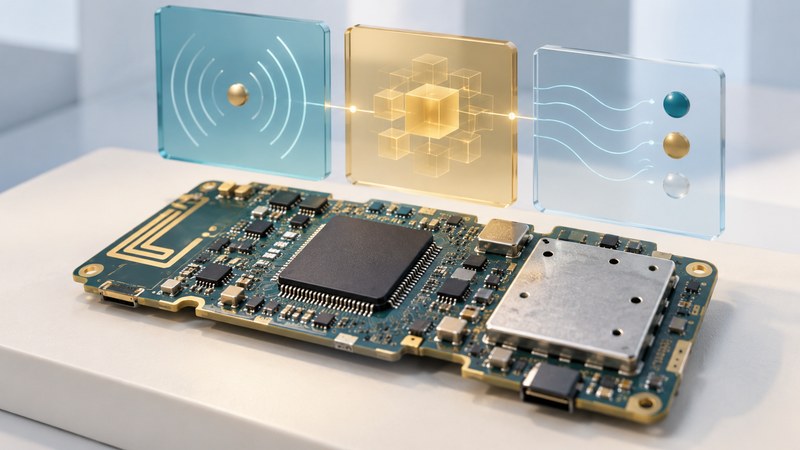
A cellular baseband modem turns digital information into the signals and protocol exchanges needed for a mobile radio connection. It works with the radio-frequency circuitry, while an application processor runs much of the software the user sees. These are distinct jobs even when a chip package combines them.
Understanding that division helps explain multimode phones, modem specifications and hardware compatibility. Begin with a functional map, then read a real chipset example as evidence of one design.
From antenna to application
- Antenna and RF front endSelect, filter and amplify radio signals
- RF transceiverTranslate between radio frequencies and baseband signals
- Baseband modemRecover data and manage radio protocols
- Application systemUse delivered data in software
Transmission uses the corresponding processing in the other direction. Data conversion and other functions may sit at different chip boundaries in different designs.
At baseband, engineers work with a representation of the modulated information near zero frequency rather than the original radio carrier. In many designs, paired I and Q components represent the signal. “Baseband” can refer to those signals, the processing function, the modem subsystem or the chip that implements it. The context matters.
Analog Devices' WCDMA reference design provides a concrete RF example: its receiver converts radio signals down through an intermediate frequency and exposes analog I/Q connections to a baseband processor. Other architectures use different conversion arrangements; the example establishes the separation of functions.
What the modem has to do
Scroll the table sideways to read all columns. Keyboard: focus the table, then use the arrow keys.
| Task | Practical purpose | Related distinction |
|---|---|---|
| Timing and synchronization | Align processing with the received radio transmission. | A detectable signal still needs usable timing and decoding. |
| Modulation and signal recovery | Map data to symbols for transmission and recover information at reception. | Different radio systems require their own supported modes. |
| Channel coding | Add and use structured redundancy to help detect or correct errors. | Radio protection is separate from compressing speech or an image. |
| Protocol control | Coordinate access, connection state, measurements and mobility procedures. | A radio link requires timed exchanges with the network. |
| Host interface | Exchange data and control information with the application system. | An application's delay may occur beyond the modem. |
Implementations distribute these jobs among digital signal processors, control processors, dedicated accelerators and software. The Texas Instruments wireless-chipset catalog shows DSP, processor, memory and peripheral blocks in actual handset platforms. It is a historical engineering example, not a prescription for how every modem must be built.
Audio makes the division especially clear. A speech codec represents microphone audio efficiently. The modem then handles the radio system's delivery requirements. Speech coding and radio channel coding solve different problems even if their implementations share processing resources.
Read a historical chipset as a system
Texas Instruments' 2003 TCS4105 platform description separates a UMTS/GPRS digital baseband processor, an analog baseband/power-management device, GSM/GPRS and WCDMA RF transceivers, and an interface to an OMAP application processor. That list makes the radio-to-application chain tangible.
Start with the role of each block rather than memorizing its part number. An RF transceiver's frequency coverage, the modem's supported protocols and the application's computing resources answer different questions. The catalog's marketing performance claims also have their own comparison conditions; the block diagram is the useful evidence here.
Integration later combined more functions. Qualcomm's November 2006 UMTS/HSDPA announcement describes products integrating radio, baseband, multimedia and power-management functions. Fewer packages can change board design and implementation choices while leaving the logical responsibilities recognizable.
What a multimode modem actually promises
A modem platform described as GSM/GPRS/EDGE/WCDMA/HSDPA supports several related radio capabilities. A finished phone still needs the appropriate RF paths, filters, amplifiers, antennas, software and product configuration. The chip's headline capability is one input to the device specification.
Keep three layers together when assessing compatibility: silicon/platform capability, finished-device implementation, and operator/service acceptance. Use the phone compatibility guide for the full device check.
A method for reading modem claims
- Identify the object. Is the document about a processor core, licensable design, chipset, module or complete phone?
- Separate functions. Mark the RF, digital baseband, application, memory and power-management blocks.
- List supported modes and bands. Record the exact model and hardware revision, along with any stated feature or software conditions.
- Locate the rate measurement. A radio peak, host-interface rate and sustained application download measure different boundaries.
- Follow the task. For an actual problem, distinguish registration, ordinary calls, mobile data and the application response.
For example, a slow image filter running offline points first toward application processing and software. A device that cannot register on a supported network raises a different set of radio, account and provisioning questions. These observations guide investigation; they do not identify a failed chip by themselves.
The infrastructure guide continues the same functional approach beyond the handset. Together, the two maps explain why an end-to-end service depends on more than either the phone's processor or the nearest tower.
Sources and further reading
Sources reviewed October 12, 2026. Standards and historical releases establish technical and period context; use current operator documentation for present service support.