Verizon's 3G network is a useful case study in the full life of a mobile technology: early packet data, laptop broadband, years of mixed-generation devices, and eventual retirement. Its CDMA network has been decommissioned. This page explains that history and how to interpret an old device today.
The scope is Verizon in the United States. A retirement date for one operator does not establish the status of every 3G network elsewhere.
From mobile data to completed retirement
Scroll the table sideways to read all columns. Keyboard: focus the table, then use the arrow keys.
| Period | Milestone | How to interpret it |
|---|---|---|
| Early 2004 | Verizon and Novatel described EV-DO service already operating in Washington, DC and San Diego, with national expansion planned. | An early deployment and expansion announcement, not nationwide coverage at that moment. |
| December 5, 2010 | Verizon launched commercial 4G LTE service. | A new radio/data platform began operating alongside the older network. |
| 2022 | Verizon's annual report records retirement of its 3G network during the year. | The support page gave December 31 as the completion deadline; the annual report confirms retirement in 2022. |
| January 3, 2023 notice | Verizon's business support page says its CDMA network has been decommissioned. | A completion notice on a page that also retains older transition instructions. |
The early deployment evidence comes from a February 2004 Verizon–Novatel release preserved by Inseego. Verizon documents its LTE launch, the retirement in its 2022 annual report, and the completed shutdown on its CDMA retirement support page.
Why a laptop card was an important 3G device
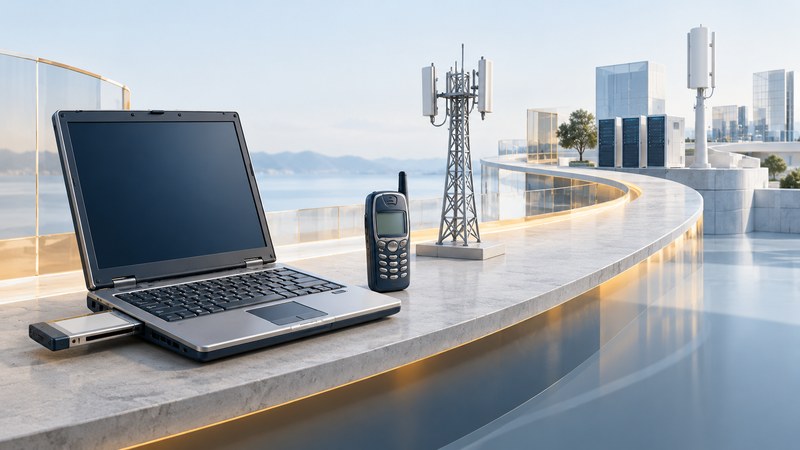
Early mobile broadband was not confined to a phone screen. A cellular PC Card placed the radio modem in a laptop, making email, web access and remote work possible away from a fixed connection where compatible service was available. The computer supplied the applications and display; the card, drivers, account and network supplied the communications path.
- Laptop applicationCreates or receives data
- Cellular cardModem, radio and connection software
- EV-DO networkRadio access and packet network
- Remote serviceWebsite, mail system or workplace
Each part needs to work. A detected card is evidence about the computer interface, not proof that cellular service exists.
EV-DO was a packet-data development in the CDMA2000 family. It should be distinguished from CDMA2000 1xRTT and from UMTS/WCDMA, the other major 3G family discussed in the CDMA guide. Verizon's older service combined technologies with different roles; the marketing label “3G” alone does not describe every radio or service a device used.
The 2004 joint release described expected typical data rates of 300–500 kilobits per second. That is a historical carrier/vendor claim, not a current benchmark or a measurement performed for this guide. It helps explain why the service was meaningful for laptop users at the time, while actual experience depended on coverage, loading, signal conditions and the rest of the connection.
A faster radio did not remove the need for working software, suitable drivers, account provisioning and reachable servers. Those dependencies explain why a preserved modem and its original installation disk cannot recreate a retired public network.
LTE support and voice support are separate checks
The arrival of LTE began a period when a device could depend on different network generations for different tasks. An early LTE-capable handset might use LTE for data while relying on the older CDMA system for calls. A label on the case therefore gives an incomplete account of its dependencies.
Voice over LTE, or VoLTE, carries supported voice service over LTE. Verizon's HD Voice documentation explains the device and service requirements for its offering. A supported implementation and account configuration matter alongside the radio bands.
The retirement page specifically identifies 1xRTT, 3G CDMA and 4G devices without VoLTE among affected categories. For a phone, checking that LTE data once worked is insufficient evidence that calling remains supported. For a data-only modem or embedded product, evaluate its actual data-network and service dependencies rather than applying a handset voice requirement indiscriminately.
This distinction also reaches beyond phones. Connected equipment can include an embedded cellular module whose capabilities differ from the label on the finished product. The equipment maker's model-specific documentation and service provider are the appropriate places to establish that dependency.
How to evaluate an old Verizon device now
- Identify it precisely. Record the exact model, regional variant and, for embedded equipment, the cellular module and firmware information available from its manufacturer.
- Name the required task. Distinguish calling, messaging, packet data and offline functions. List any app, server or subscription the task uses.
- Read the network specifications. Identify supported radio families and bands. For a phone requiring Verizon voice service, also establish compatible VoLTE support.
- Check current eligibility. Use Verizon's bring-your-own-device compatibility process or the relevant equipment/service provider. A historical compatibility list or a seller's “unlocked” description does not settle current activation support.
- Test the intended service after setup. Successful registration or a signal indicator alone does not demonstrate every required function. Record what actually works.
The 3G phone compatibility guide and worksheet provide a reusable way to record those findings. Offline functions may remain available even when cellular service does not; assess them separately.
Verizon's retirement page retains dated billing, migration and promotional details alongside its completion notice. Read those details as records of the transition. Use current support and account information for a present-day device decision.
What this network's lifecycle teaches
Mobile connectivity is a relationship among a device, radio system, operator and service. Hardware can outlast the public infrastructure it was designed to use. Conversely, introducing a newer data network does not automatically remove every dependency on an older voice network.
Verizon's experience makes those relationships concrete: EV-DO helped extend internet access to portable computers; LTE changed the data platform; VoLTE changed voice dependencies; retirement exposed the remaining legacy links. The infrastructure guide shows the network functions involved, and the baseband guide explains the modem inside the device.
For other countries and operators, repeat the same dependency checks with their own current documentation. The enduring lesson is to identify the required service and every layer it relies on.
Sources and further reading
Sources reviewed October 12, 2026. Standards and historical releases establish technical and period context; use current operator documentation for present service support.
- Novatel Wireless / Verizon: EV-DO PC Card agreement, February 10, 2004
- Verizon: LTE launch date and initial coverage
- Verizon 2022 Annual Report on Form 10-K: completed 3G retirement
- Verizon: CDMA retirement confirmation and affected device categories
- Verizon: HD Voice support and requirements
- Verizon: bring-your-own-device compatibility check