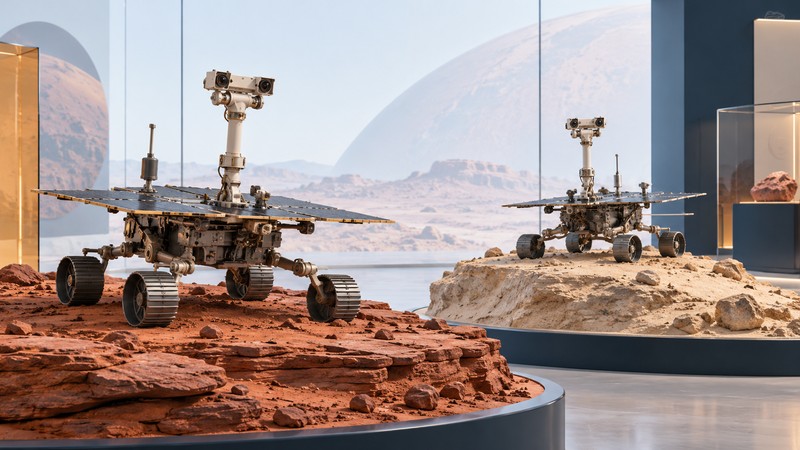
Spirit and Opportunity carried similar geological tools to different places on Mars. Their value came from putting images, mineral measurements and rock textures into a local setting. Comparing the two missions shows why a planet's water history requires more than one landing site or one striking photograph.
Both rovers landed in January 2004. Spirit explored Gusev crater and the Columbia Hills; Opportunity explored Meridiani Planum and later the rim of Endeavour crater. NASA's Mars Exploration Rover mission overview introduces their shared question: what do rocks and soils reveal about past water and potentially habitable environments?
Two sites gave the same toolkit different work
| Question | Spirit | Opportunity |
|---|---|---|
| Where did it work? | Gusev crater, including the Columbia Hills and Home Plate area. | Meridiani Planum, from Eagle crater to later targets including Endeavour's rim. |
| Examples of water-related evidence | Altered rocks and silica-rich soil, with evidence consistent with ancient hydrothermal activity. | Hematite-rich concretions, sedimentary rocks, mineral veins and evidence of different watery environments. |
| What limited operations? | Wheel problems, entrapment and difficulty achieving a favorable winter position. | A 2018 planet-wide dust storm reduced sunlight available to its solar panels. |
| Last contact / formal mission end | March 22, 2010 / May 25, 2011. | June 10, 2018 / February 13, 2019. |
The separate Spirit and Opportunity mission records distinguish the last received signal from the later decision to end recovery efforts. Those dates answer different historical questions.
A field geologist's sequence, carried out remotely
The rovers combined panoramic views with close inspection and composition measurements. Their cameras placed a target in the landscape. Mini-TES examined infrared radiation to help investigate mineral composition from a distance. Instruments on the robotic arm brought the investigation to a rock's surface.
- Panoramic and navigation images: identify outcrops, routes, layers and the spatial relationship between targets.
- Microscopic imager: examine grains and textures at close range.
- Alpha-particle X-ray and Mössbauer spectrometers: investigate chemistry and iron-bearing minerals.
- Rock Abrasion Tool: expose material beneath a weathered or dusty surface for closer examination.
The instrument lists in NASA's mission records help connect a statement to the tool capable of supporting it. A color picture can locate an interesting patch; a compositional result requires the relevant measurement. For image scale and processing, use the Mars image-reading guide.
Follow the chain from observation to interpretation
Spirit: a disturbed patch of soil became a target
Spirit exposed bright soil while dragging a damaged wheel. Infrared observations helped identify an interesting target; the team then brought the arm's chemical analyzer close enough to investigate it. NASA's silica-rich soil record explains this sequence and the evidence for water's role in concentrating the material.
The useful lesson is the combination of observations. Brightness drew attention to the patch. Instrument measurements supplied information about composition. Geological context helped researchers assess processes capable of producing it. Calling it a water-related deposit rests on that combined reasoning.
Opportunity: several kinds of watery environment
Opportunity's hematite-rich rounded concretions became famous as “blueberries.” Later work added mineral veins and evidence of clay-bearing environments near Endeavour. NASA's science highlights connects those discoveries to different water chemistry and geological settings.
A planet can preserve acidic, salty water environments in one unit and more neutral conditions in another. “Mars once had water” is therefore a starting point. The next questions are where, when, for how long and under which conditions. The water evidence guide explains how these questions relate to habitability. Establishing an environment suitable for life remains a separate step from identifying evidence that life existed.
Exploration meant choosing the next useful measurement
Rover work joins science priorities with mobility, energy and communication limits. A distant outcrop may be scientifically attractive but costly to reach; a nearby target may answer a question before a longer drive. Teams use the returned observations to choose follow-up measurements and build a sequence the rover can execute.
Consider an illustrative choice between a bright soil patch and a layered outcrop. If the immediate question is why the soil looks unusual, a composition measurement and close image can narrow the possibilities. If the question is how a deposit accumulated, the arrangement and continuity of layers may be more useful. State the question first, then choose the observation.
The rovers depended on solar power and workable terrain throughout this process. Their histories show how damaged hardware, soft ground, changing seasons and atmospheric dust shaped what could be attempted. Long mission duration reflects repeated operational decisions as well as the original design.
Read a rover result as a small field notebook
Record the rover, site or target, Martian day (sol), instrument and observation. Then write the interpretation in a separate sentence. Add the evidence that would help distinguish it from another explanation. This keeps a memorable image attached to the measurement and context that make it useful.
For the path those observations took back to Earth, read how Mars missions send data home. Compare their moving fieldwork with InSight's stationary interior investigation, or return to Space Exploration.