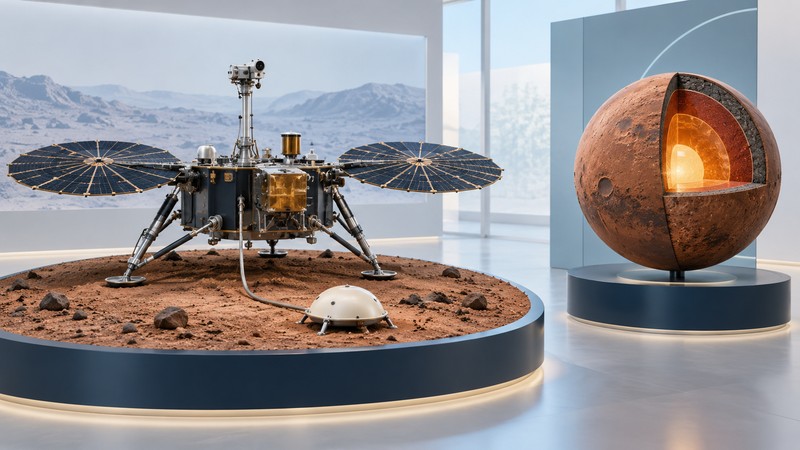
InSight studied Mars by staying in one place and measuring what moved around and beneath it. Its seismometer recorded ground vibrations; radio tracking measured the planet's rotation; environmental sensors helped distinguish a signal from local disturbances. Together, those observations opened a way to investigate the crust, mantle and core from the surface.
NASA's lander launched on May 5, 2018, and touched down in Elysium Planitia on November 26. Its last communication was December 15, 2022; NASA announced the mission's end on December 21 after repeated contact attempts failed. The mission record and retirement account distinguish those dates. The spacecraft stopped collecting data, but its measurements remain available for research.
Three experiments, different routes into the interior
A planetary interior is inferred from measurements. Keep the instrument, the recorded quantity and the scientific interpretation together when reading a discovery.
| Experiment | Measurement | Scientific use and outcome |
|---|---|---|
| SEIS: seismometer | Ground motion over time, including marsquakes and impacts. | Wave arrivals and reflections constrain layers and material properties. This became the mission's central record of the interior. |
| RISE: radio tracking | Precise tracking of the lander's motion as Mars rotates. | Changes in rotation and wobble provide a complementary constraint on the planet's interior. |
| HP³: heat probe | Designed to measure subsurface temperature behavior and heat flow. | The self-hammering probe could not reach the required depth, so the planned deep heat-flow measurement was not obtained. |
NASA's instrument descriptions explain the different measurements. Wind, pressure, temperature and magnetic-field observations also helped interpret the seismic record. A lander vibration occurring during a strong gust requires different scrutiny from a clean wave arrival during quiet conditions.
How a vibration becomes evidence of a layer
A seismogram plots motion against time. A quake sends waves through the planet along different paths. Some travel more directly; others reflect or change behavior at boundaries. Their arrival times and shapes depend on the materials they cross.
In the July 2021 report on Mars's interior, researchers used direct arrivals and echoes to investigate the crust, mantle and molten core. The measurement was a time series at the lander. The layered model was the explanation that fit those signals.
- Identify the event. Check whether the signal is classified as a marsquake, an impact or another disturbance.
- Inspect the context. Look for environmental noise, instrument conditions and the quality of the usable arrivals.
- Compare wave paths. Ask which arrivals passed through or reflected from the proposed boundary.
- Test a model. Compare predicted arrival behavior with the observations, including uncertainty and alternative structures.
Think of echoes in a building as an analogy: their timing can tell you about distances and surfaces, but you must know something about the original sound and its route. Planetary seismology has the additional challenge of uncertain source locations and changing wave speeds. A diagram showing one neat set of layers summarizes an interpretation.
What InSight changed about the picture of Mars
The mission established a substantial seismic record: NASA reported 1,319 detected marsquakes at retirement, including events associated with meteoroid impacts. It gave scientists observations with which to test interior models that previously relied more heavily on indirect constraints.
Results also evolved as useful events accumulated. A 2023 analysis of waves that traveled through the core inferred a smaller, denser liquid iron core than earlier estimates. This is a useful example of scientific refinement: different paths through the planet can separate explanations that previously fit a limited set of observations.
When comparing two interior diagrams, record the study date, observations used and assumptions about layer boundaries. A quoted radius without that context can make an earlier model appear to be a timeless measurement. This guide emphasizes the reasoning rather than a single numerical cross-section.
The heat probe and the power limit
The HP³ probe needed friction from the surrounding soil to advance. The actual soil behaved differently from expectations; repeated attempts, including help from the robotic arm, failed to achieve the intended depth. NASA and DLR ended the effort in January 2021. The account of the mole's outcome explains both the missing heat-flow result and what engineers learned about the soil and mechanism.
Later, dust accumulation on the solar arrays reduced available power. The retirement account connects the end of operations to that energy constraint. These were distinct outcomes: one instrument's deployment difficulty and the lander's eventual power exhaustion should be evaluated separately from the seismic observations it returned.
Follow an InSight finding with four notes
For a new paper or news report, write down the event or data set, instrument, inferred property and remaining uncertainty. Then check whether the report describes new observations, a reanalysis or a revised model. The mission's end date alone tells you little about when its last scientific discovery will be published.
Continue with why InSight missed its first launch window, how different Mars missions complement one another, or the Space Exploration library.