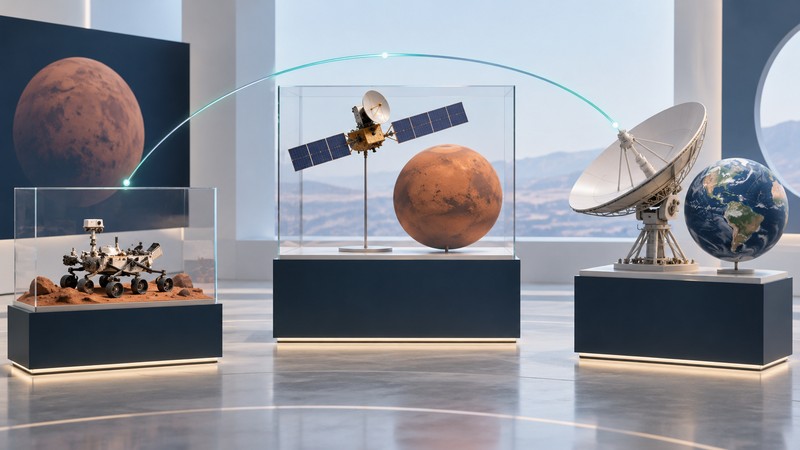
A Mars image reaches Earth through a planned chain of radio contacts. A rover can send stored observations to an orbiter passing overhead; the orbiter then downlinks the data to a ground antenna, where mission systems deliver it to the team. Distance, visibility, power and scheduling all affect when the result arrives.
This is why the time a camera takes a picture and the time a reader sees it can be far apart. Understanding the route also explains why teams prepare activity sequences and wait for returned telemetry before judging what happened.
Follow a science observation home
- Surface instrument → rover storage. A camera or other instrument produces data that must be packaged and retained for transmission.
- Rover → Mars orbiter. During a scheduled pass, compatible radios establish the nearby relay link.
- Orbiter → Earth antenna. The spacecraft sends the data across interplanetary space; depending on the spacecraft and geometry, forwarding may occur during the pass or later.
- Ground systems → mission team. Received data are processed and checked so scientists and engineers can use them.
NASA's Mars Relay Network overview explains why orbiters carry much of the high-volume return from the surface. A nearby relay link is practical for a rover's power and antenna limits, while an orbiter can support the longer Earth-facing link. Direct-to-Earth capabilities also exist on Mars spacecraft; the route above describes a common relay path.
On Earth, NASA's Deep Space Network has complexes near Goldstone in California, Madrid in Spain and Canberra in Australia. Their geographic spacing supports contact as Earth turns. Antenna time still has to be allocated among missions.
Four different reasons a result can take time
| Constraint | What it means | Reader's check |
|---|---|---|
| Signal travel time | Radio waves need time to cross the Earth–Mars distance. | Is a stated delay one-way or round-trip? |
| Contact geometry | The rover, orbiter and ground station must have usable viewing geometry. | Was the next relay pass or downlink still ahead? |
| Data rate and volume | A finite number of bits can cross a link each second. | Does the quoted rate describe the local relay or the Earth link? |
| Operations and processing | Scheduling, priorities, checks and release work add time. | Are you comparing acquisition, receipt or public release dates? |
NASA gives a broad Earth–Mars light-time range of about 3 to 22.4 minutes one-way, depending on orbital positions. A higher data rate can transmit more information per second, but it leaves the propagation speed unchanged. A link can therefore be both fast in bits per second and slow to answer.
Near Mars solar conjunction, interference from the Sun complicates radio communication. Teams prepare activities in advance and may suspend routine commanding for a defined interval. Read each mission's dated notice for its actual arrangements; a general explanation of conjunction is not a current outage schedule.
Worked example: a quick action can still take twenty minutes to confirm
Illustrative assumptions: Earth and Mars are 180 million kilometers apart; use a rounded signal speed of 300,000 kilometers per second. Assume the command can be sent immediately, the spacecraft acts immediately and a response is returned immediately. Ignore processing and contact waits.
One-way travel: 180,000,000 km ÷ 300,000 km/s = 600 seconds = 10 minutes. An immediate reply needs another 10 minutes to reach Earth. The earliest confirmation in this simplified example is therefore 20 minutes after transmission.
Now add an independent data-volume example. A 100-megabit file transmitted at a constant 1 megabit per second needs 100 seconds of transmission time, before protocol overhead or interruptions. Those 100 seconds describe how long the link sends the file; the 10-minute value describes how long its signals travel. Neither calculation includes waiting for a scheduled pass.
Use the plain-text Mars link timing sheet to repeat the calculation with stated assumptions. It is a learning aid, not a mission scheduling or link-budget tool.
What Mars Express and Spirit demonstrated in 2004
On February 6, 2004, ESA's Mars Express transferred commands to NASA's Spirit rover and relayed its telemetry back to Earth. The command path passed from the Spirit team at JPL through ESA's operations center, then to the orbiter and rover. Returned data followed the coordinated relay chain.
ESA's account of the demonstration records the successful exchange. Its significance was the compatible spacecraft and coordinated operations across two agencies. Interoperability includes radios, command preparation, data handling and agreed procedures, not simply the presence of two spacecraft above the same planet.
Read the timestamps before judging the connection
For a communication report, identify the sending spacecraft, relay spacecraft if used, ground network, contact time and kind of data. Then distinguish a planned pass from a completed reception. Use NASA's network overview for the maintained fleet description; operational membership and capacity change.
Continue with Spirit and Opportunity's fieldwork, reading Mars image metadata, or the Space Exploration library.