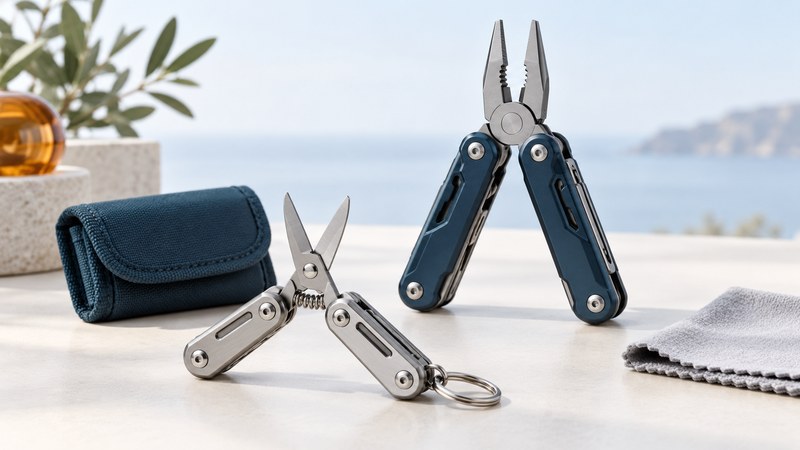
Choose around three real tasks
A useful multitool is one you can carry, open and control for the jobs that recur. List three of those jobs before comparing models: trimming a tag, turning a particular small screw, or holding a small part, for example. Describe the material and access as well as the action.
Leatherman’s Micra product information describes a compact keychain format centered on spring-action scissors, with small drivers, tweezers and personal-care implements. A pliers-centered model places a different function at the center of the tool. The Rebar product information illustrates that larger format with pliers, cutters and folding implements.
Compare the actual implements you will use, including their size and reach. A higher function count can include several sizes or closely related tasks. It gives less information than whether the right driver fits your fastener or the scissors can comfortably reach the intended cut.
Compare handling as well as features
| Question | Compact scissors format | Larger pliers format |
|---|---|---|
| What is the frequent task? | Small trimming and light detail work | Holding parts and a broader mix of workshop tasks |
| How will it be carried? | Check keyring or small-pocket access | Check pocket, clip or sheath fit for the actual model |
| Does the implement reach? | Try access with the short body in position | Account for the handles and full working envelope |
| How does it open and close? | Learn the specific implement sequence | Learn the specific locks, releases and pinch points |
| When is a separate tool better? | Repeated cutting or a poorly matched screw | High force, extended work or a specialized requirement |
Use the manufacturer’s published dimensions to make a simple paper footprint of the closed tool if you cannot handle it first. Include the sheath or clip in the carrying decision. That comparison helps estimate space; a real handling check still answers grip and access questions better.
Inspect the model and practice deployment
Find the exact model’s instructions through Leatherman support. Confirm which implements lock and how they release. For example, the Rebar page identifies locking folding implements while excluding the plier head from that description. Transfer that detail only to the documented model.
- Inspect the pivots, edges, jaws and handle condition in good light. Resolve damage or unexpected looseness before use.
- Practice opening the needed implement using the model’s instructions, with fingers out of its closing path. Keep other implements stowed.
- Support the work and check the approach before applying force. Confirm a driver’s fit in the fastener instead of relying on its label alone.
- Use controlled pressure in the implement’s intended direction. Stop if it slips, folds unexpectedly or requires excessive force.
- Close and stow the tool by its prescribed sequence, checking that sharp implements are fully contained.
CCOHS hand-tool guidance supports choosing the right tool, securing the work and avoiding excessive force or unintended uses. A folding blade should not be used as a pry bar. Electrical work requires equipment rated for that purpose; ordinary metal multitools do not provide that protection.
Compare a small task kit
For work at a bench, compare the multitool with dedicated needle-nose pliers and a suitable screwdriver. Separate tools may be easier to hold for repeated operations. Keep the folding tool for tasks where its compact arrangement is actually useful.
Before carrying a blade-equipped tool to a workplace, venue or transport setting, check that destination’s current requirements. Select a permitted configuration or leave it stored; the presence of scissors or a keyring does not determine admission.
Clean, dry and check before storage
Leatherman’s maintenance guidance explains that its stainless steel is corrosion-resistant rather than rust-proof. Remove debris, clean as directed, dry thoroughly and lubricate the appropriate pivot or wear areas. After saltwater exposure, its guidance calls for a fresh-water rinse, drying and light lubrication.
Choose cleaning materials compatible with the model and finish. Leatherman cautions that acetone and brake cleaners can damage plastic components. Keep care products away from food-contact tasks unless their instructions permit that use, and remove unwanted residue before the next job.
After cleaning, inspect movement and closure without forcing a stiff part. Use manufacturer support for damaged locks, pivots or cutting parts. Check the current service terms for the actual tool and region when repair is needed; keep its model information and any purchase record together. Store it dry, closed and out of children’s reach.
Choose your next guide
- Leatherman Wave — Identify the Wave version before choosing accessories.
- Swiss Army Knives — Compare pocket-knife functions, size and care.
- Needle-Nose Pliers — Choose reach, jaw shape and control for small parts.
Browse hand tools and kits or explore all 47 tool guides.