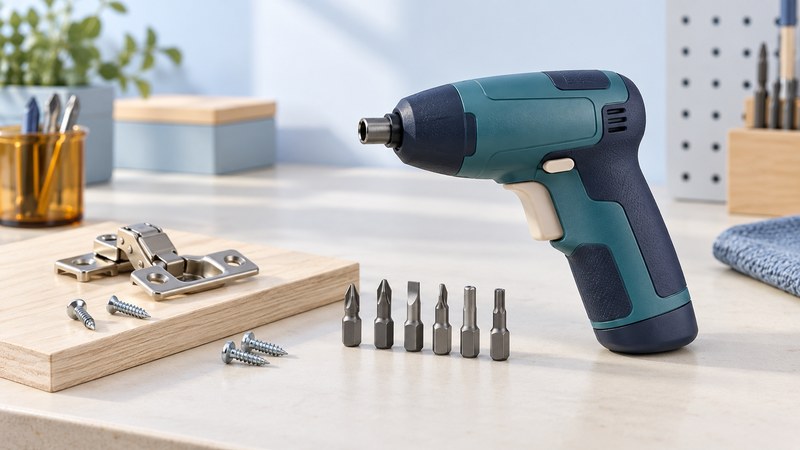
Choose around the assembly
A compact cordless screwdriver can reduce repetitive turning during furniture assembly and small household work. Its usefulness depends on reaching the screw squarely, fitting the head and stopping at the appropriate point. Start with the assembly instructions and the actual fasteners, then decide whether powered driving is appropriate.
Compare the tool in the orientation the job requires. Check the grip, visibility and space for your hand as well as the length of the body. A handle that pivots can help in some spaces; in others, a short manual driver or a permitted offset attachment gives better access. Keep the finished surface and nearby fittings in view.
| Feature | Question to ask | Useful check |
|---|---|---|
| Bit holder | Does it accept the required bit system? | Confirm fit and retention before use |
| Control | How does starting, speed and stopping work? | Read the exact model instructions |
| Clutch or torque attachment | Is it fitted, optional or absent? | Understand the actual stopping behavior |
| Access | Can the bit stay aligned with the screw? | Check the complete tool and attachment length |
| Charging | What supply, cable and service options are specified? | Plan around your work sessions |
Match the head and support the parts
Choose the correct bit profile and size before starting the motor. Similar cross-head shapes can require different bits. CCOHS screwdriver guidance specifically distinguishes Phillips and Pozidriv fit and recommends supporting small work so it cannot move unexpectedly.
Inspect the bit and screw recess. A worn tip, clogged recess or poor alignment can turn an otherwise simple assembly into a damaged fastener. Keep the bit in line with the screw, secure the work and keep your free hand out of the path if the tool slips. Use appropriate eye protection.
Follow the assembly instructions for screw type, pilot holes and tightening order. A compact driver’s convenience does not change what the joint requires. Electrical work needs the appropriate isolation and procedures; ordinary plastic tool housings or grips do not establish suitability for live work.
Learn what the controls actually do
Tools sold as cordless screwdrivers vary considerably. Some offer variable speed or a clutch; others rely on different stopping controls or optional attachments. The Bosch IXO manual dated July 2024 (PDF) describes a separate torque-setting adapter, so its behavior should not be assumed for a bare tool or a different generation.
Treat adjustable stages as settings to evaluate in the specified application. A numbered clutch position is not, by itself, a documented fastener torque. If the assembly requires a measured torque, use a suitable torque tool and the assembly’s specification.
The IXO manual also specifies a center-switch position against unintended activation during bit changes and prohibits operation while charging. Use your own model’s change, charging and storage instructions; battery and control arrangements differ.
Check one screw before repeating the job
- Identify the intended final position and any instruction to leave fasteners loose until alignment is complete.
- Support the parts, fit the correct bit and confirm direction with the tool clear of the work.
- With the tool stopped, seat the bit in the screw. Start gently using the model’s controls and stop to check progress.
- Inspect alignment, seating and the surrounding material. Complete final tightening by the method the assembly requires.
- Repeat only after the trial gives the intended result. Recheck when the material, screw or access changes.
Respond to slipping or an early stop
If the bit slips, stop and inspect fit, wear and alignment. If the tool stops early, check the selected control, battery condition and the joint requirements before increasing a setting. If the screw turns without securing the part, inspect the fastening point; additional powered turning can enlarge the damage.
For larger drilling or driving tasks, compare the capacity and controls of a drill/driver. Keep bits organized by profile and size, and store the screwdriver according to its charging and battery-care instructions.
Choose your next guide
- Cordless Drills — Match drilling capacity, gears and clutch settings to the job.
- DeWalt Screw Guns — Plan depth-controlled fastening and verify the exact screw-gun model.
- Tool Sets — Build a household kit around the repairs you actually do.
Browse powered fastening and air tools or explore all 47 tool guides.