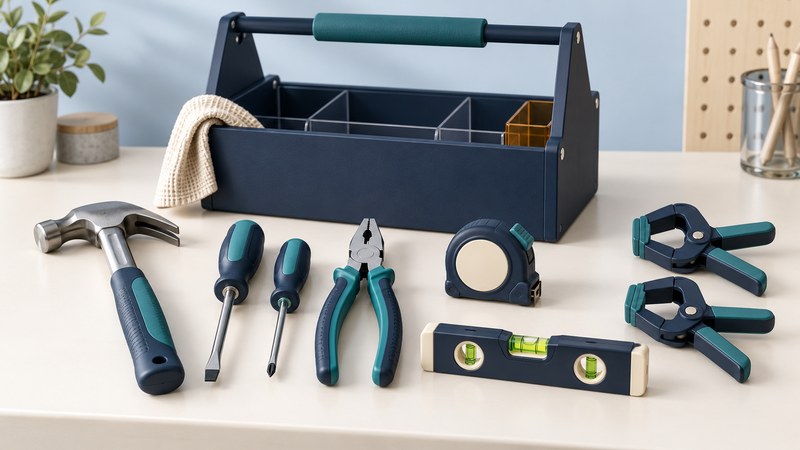
Start with three jobs
A useful household tool set covers the work you expect to do and makes each tool easy to find. List three likely jobs—assembling furniture, adjusting a loose handle and measuring a replacement part, for example. For each, inspect the fasteners, read the instructions and note the sizes before shopping.
The list below is a starting kit proposal for ordinary household assembly and minor mechanical adjustments. Adapt it to your belongings and experience. Gas work, energized electrical work and safety-critical repairs require their own competence, procedures and equipment.
| Task | Useful starting tools | Check before choosing |
|---|---|---|
| Measure and mark | Tape measure, pencil and short level | Readable graduations, useful reach and a size that fits your storage. |
| Turn common screws | Manual screwdriver or bit driver with matched bits | Profiles and sizes used by your furniture and fittings. |
| Turn accessible nuts and bolts | Correct-size wrenches or sockets | Metric/inch sizes, drive compatibility and clearance. |
| Hold and position small parts | Suitable pliers and a pair of clamps | Jaw shape, opening and protection for finished surfaces. |
| Light hammering | A manageable claw hammer | Secure head, sound handle and comfortable balance. |
| See and organize the work | Task light, small parts tray and divided storage | Keep loose fasteners and replacement bits identifiable. |
Add protection appropriate to the job: eye protection for flying particles and hearing protection for hazardous noise. Workholding deserves space in the kit; clamps let the work stay still while you control a tool.
Choose the right profiles and sizes
Match the driver to both the screw profile and size. Phillips and Pozidriv can look similar, yet the wrong profile can slip. CCOHS screwdriver guidance explains this distinction and recommends securing small moving pieces. Stop if the bit does not seat fully instead of compensating with extra force.
For nuts and bolts, choose the exact metric or inch size. CCOHS wrench guidance explains why a close fit matters and why worn jaws or improvised handle extensions create hazards. In a small kit, a few correct sizes used repeatedly are more useful than many near-matches.
Read a socket set’s inventory line by line. The square drive size identifies the ratchet connection; the socket size identifies the fastener it fits. Deep and shallow sockets solve different access problems. Confirm a replacement is available for the sizes you use most.
Compare the contents, not the headline count
- Coverage: mark which pieces serve one of your three jobs. Count duplicate bits, small consumables and unrelated accessories separately.
- Handling: try grip shape, reach and balance. A tool that is awkward in your hand can remain awkward even if the set is highly rated.
- Replacement: check how to obtain a worn bit, missing socket or damaged handle and read the actual warranty terms.
- Storage: look for clear size markings and a layout that makes a missing piece obvious. Leave room for project-specific additions.
Add power and specialist tools when a task earns them
A cordless drill-driver can help when repeated drilling or driving becomes common. Include its compatible charger, batteries and bits matched to the materials in the total cost. Buy a specialist tool once you understand the task, setup and storage it requires; occasional work may be better served by borrowing or renting suitable equipment with instructions.
A torque-specified joint earns an appropriate torque wrench and specification check. General household kit selection cannot establish a tightening value for a vehicle, bicycle or other critical assembly.
Make the kit ready for the next repair
Inspect handles, edges, jaws and moving parts before use. Set damaged tools aside for proper repair or replacement. Keep tools clean, dry and organized, with sharp points protected. CCOHS general hand-tool guidance supports regular inspection, maintenance and using each tool for its intended purpose.
After a job, return every piece and write down only the genuine gap you encountered: a missing size, poor reach or unsuitable bit. That small record keeps future purchases tied to experience.
Download the household-kit planner (plain text). Fill in the next three jobs, mark what you already own and save the remaining list for the next project. The planner includes a guide link and has no prices or assumed product availability.
Choose your next guide
- Stanley Tool Sets — Identify the exact kit and check its inventory for gaps.
- Automotive Tool Sets — Plan sockets and hand tools around specific vehicle tasks.
- Metric Tool Sets — Audit metric sizes, drive systems and useful coverage.
- Dustbuster Handheld Vacuums — Choose a handheld vacuum for everyday debris and check its limits.
Browse hand tools and kits or explore all 47 tool guides.