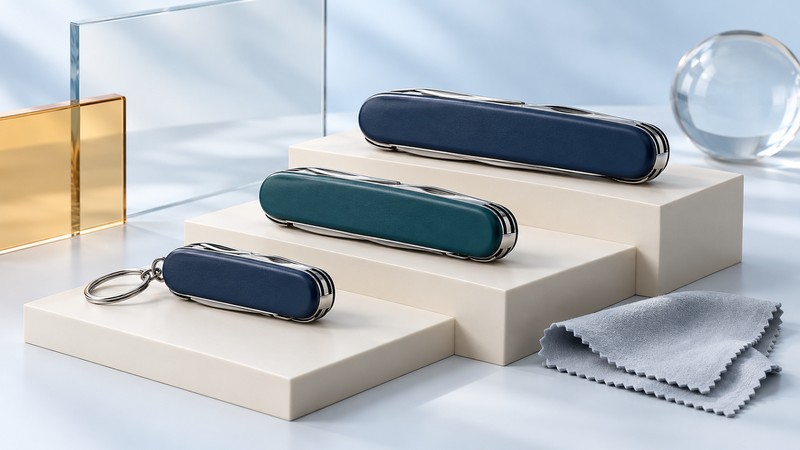
Choose the functions you will actually use
Start a Swiss Army knife comparison with three recurring tasks. Small scissors for loose threads, a screwdriver that fits a familiar screw and a compact blade for ordinary cutting may serve you better than a long list of seldom-used features. Decide where the knife will be carried and used before selecting its size or locking mechanism.
Read the implement list as a set of physical tools. A manufacturer may count several functions on one implement, such as an opener that also serves as a screwdriver. Check the shape, access and size of each tool that matters to you. Product photographs and a careful handling check can answer questions that the total feature count leaves open.
Compare three specific formats
The following manufacturer examples illustrate size and function choices. Specifications were checked in October 2026 for the item numbers shown; colors, special editions and similarly named models can differ. Length refers to the closed tool body, not blade length.
| Example and source | Size and weight | Useful distinction |
|---|---|---|
| Classic SD, 0.6223.T2G | 58 mm; 21 g | Small blade, scissors and nail file with screwdriver; nonlocking blade. |
| Super Tinker, 1.4703 | 91 mm; 84 g | Scissors, Phillips screwdriver and two blade sizes; nonlocking blades. |
| Forester, 0.8363 | 111 mm; 128 g | Wood saw and large locking blade; this version is not one-hand opening. |
Use the table to create a shortlist, then check what your task requires. The Super Tinker’s scissors and Phillips driver may be more relevant to small repairs than the Forester’s wood saw. A larger handle may be easier to hold for a particular task, while a smaller body may fit your chosen carry location better. Neither comparison follows automatically from the function count.
Check access, grip and locking
With permission in a shop or with your own knife, inspect the closed tool before carefully opening one implement at a time. Keep fingers clear of the folding path, close unused implements and follow the supplied instructions. Check whether you can reach the tool you need and hold the body comfortably without an unused implement pressing into your hand.
A locking blade has a release mechanism to learn; a nonlocking blade relies on careful handling within its intended use. A lock does not turn a folding knife into a pry bar. Choose a dedicated tool for forceful work, damaged fasteners or jobs that require a specified torque. A pocket tool with a wire-related feature also gives no assurance of electrical insulation. CCOHS hand-tool guidance calls for tools specifically designed for electrical work.
For used knives, examine the blade tips, edges, pivots, springs and any lock. Cracks, loose or damaged implements, poor closure or an unreliable lock need service before use. Check replaceable small parts against the exact model and scale style.
Make carry and travel checks part of the choice
Knife rules depend on the jurisdiction and setting. Before carrying, check the current rules for the country, state or locality and any workplace, school, venue or transport operator involved. Blade length, locking and opening method can all matter. A compact size or a familiar brand does not establish permission.
For a trip, separate the everyday carry decision from baggage screening requirements and destination rules. Consult the relevant official authorities before packing. If the knife cannot accompany you into a frequent destination, plan secure storage or choose a permitted alternative tool for that setting.
Clean, dry and lubricate the moving parts
Victorinox’s Swiss Army knife care FAQ calls for regular cleaning and oiling and specifically excludes pocket knives from dishwasher cleaning. Its linked pocket-knife care sheet describes working stiff implements in warm water, drying the knife and applying a small drop of appropriate oil at friction points. Keep clear of sharp edges throughout.
Check model-specific instructions first, especially for wood scales, electronics or removable USB components. Use a suitable lubricant for the intended contact, including food contact where relevant. Salt, acids and prolonged dampness can affect corrosion resistance, so clean and dry after exposure rather than storing a wet knife in a pouch.
For a damaged edge or unfamiliar sharpening geometry, use the manufacturer’s guidance or a qualified sharpening service. Persistent stiffness, a failed spring or a faulty lock needs assessment; forcing the implement adds risk without identifying the cause.
Finish with a four-line shortlist
- My tasks: the three implements I need and the objects they must fit.
- My format: closed length, weight, grip and carry location.
- My checks: opening method, locking, condition and permission in intended settings.
- My care plan: cleaning, drying, suitable oil and service route.
If gripping and turning dominate the tasks, compare a plier-based multi-tool or separate pliers before adding more layers to a pocket knife. Choose the format around the work you expect to do.
Choose your next guide
- Leatherman Tools — Compare multi-tool functions, format and model-specific accessories.
- Leatherman Wave — Identify the Wave version before choosing accessories.
- Tool Sets — Build a household kit around the repairs you actually do.
Browse hand tools and kits or explore all 47 tool guides.