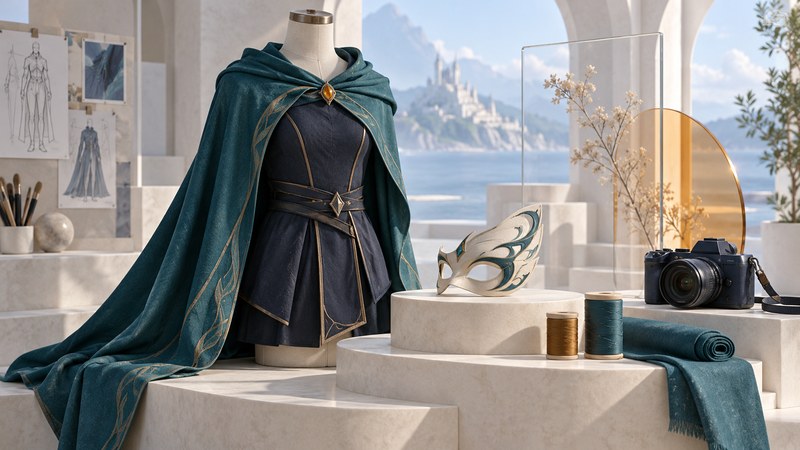
Cosplay brings a story into the room. A familiar silhouette, a carefully chosen color, or a gesture can turn fabric and imagination into a character someone else recognizes. Its pleasure lives in that exchange: one person makes an interpretation, and another finds something they love in it.
A story made by hand
Cosplay combines costume and play, drawing inspiration from animation, games, comics, film, and other imagined worlds. It can begin with a garment found in a closet, a purchased outfit, a commissioned piece, or a pattern spread across a worktable. Each route leaves room for decisions about fit, color, texture, and how the wearer wants to inhabit the character.
The interesting work often happens in translation. A drawn coat has to become a coat that moves. A shape that floats effortlessly on screen needs support in the real world. A metallic surface might be suggested through lightweight material and a careful finish. These choices make cosplay a conversation between an image and the possibilities of an actual body, an actual budget, and an actual afternoon.
For a first costume, choose a few details that carry the character: perhaps the outline of a jacket, a distinctive hair shape, and a small accessory. Give those details your attention, then try the outfit as a whole. Walk, sit, reach, and practice a pose. A costume that lets you enjoy wearing it has already solved an essential design problem.
The person inside the character
A costume becomes expressive through its wearer. The same clothes can suggest confidence, uncertainty, mischief, or resolve through a change in posture. A lifted chin or the way someone holds a book can tell as much of a story as an elaborate prop. Cosplay offers a place to explore those small acts of interpretation.
Accuracy is one possible creative goal; so are reinvention, humor, and a personal connection to the story. A character can be reimagined through different clothing, adapted around mobility equipment, or translated into an everyday outfit. The useful question is what you want another person to recognize or feel. Your body belongs in that interpretation as it is.
Choose a moment as well as a look. Imagine the character greeting an old friend, waiting for a journey to begin, or enjoying a rare quiet minute. That little piece of direction gives hands and eyes something to do. It can also make a first photograph feel less awkward: you have an intention to play with.
Recognition becomes community
At a gathering, recognition can be an invitation to talk. Someone notices a carefully matched detail; someone else asks how a sleeve was made. Techniques travel through these conversations, along with encouragement and the relief of meeting people who understand why a fictional world matters to you. A shared interest gives strangers a starting point.
Care for the person makes that exchange work. Ask before photographing someone, touching a costume, or handling a prop. Make it easy for them to decline or take a break. A specific compliment about construction, styling, or expression can recognize the work without judging the wearer's body. When sharing a collaborative result, agree on credits for the cosplayer, photographer, and makers involved.
Each event has its own requirements. Before attending, read its current costume, prop, photography, and accessibility information. For example, Otakon's convention rules ask attendees to obtain consent before photographing people and keep photography from obstructing traffic. Check the organizer's current guidance when planning; a photograph from a previous year records that moment in time.
A photograph made together
Cosplay photography gives the interpretation another form. The costume establishes a visual language; expression, light, framing, and setting help it speak. A quiet background can make the work on a garment easier to see. A wider view can suggest a place in the character's world. A close portrait can hold a feeling that a full-length record of the outfit would leave small in the frame.
Start with a brief conversation about the picture you want to make together. Discuss the character's mood, comfortable poses, available time, and how the finished images will be shared. Make one straightforward photograph of the costume, then try a small change in angle or expression. Look at the result together when practical. Collaboration improves when both people can shape the picture.
The photographs and stories collected below preserve particular encounters with cosplay: convention friendships, individual character portraits, a conversation about shared art, and the practical work of keeping a costume together. As you explore, look for the choices behind the image. A seam, a gesture, a patch of light, or a familiar face can reveal how much imagination fits into a single frame.
Cosplay photographs and stories
Explore nine selections from Yenra's cosplay collection. These photographs, interviews, and notes reflect the events and dates described in each piece.
10 reasons to go to Tekko
A 2017 reflection on the Pittsburgh convention, its setting, and its friendships.
20 Otakon Cosplays
A selection of character photographs from Otakon 2016, published in 2017.
24 Tekko Pictures
A 2017 collection of photographs from four years of Tekko visits.
Colossalcon East
Early coverage of Colossalcon East, with a link to the 2017 photo album.
Cosplay photographer interview
A conversation recorded at Otakon 2013 about photography as a shared art.
Cosplay repair kit
A 2016 list of supplies assembled with costume repairs and photography outings in mind.
16 Katsucon evacuation cosplays
Sixteen character photographs made during the 2016 Katsucon evacuation.
Margaret Persona 4 cosplay
A portrait of Tsubasahime as Margaret at Anime USA 2015, with notes on the photograph.
4 No Game No Life cosplays by the water at Otakon
Four character portraits beside the Baltimore harbor at Otakon 2015.