Choose for the measurement you repeat
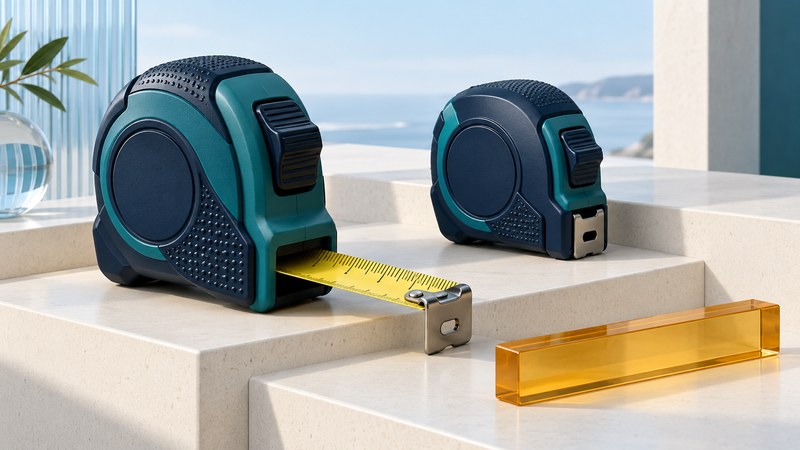
A tape rule is a retractable measuring tape, commonly with a curved steel blade. Its case, blade and hook work together: a tool that is easy to carry can behave differently from a larger model when reaching across a panel or catching an edge alone. Start with your recurring measurement, then compare the features that support it.
Write down the longest usual span, whether the blade will be supported, the surfaces the hook must catch and the lighting where you read the scale. Include the space available for the case and your grip. These practical details are more useful than choosing solely by an advertised maximum reach.
Read standout and reach as different claims
Standout describes unsupported blade extension under the stated test conditions. Reach can include the user’s extension as well as the blade. Check the maker’s definition before comparing numbers across packages. Stanley’s STHT37242 listing advertises 10-foot maximum reach and ties that claim to an average end user’s maximum extension. That wording describes a reach convention, not a ten-foot unsupported blade or a measurement-accuracy rating.
For a fair comparison, record the exact model, claim, definition and any stated test conditions. If two manufacturers use different methods, leave those figures in separate columns. Do not subtract an assumed arm length to manufacture a comparable standout number. Check scale condition and accuracy independently of how far the blade can extend.
Compare the features as a system
| Feature | Try or inspect | Useful when |
|---|---|---|
| Blade width and shape | How easily the blade reaches the required span with stable support | Measuring alone across boards or panels |
| Hook | Ability to catch the intended edge from the required direction | Working above, below or beside an edge |
| Lock and case grip | Hold a supported extension and release it under control | Repeating measurements with one hand occupied |
| Scale and printing | Read the needed units and divisions in realistic light | Transferring dimensions accurately |
| Case size and clip | Grip, pocket fit and clearance at an inside corner | Carrying the tape or working in confined spaces |
A wider blade can be bulkier to carry, and its useful rigidity still depends on its shape and construction. A large hook offers more ways to catch an edge but may obstruct a small recess. A dual-sided scale can help when the tool is turned around; first check which units and direction you are reading.
Inspect the actual tool where possible. Guide retraction according to its instructions and keep hands clear of blade edges. Stop using a blade that is kinked, split or sharp from damage. For detailed hook and reading checks, use the tape-measure technique guide.
Use the same simple trial for both candidates
- Choose a sound workpiece that represents your usual job and an easily supported measurement. Use the same endpoints for both tapes.
- Check hook engagement and scale visibility before extending farther. Note whether the case or hook obstructs the work.
- Repeat the reading after repositioning. If results differ, investigate the endpoints, hook condition and reading method.
- Compare the lock, grip and controlled return. Record the comfortable working span and any handling issue.
Keep the trial within a stable working position and the tool’s intended use. The aim is to find a usable tool for your work, not to force the blade to its collapse point or reproduce an advertising test. A repeatable reading and good handling at the required span matter more than an impressive extension you cannot control.
Keep a short comparison record
Record model, blade length, units, claimed reach and definition, hook access, comfortable span, lock behavior and case fit. Add the task for which you preferred it. This preserves the reason for your choice when you later replace the tape or equip someone else.
For shopping trips and frequent pocket carry, see compact tape selection. For electronic readouts and stored values, see digital tape-measure reference checks. Choose the format that makes the measurement easier to take and easier to interpret later.
Choose your next guide
- Tape Measures — Check reference points, reading technique and measurement errors.
- Pocket Tape Measures — Choose a compact tape and record a practical fit check.
- Digital Tape Measures — Compare digital readouts and verify the measurement reference.
Browse measuring and layout or explore all 47 tool guides.