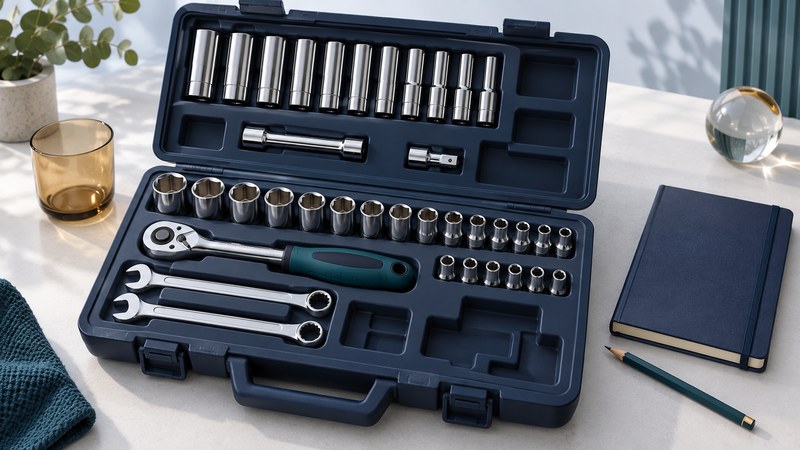
Start with the kit number and actual contents
A Stanley mechanics set becomes more useful when you know which jobs it covers and which pieces are missing. Record the kit model or SKU, photograph the case and lay out the contents in a clean area. Keep the case’s molded size labels as clues, then confirm the markings on each tool. A used case may contain replacements from several kits.
Search the exact number on Stanley’s site. For example, the U.S. STMT71652 product page identifies a 123-piece set and lists included items, but its online list is not a complete size-by-size inventory. Where a list is incomplete or a specification looks ambiguous, ask support for the correct contents record. A different set with the same piece count is not an equivalent inventory.
Sort by what connects and what fits
| Group | Record separately | Look for |
|---|---|---|
| Sockets | Drive size; metric or inch; fastener size; shallow/deep; point profile | Missing sizes, duplicate pieces and an appropriate profile for the task |
| Ratchets and extensions | Drive, length, retaining mechanism and condition | Usable access and secure compatible connections |
| Wrenches | Size system, marked size, end type and length | Ability to hold the other side of a connection |
| Bits and hex keys | Exact tip/profile and size; holder type | Correct engagement with the actual fastener |
| Case and storage | Readable locations, latches and loose pieces | A way to notice missing tools before packing |
Keep drive size and fastener size in different fields. A 3/8-inch-drive socket can fit a metric fastener; the square drive describes the connection to the ratchet. Separate shallow and deep sockets even when they share the same marked size. Their usefulness depends on stud projection and surrounding clearance.
Use the metric-set guide for coverage planning. Mark an entry “unverified” when its size or intended use cannot be established. Avoid turning an uncertain tool into an assumed match.
Fill a job gap, then reconsider a larger set
Choose two or three recurring maintenance tasks and list their fasteners, access and tightening requirements. Compare that list with the inventory. Buy or borrow the specific missing capability only after checking how it will fit the rest of the setup. A duplicate socket count can make a kit look complete while one required deep socket remains absent.
Accessories introduce their own limits. Use only tools specifically intended for powered impact use with an impact wrench. Follow the tool manufacturer’s instructions for force and leverage, and remove cracked sockets, damaged drives or slipping ratchets from use. Obtain replacement or repair advice instead of extending a failing tool’s service with improvised modifications.
Separate tool replacement from case support
Stanley’s U.S. warranty information provides the current route for mechanics tools and identifies categories such as sockets, ratchets and wrenches. Its mechanics-tool support FAQ separately notes that set cases do not carry the same lifetime coverage. Check the applicable country and product category before assuming every item in a kit has identical terms.
For a support enquiry, prepare the kit number, the individual tool’s markings, a clear photograph and a factual description of the fault. Identify whether the issue concerns a tool, missing purchase contents or a damaged storage case. Retain any purchase or service record you have. Confirm the replacement procedure with support before shipping anything.
The outcome you need is a verified replacement specification or repair route. If the original storage case is unavailable, a labeled rail or tray can preserve the inventory without forcing a purchase of an entire new kit.
Keep the inventory useful after the first audit
Return tools to their marked places after each job and update the record when something is replaced, borrowed or removed from service. Distinguish a missing tool from a size the kit never included. Keep specialty requirements, such as a torque wrench, alongside the task list even when those tools live in another case.
An effective set audit ends with three short lists: ready to use, needed for the next job, and awaiting identification or service. This keeps a shopping list tied to real work and makes lending or checking the kit much easier.
Choose your next guide
- Tool Sets — Build a household kit around the repairs you actually do.
- Metric Tool Sets — Audit metric sizes, drive systems and useful coverage.
- Cordless Screwdrivers — Choose reach and control for small screws and household assembly.
Browse hand tools and kits or explore all 47 tool guides.