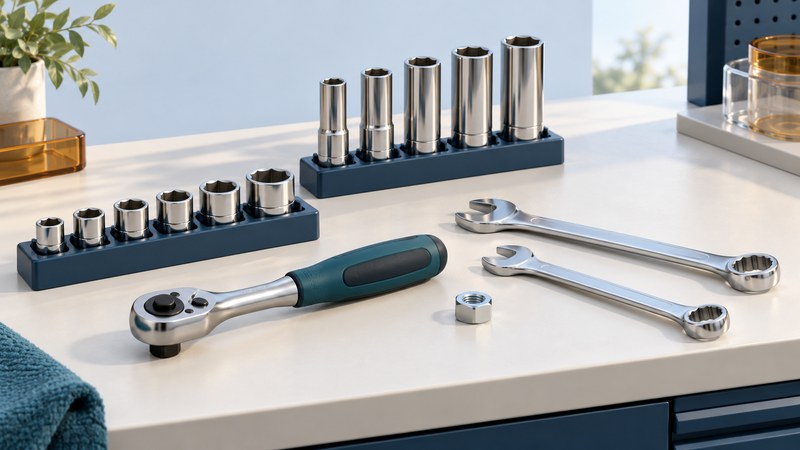
Start with the fasteners you need to reach
A metric tool set earns its space by fitting the work you actually do. Begin with two or three recurring jobs and the service instructions for each. List the fastener sizes and profiles, the space around them and any specified tightening method. Then compare that list with the contents of a kit.
A large piece count can include duplicate sizes, bits and small accessories. Count the useful coverage separately: sockets, wrenches, hex keys and drive tools. A compact set plus a few individually chosen pieces may cover your list more neatly than another large case. Keep a separate list for occasional specialist tools that can wait until a defined job needs them.
Read both the opening and the drive size
The millimetre marking identifies the socket opening that fits the fastener. The square drive connects it to a ratchet or other drive tool and is commonly described in inches. A metric socket can therefore have a 3/8-inch square drive and a 13 mm opening; those labels describe different interfaces.
| Detail | What it tells you | What to check |
|---|---|---|
| Opening size and profile | The shape that meets the fastener | Exact millimetre size; hex, twelve-point or another specified profile |
| Square drive | The connection to the drive tool | Match the ratchet, torque wrench or approved powered tool |
| Depth and outside diameter | The space the socket occupies | Stud clearance and access inside the surrounding recess |
| Intended drive use | Hand or impact application | Manufacturer approval for the complete socket and accessory combination |
| Size sequence | Which openings the set includes | Read the individual sizes, including gaps and duplicate depths |
CCOHS wrench guidance emphasizes using the correct metric or inch tool and fully seating it. Identify the fastener before applying force. A nearby fractional size that feels almost right can slip. The bolt’s thread designation and the required wrench opening are also separate specifications; confirm the actual head or nut size.
Choose depth and reach together
A shallow socket can help where there is little room above a fastener. A deep socket may clear a projecting stud, but its internal well and outside dimensions still matter. Try the complete tool arrangement with the equipment safely isolated before assuming it can reach and turn.
As a concrete inventory example, Tekton’s SID91401 contents list separates shallow and deep metric sockets from extensions and a universal joint. It also describes the internal well and stepped shoulders. Those are useful details to look for in any set specification; the listed range is an example, not a universal shopping list.
Choose the drive tool around the required load, available swing and access. An adapter changes a connection; it does not upgrade the strength or permitted use of the smaller component. For powered impact work, verify impact suitability for every socket, extension and adapter rather than judging by finish or colour.
Make a small coverage sheet
- Write one row per task, including the equipment model and its service-document reference.
- Record the actual opening/profile, required depth, access direction and compatible drive tool.
- Mark each need as present, missing or awaiting a fit check. Keep duplicates visible instead of counting them as new coverage.
- Add the specified torque and units where relevant, then verify that the intended torque wrench covers the requirement.
- After the job, note what worked and return each piece to its labeled location.
This audit also exposes missing non-socket tools: a wrench to hold the opposite side, a correctly sized hex key, or a task-specific bit. Purchase against the completed task list, with replacement availability and clear size markings among the practical comparisons.
Keep fit and condition easy to check
Before use, inspect the socket opening, drive connection and ratchet action. Replace cracked, spread or badly worn tools. CCOHS advises a controlled pull, stable footing and avoiding improvised handle extensions or hammer blows on ordinary wrenches. If the fastener resists, stop to identify the cause and the appropriate removal method.
Clean and dry the pieces before storage. Leave an empty labeled space for a missing socket and add it to the replacement list. For specified final tightening, use the equipment’s procedure and a suitable torque wrench; a kit’s size coverage alone says nothing about the correct torque.
Choose your next guide
- Automotive Tool Sets — Plan sockets and hand tools around specific vehicle tasks.
- Stanley Tool Sets — Identify the exact kit and check its inventory for gaps.
- Torque Wrenches — Plan specified final torque and check the wrench setup.
Browse hand tools and kits or explore all 47 tool guides.