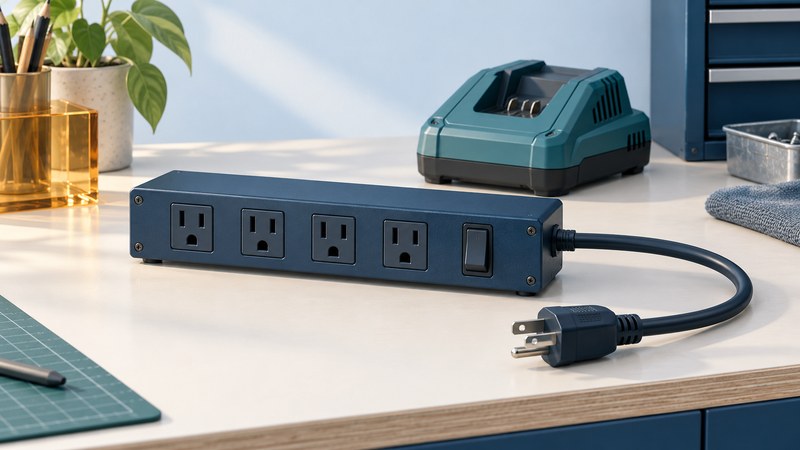
Define what the strip will supply
A power strip provides convenient connection points for compatible equipment at one location. Begin with a list of the devices you want to run together and their AC input ratings. For a workshop, distinguish a small charging and lighting station from the supply needed by saws, compressors, heaters or other demanding equipment. This guide uses U.S. electrical terminology.
Check the product’s certification, total rating, location limits and permitted uses. A metal enclosure or “workshop” description is insufficient evidence for a particular load. UL’s power-strip overview distinguishes several product categories and describes their intended connection to the branch circuit. Follow the exact product’s listing and instructions.
| Feature | Role | What to verify |
|---|---|---|
| More receptacles | Connects several permitted loads at one point | Total input load and the supply circuit |
| Overcurrent protection | Interrupts excessive current under specified conditions | Strip rating and upstream circuit protection |
| Surge protection | Limits transient voltage reaching equipment | Explicit surge-protective-device labeling and status instructions |
| GFCI protection | Reduces shock risk from ground faults | Required protection at the location and its test procedure |
ESFI explains surge protection as a specific function. CPSC’s GFCI fact sheet (PDF) describes protection against severe ground-fault shocks. A strip’s switch or breaker does not establish that it provides both features.
Build a record from input labels
Record each device’s AC input current at the intended supply voltage. For a charger, use the input label or manual, not the battery’s voltage, ampere-hours or charger output. Note which equipment can operate at the same time, then add those input currents as a first screening step. If only watts are given, obtain suitable input-current information for electronic or motor loads rather than assuming watts divided by volts captures every condition.
The total rating belongs to the strip as a whole. A 15-A marking on a strip does not provide 15 A at each receptacle. UL’s selection guide emphasizes checking electrical ratings against connected equipment. A large motor’s starting demand and the other equipment on the circuit require consideration beyond a simple label sum.
Use the workshop load record (plain text) to gather the details. If the circuit, permitted equipment or required protection is uncertain, take the record to a qualified electrician before using the proposed arrangement.
Plan the connection and physical location
For ordinary relocatable power taps, connect directly to a suitable permanently installed wall receptacle. Do not connect strips in series or feed one through an extension cord. OSHA’s power-strip interpretation explains those listing restrictions for U.S. workplaces and distinguishes low-powered equipment from high-power appliances. It also notes that ordinary relocatable taps are not intended for construction sites and similar locations.
- Choose a cord that reaches the intended receptacle without chaining devices. Arrange a qualified installation if more permanent outlets are needed.
- Keep the strip and cord accessible for inspection. Route them away from cutting paths, sharp edges, pinch points and traffic; never cover the cord with a rug.
- Mount only by the methods supplied or approved for the model. Keep ventilation openings clear and preserve the grounding connection.
- Check the environmental rating. A dry indoor charging bench and a wet or dusty worksite need different equipment assessments.
An adjacent wall outlet may share the same branch circuit. Moving a plug a few feet can leave the total load unchanged. Establish the circuit arrangement without opening electrical enclosures; have an electrician resolve unknown wiring or inadequate capacity.
Inspect and respond to a fault
Before use, look for cracked housings, damaged insulation, loose-fitting plugs, scorching or other damage. Remove damaged equipment from service. If you notice unusual heat, odor, sparking or repeated trips, stop using the arrangement and have the cause resolved. Repeated resetting is not a repair.
For a surge protector, follow the maker’s instructions for its protection-status indicator and replacement criteria. Power may remain available even when a particular product indicates that surge protection has been lost. Check what the indicator actually means in that model’s manual.
Revisit the load record whenever you add a charger, light or tool. Keep high-demand machinery on the supply arrangement specified by its maker, and have circuit changes designed and installed by a qualified electrician. The useful outcome is a documented, suitable charging or accessory station with a clear limit on what belongs there.
Choose your next guide
- Cordless Soldering Tools — Compare power, tips and temperature control for bench tasks.
- Dustbuster Handheld Vacuums — Choose a handheld vacuum for everyday debris and check its limits.
- Tool Sets — Build a household kit around the repairs you actually do.
Browse workshop setup and skills or explore all 47 tool guides.