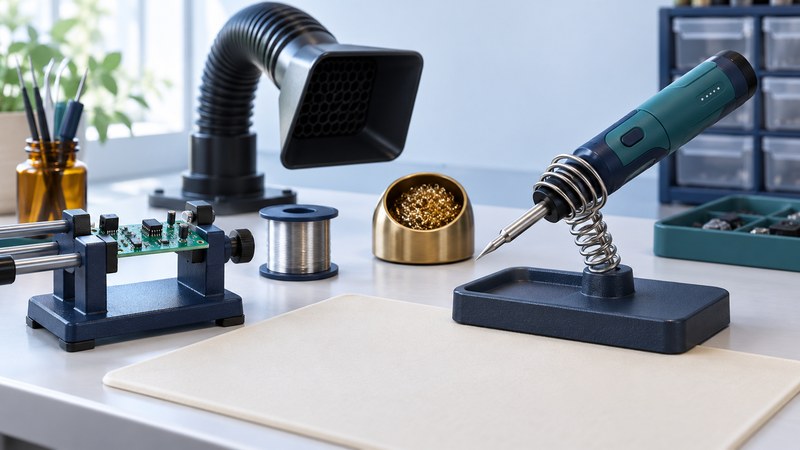
Choose how the tool receives power
Portable soldering tools differ in how they heat the tip, regulate it and replenish their energy supply. Start with the joint, the work environment and the length of the session. A convenient power source is useful only when the complete setup can heat the intended connection under control.
| Power approach | Useful question | Check in the documentation |
|---|---|---|
| Rechargeable battery | Can it support the intended work session? | Temperature control, charging, tip availability and serviceability |
| External USB supply or power bank | Is a cable acceptable at the bench? | Required power protocol, voltage, cable and permitted supply |
| Butane | Is fuel-powered heating suitable for the location? | Fuel instructions, ignition, hot exhaust and application restrictions |
| Contact-activated resistance design | Is this design approved for the intended connection? | Its specific contact method and application limits |
For example, Weller’s WLBRK12 rechargeable iron uses a battery-powered heated tip. Compare the actual control features and replacement tips when evaluating an iron; wattage or advertised peak temperature alone does not describe the quality of a joint.
Match the tip to the connection
The tip needs to transfer heat into the connection without touching adjacent parts. Consider the joint’s size, the surrounding clearance and the thermal mass of the parts. A very fine tip may reach a tight space while providing poor contact on a larger connection.
Confirm the solder alloy, compatible electronics flux and component limits in the relevant documentation. Practice on expendable material before working on a valuable assembly. Hakko’s explanation of insufficient wetting discusses the importance of clean surfaces and adequate heat transfer to the joint.
Keep the tip in the condition prescribed by the manufacturer, using approved cleaning and maintenance methods. When a connection resists wetting, inspect the setup and contamination before extending the heating time. Prolonged heating can damage the work.
Build the portable workstation
- Use a heat-resistant surface and a stable holder designed for the tool.
- Secure the unpowered workpiece and arrange clear access to the joint.
- Keep the hot tip and any hot exhaust away from cables, batteries and combustible material.
- Provide eye protection and suitable fume extraction at the source.
- Plan a protected cooling period before packing the tool away.
Rosin-based flux fumes can cause occupational asthma. The HSE solder-fume guidance (PDF) explains exposure control and local extraction. A fan moving fumes around a room does not establish effective capture at the source; select and maintain extraction for the work and exposure.
For a fuel-powered tool, follow its own ignition, shutdown and refilling instructions. The Dremel VersaTip manual (PDF) covers its butane supply and hot-tool precautions. Fuel handling and exhaust change the suitability of a portable setup, especially around sensitive materials.
Plan and inspect a practice joint
- Identify the connection, solder and component requirements. Isolate all power sources according to the device instructions.
- Prepare clean surfaces, secure the work and select an approved tip and setting.
- Heat the intended connection as the process requires, then introduce solder so it wets the surfaces. Keep nearby components within their limits.
- Let the joint cool undisturbed and inspect for incomplete wetting, bridges and unwanted movement.
- Perform the appropriate checks before returning the assembly to service.
These are planning stages; the device and soldering-process instructions supply the details. Practice on a simple expendable, unpowered assembly. Battery terminals, energized circuits and unfamiliar safety-critical electronics call for their own approved procedures and expertise.
Understand the Cold Heat connection
Cold Heat devices promoted in 2004 brought attention to contact-activated portable soldering. A contemporary Hyperion Innovations patent, US6646228B2 describes a split conductive tip whose circuit closes through contact with conductive material, producing resistance heating.
That mechanism helps explain why portable soldering tools cannot be treated as interchangeable. Contact-activated designs require their own application instructions. Battery power by itself establishes neither temperature regulation nor suitability for a sensitive electronic component. For a tool being selected today, use its current manual, supported tips and permitted applications.
Choose your next guide
- Needle-Nose Pliers — Choose reach, jaw shape and control for small parts.
- Cordless Rotary Tools — Match small rotary accessories to the task and speed range.
- Workshop Power Strips — Check load, ratings and placement when planning outlet use.
Browse workshop setup and skills or explore all 47 tool guides.