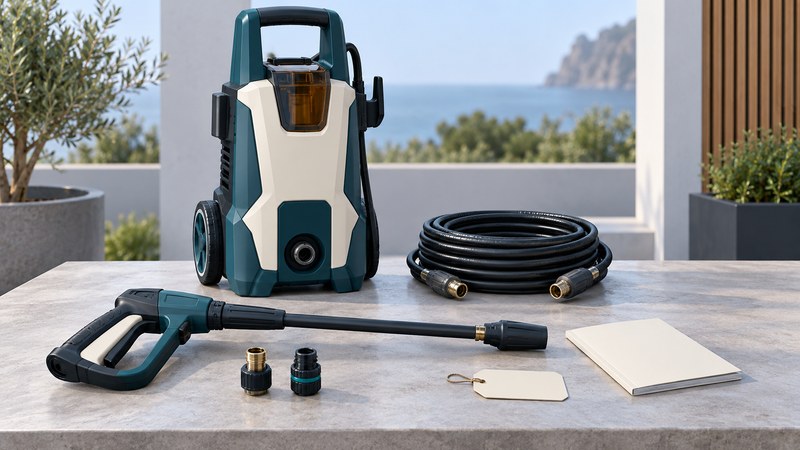
Find the full identity before choosing an accessory
A useful replacement-part search starts with the washer’s full model name and product or article number. Photograph the identification plate and record the country where the machine was sold. Add the hose-reel configuration and any parts that a previous owner changed. An advertised pressure value alone cannot identify the connection system.
Locate the model through Kärcher’s U.S. operator-manual page. Match the manual to the identification plate, then compare its component illustrations with the actual machine. If the label is unreadable or the illustrations differ, use Kärcher Home & Garden support with photographs before ordering. A regional manual must also match the electrical version of the washer.
Check the complete connection chain
| Connection | Record | Check before ordering |
|---|---|---|
| Washer to hose | Machine outlet and hose-end fitting; reel or no reel | Exact washer listed for the hose or conversion kit |
| Hose to gun | Existing hose end and gun inlet | Matching approved interface and required retention parts |
| Gun to lance | Gun model and lance attachment | Approved lance/accessory for that gun |
| Lance to nozzle or attachment | Part number and permitted pressure/flow/temperature | Complete assembly intended for the machine and cleaning task |
Use the official accessory finders to narrow the search, then read the detailed compatibility list and exceptions. Save the part number and the matching model entry with the order. Check whether the listing replaces one component or supplies a hose-and-gun set; the included pieces can change which existing parts you can retain.
Kärcher’s spray-gun compatibility guide distinguishes several connection families and makes hose-reel exceptions for a replacement kit. Some models appear under more than one option. Read the notes for the particular option and confirm unclear or conflicting part numbers with support. Physical resemblance and the same brand name are insufficient evidence of a safe match.
Gather useful evidence for a pressure or cycling problem
Begin with the manual’s fault table and permitted owner checks. Note whether the motor starts, whether the symptom occurs while spraying or with the trigger released, whether supply conditions changed, and which accessory is fitted. A short written sequence is more useful to support than “it has no pressure.”
- Stop and follow the model’s shutdown, unplugging and pressure-release sequence before touching connections, filters or nozzles.
- Compare the water supply, hose routing and accessory combination against the manual. Inspect only the owner-serviceable items it identifies.
- Record the condition of the cord, hose and fittings. Keep damaged equipment out of service.
- If approved checks leave the fault unresolved, send the model record, accessory numbers and observations to support.
Automatic motor stop does not prove the hose is depressurized. Leave internal electrical, pressure-switch and pump repairs to the service route specified by the manufacturer. CDC guidance calls for electrical investigation by a qualified electrician after a circuit-breaker trip.
A replacement-gun decision in practice
Keep the supplier’s confirmation with the machine record. After installation, follow the manufacturer’s assembly and operating checks before a cleaning trial. Stop if retention, sealing or control behavior differs from the instructions. Never test a leak with a hand or point the spray at a person.
Keep compatibility information with the machine
Store the manual, part numbers and service record together. Mark accessories by the machine they belong to, especially when a household or workshop has several washers. Record substitutions so a later owner can distinguish the factory configuration from the current one.
Before freezing weather, follow the model’s full storage instructions for the pump, hose and accessories. Before cleaning a new material, check that material’s care guidance and plan a small inconspicuous trial. Use the electric-washer guide for power and water planning and the general pressure-washer guide for surface selection.
Choose your next guide
- Pressure Washers — Start with the cleaning task and compare complete washer systems.
- Electric Pressure Washers — Check electrical supply, hose setup and machine compatibility.
- Honda-Powered Pressure Washers — Identify both the engine and washer before planning maintenance.
Browse cleaning equipment or explore all 47 tool guides.