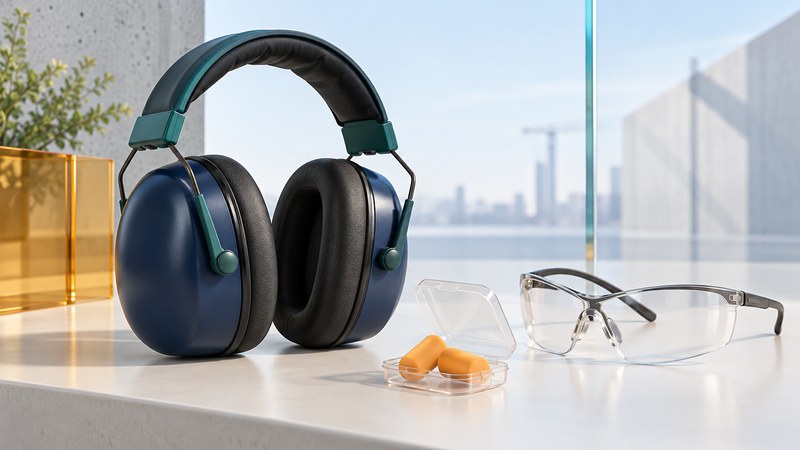
Start with the noise and the task
Choose hearing protection by the noise exposure and the fit you can maintain through the job. Write down the tool, task duration, other equipment worn and how you must communicate. For recurring workplace exposure, ask for the noise assessment and hearing-conservation arrangements before selecting a device.
NIOSH recommends reducing noise at its source through suitable quieter equipment, maintenance or other engineered controls before relying on protectors alone. Work practices and time away from noise can also reduce exposure; plan these alongside protection.
NIOSH’s occupational recommended exposure limit is 85 dBA averaged over eight hours, with allowable duration halving for each 3 dBA increase. Its noise-exposure guidance distinguishes an area sound reading from a person’s accumulated dose. Record the measuring method and duration; an isolated phone reading cannot establish a complete exposure assessment.
Choose a format you can wear correctly
| Format | Practical question | Check alongside it |
|---|---|---|
| Foam or reusable earplugs | Can I achieve the instructed fit repeatedly? | Size, insertion method, cleanliness and replacement instructions. |
| Earmuffs | Do the cushions surround my ears and seal against my head? | Glasses, headwear and other straps worn on the job. |
| Communication or electronic protectors | Can I hear required signals while protected? | Protective rating, supported operating modes and employer requirements. |
NIOSH’s protector-selection guidance emphasizes comfort, compatibility and consistent use. Consumer noise-canceling headphones should count as hearing protection only when labeled with a noise reduction rating (NRR). Wireless audio or radio reception alone establishes no protection level.
For noise at 100 dBA or above, or impulse noise, NIOSH recommends double protection—muffs over plugs. Selection for those conditions needs appropriate assessment; adding two package ratings does not give the combined protection.
Use ratings to compare; use fit testing to verify
The package NRR is a laboratory rating. The reduction achieved by an individual can differ substantially. A higher label alone cannot settle which device fits you best.
In its January 2025 policy update, NIOSH recommends individual quantitative fit testing for workers. This replaces its earlier recommendation to estimate protection through generic NRR derating. The test produces a Personal Attenuation Rating (PAR), or establishes that a specified protection level has been achieved.
Ask the fit tester to record the protector model and size, your fitting method and the result. If the fit is inadequate, get instruction and repeat the test; another size or design may work better. Revisit the result when the device, fit or working conditions change. A fit test evaluates protection; an audiometric hearing test evaluates hearing thresholds. Both can have a role in a workplace program.
Check the complete combination
Put on the glasses, helmet or other equipment you actually use when checking compatibility. The 3M PELTOR H505B fitting instructions (PDF) warn that items between the earmuff cushions and the head can impair the seal; they recommend thin, flat eyewear temples or straps to minimize interference. Follow the instructions for your own model and retain all other required protective equipment.
- Inspect cushions, bands and plugs before use. Check the manufacturer’s cleaning and replacement instructions.
- Fit the device using its illustrated procedure. For earplugs, use the instructions for that exact type; foam and premolded designs can require different techniques.
- Check comfort and seal with the rest of the equipment in place. Resolve an obvious gap or painful fit before entering the noisy area.
- Arrange quantitative fit testing for workplace use and keep protection on throughout exposure. Move to a quiet place before removing it for a conversation.
Keep U.S. workplace rules distinct from recommendations
For U.S. general industry, OSHA 29 CFR 1910.95 requires a hearing-conservation program at an eight-hour time-weighted average of 85 dBA and specifies monitoring, audiometry, training and protector provisions. This action level and OSHA’s exposure calculations have a different regulatory role from the NIOSH recommended limit. Other industries and jurisdictions can have different applicable rules.
If exposure is uncertain, ask an occupational safety professional to assess it. Bring the tool/task list, durations, existing measurements and the protector model. Those details support a decision more effectively than selecting the largest rating on a shelf.
Choose your next guide
- Rotary Hammers — Compare accessory interfaces, drilling modes and dust control.
- Miter Saws — Check crosscut capacity, support and the first test cut.
- Air Hammers — Plan the compressor, air supply and chisel as one setup.
Browse workshop setup and skills or explore all 47 tool guides.