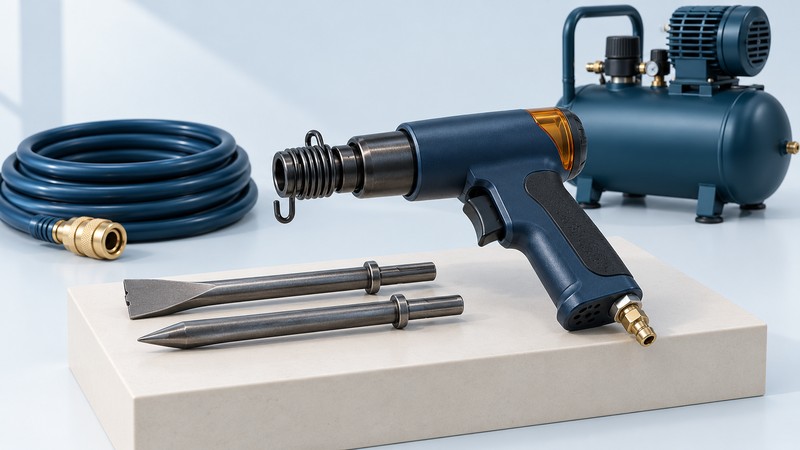
Start with the material and the intended result
An air hammer drives an attachment in repeated straight-line impacts. Its usefulness depends on the workpiece, the attachment and a compressor that can supply enough air while the trigger is held. For an occasional small task, compare the complete setup with a suitable hand tool before buying a pneumatic system.
Write down what must move or be removed, what must remain undamaged, and how the work will be supported. A delicate finished surface, an unidentified coating or an assembly containing hidden services calls for a different method or specialist advice. For a vehicle assembly, follow the vehicle service procedure to establish whether impact is appropriate; this guide is a selection aid, not a removal procedure.
The Ingersoll Rand 114G/114GQC product manual describes hammering, cutting, chipping and scraping applications. Select the specific attachment for the material and operation. A rotary hammer uses a different tool interface and can add rotation; the two names do not establish interchangeable accessories.
Read pressure and flow separately
Pressure, usually shown in psi or bar, describes the air supply pressure. Flow, commonly cfm or L/min, describes the volume delivered over time. A compressor can reach a pressure when idle yet fail to sustain the required flow during work. Tank capacity provides a reserve; the pump must replenish it.
| Item | Record this | Why it matters |
|---|---|---|
| Hammer | Rated inlet pressure and air consumption under load | Compare the same operating conditions; an average-use figure can hide short periods of much higher demand. |
| Compressor | Delivered flow at the required pressure and permitted duty cycle | A tank-pressure limit or motor horsepower alone cannot establish compatibility. |
| Hose and fittings | Inside diameter, length, pressure rating and specified connection arrangement | Long or restrictive supply paths can reduce pressure available at the tool. |
| Treatment and lubrication | Filter, drainage and lubricant requirements in both manuals | Follow the equipment-specific instructions before connecting the system. |
For one verified example, the 114GQC specification table lists 90 psi, 20 cfm (565 L/min) air consumption at load, a 3/8-inch minimum hose and a 1/4-inch NPT inlet. These are this model’s figures. The inlet thread size and the hose’s inside diameter describe different parts of the system.
Verify the complete attachment interface
Record the hammer model, accessory part number, shank profile and diameter, and specified retainer. Compare the dimensions in the manufacturer’s drawing; a shank that slides into the barrel still needs the correct retention arrangement. The 114G/114GQC drawing identifies a .401-inch shank interface. Treat that as a model-specific example, and confirm the shoulder and retainer details as well.
The Ingersoll Rand percussive-tool safety manual requires approved accessories and appropriate retainers. Before changing or adjusting an attachment, shut off the air supply, bleed pressure and disconnect the hose as directed. Replace worn, cracked or distorted retainer parts; never operate with an improperly retained attachment.
Keep pneumatic accessories for their intended powered use. Do not strike them with a hand hammer or use the chisel as a pry bar. Those loads differ from the tool’s intended action.
Plan the work area before applying power
Secure the workpiece and identify where fragments could travel. The CCOHS pneumatic-tool guidance emphasizes sound hoses and fittings, recommended attachments, eye protection, hearing protection and controls for flying debris and vibration. Protect nearby people with appropriate separation or screens. Assess any dust at its source before choosing respiratory protection.
Use the actual tool manual to plan the hose, shutoff and anti-whip arrangement. The illustration above shows separate selection items, not an approved hose connection. Never point compressed air at a person or use it to clean clothing.
If the tool loses effectiveness
- Stop and isolate the air supply before inspecting the attachment, retainer or hose. Check for wear and damage first.
- Compare pressure under operation with the manufacturer’s limit and check compressor recovery, hose restrictions and leaks through the specified diagnostic procedure. Increasing pressure beyond the tool rating is unsafe.
- Review prescribed lubrication and maintenance. Persistent malfunction, damaged retention or uncertain compatibility belongs with the supplier or authorized service center.
Keep the model numbers, verified supply ratings and accessory part numbers together. That short record is more useful for a later replacement than a remembered blows-per-minute claim.
Choose your next guide
- Automotive Tool Sets — Plan sockets and hand tools around specific vehicle tasks.
- Hearing Protectors — Choose protection for the exposure and check the fit.
- Cordless Impact Wrenches — Check drive size, sockets and control before powered fastening.
Browse powered fastening and air tools or explore all 47 tool guides.