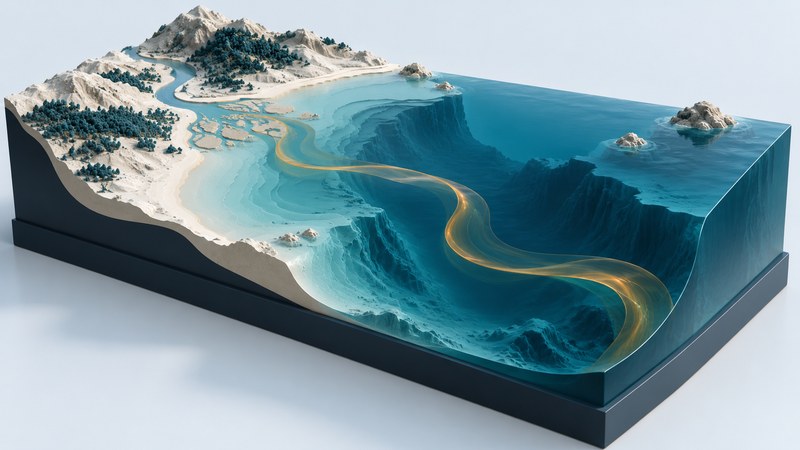
The Gulf of Mexico is a nearly enclosed ocean basin connected to the Caribbean Sea and the Atlantic. Understanding it starts with three different maps: the shape of the seafloor, the movement of water, and the changing conditions along its coasts. Each answers a different question.
Locate the basin and its two gateways
On a regional atlas, find the southern United States, eastern Mexico, the Yucatán Peninsula, Florida, and Cuba. The Gulf lies between these land areas. The Yucatán Channel connects it with the Caribbean between Mexico and Cuba; the Straits of Florida provide the eastern connection toward the Atlantic. The Bay of Campeche occupies the southwestern part of the basin.
Next switch to a bathymetric map, which represents depth below a stated reference surface. Continental shelves form the relatively shallow submerged margins of the land; slopes descend toward the deep basin. Shelf width varies around the Gulf. Read depth contours or the legend before interpreting a blue shade: colors can represent depth, temperature, or another quantity depending on the map.
The NOAA Gulf Data Atlas is a starting point for exploring bathymetry and other regional layers. Check each layer’s description and source date. A shaded-relief view emphasizes landform shape through simulated illumination; its shadows are a display treatment.
Naming varies among sources. NOAA currently uses “Gulf of America” in its Loop Current explanation; older scientific publications often use “Gulf of Mexico.” When comparing datasets, identify the basin by its coordinates and boundaries as well as its label.
Follow circulation through a changing system
Warm Caribbean water enters between Yucatán and Cuba, flows into the Gulf, then turns toward the Florida Straits. NOAA describes this as the Loop Current. Its reach changes: at times the loop extends far north into the basin, while at others its path turns toward the exit much sooner. A single arrow on an atlas summarizes this connection; a dated current product describes a particular observation or model period.
For a current map, record whether arrows show surface flow, a deeper layer, or a depth average. Check their units and whether they represent an observation, a model analysis, or a forecast. Sea-surface temperature can help identify contrasting water masses, but a temperature color by itself supplies neither flow direction nor speed. Compare products covering the same time and area.
Keep the open basin and the coast at their appropriate scales. A basin-wide circulation diagram leaves out details of a bay, inlet, or river mouth. For local water levels and station records, use NOAA Tides and Currents and check the station’s datum, location, and measurement period.
Connect rivers, shelf waters, and oxygen
Rivers connect inland watersheds with coastal water. They deliver freshwater, sediment, and dissolved material, while winds and ocean movement redistribute what reaches the coast. A visible plume is evidence of an optical pattern at a particular time; understanding its composition or environmental effect requires measurements suited to that question.
NOAA’s account of Gulf hypoxia monitoring explains a specific northern-shelf process: excess nutrients can support algal growth, and decomposition consumes oxygen. Layering of fresher surface water over denser water can limit oxygen replenishment below. Scientists measure dissolved oxygen to map the affected bottom water. The extent varies, so attach the survey date and measurement method to any map of a low-oxygen area.
This is a useful distinction when reading imagery: brown surface water, warm surface water, and oxygen-poor bottom water are separate observations. Their relationships need evidence. The Yangtze sediment-plume guide offers another example of separating visible color from a measured environmental quantity.
Choose the map that answers your question
| Question | Useful product | Check before interpreting |
|---|---|---|
| Where does the shelf deepen? | Bathymetry and depth contours | Depth units, reference surface, resolution, and survey coverage |
| Where is water moving? | Dated current observations or model fields | Depth, time, arrow scale, and observation versus forecast |
| Where was oxygen low? | Dissolved-oxygen survey | Sampling dates, sampled depth, threshold, and spatial coverage |
| How is a coastal water level changing? | Tide-station record | Station datum, record length, and land motion |
Try this short atlas exercise: locate the two gateways, trace a shelf edge using the depth legend, and identify the Mississippi River’s outlet. Then open one dated environmental layer. Write two sentences: one describing the basin feature that provides context, and one describing the quantity actually measured. Finish with the source, date, and one limitation of the layer.
For example: “This survey covers part of the northern continental shelf. Its colors represent bottom-water oxygen during the stated sampling period; areas outside the survey require additional observations.” That is a more usable reading than treating one colored patch as a permanent condition across the whole Gulf.
Related reading
- Coastal water-level records: Read local trends and future scenarios alongside the basin geography.
- Earth imagery comparison: Choose observations with suitable dates, scale, and processing.
- Isla Calafia: Practice distinguishing seabed measurements from an interpretation of past land.