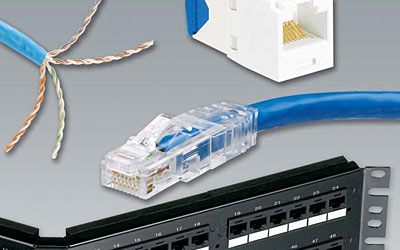
10 Gigabit Ethernet over copper, known as 10GBASE-T, sends 10 Gbit/s Ethernet over four-pair twisted-pair cabling using the familiar 8P8C modular connector. Its appeal is straightforward: it lets buildings keep the structured copper cabling model used for 100BASE-TX and 1000BASE-T while moving selected links to 10G switching speeds.
When this article first appeared in 2005, 10GBASE-T was still being finalized and vendors were racing to prove that unshielded twisted-pair cabling could support 10G operation at a 100-meter channel length. IEEE 802.3an was approved in 2006, and Category 6A/Class EA cabling became the practical answer for new 100-meter 10GBASE-T installations.
Why Cat 6A Matters
Category 6A is rated to 500 MHz and was designed to support 10GBASE-T channels up to 100 meters. The important new enemy was alien crosstalk: interference from neighboring cables, not just from pairs inside the same cable. At 10G speeds, bundles of cables can interfere with one another enough to damage performance unless the cable, connectors, patch panels, installation practices, and testing all account for it.
- Cat 5e: excellent for 1GBASE-T and often usable for 2.5GBASE-T. It was not designed for 100-meter 10GBASE-T.
- Cat 6: supports 1G and may support 10G over shorter, well-installed links, but 100-meter 10G is not its standard design target.
- Cat 6A: the normal recommendation for new 10GBASE-T structured cabling to 100 meters.
- Cat 8: designed for 25GBASE-T and 40GBASE-T over short data-center links, with a 30-meter channel objective. It is not a general replacement for Cat 6A in buildings.
Multi-Gigabit Copper
Not every upgrade needs 10G. IEEE 802.3bz standardized 2.5GBASE-T and 5GBASE-T in 2016, creating a practical middle path for existing cabling. These speeds were driven partly by Wi-Fi access points that outgrew 1G uplinks but were already installed on Cat 5e or Cat 6 cable runs. Ethernet Alliance material continues to describe 2.5GBASE-T and 5GBASE-T as a strong growth area because they can improve throughput while preserving much of the installed twisted-pair base.
This is why a modern access switch may offer 1G, 2.5G, 5G, and 10G copper ports. The best speed depends on the cable category, link length, noise environment, switch power and heat, endpoint support, and whether PoE is needed.
Power Over Ethernet
Copper Ethernet has one advantage fiber does not: it can deliver power. Power over Ethernet supports phones, cameras, access points, sensors, thin clients, door controllers, lighting, and other edge devices over the same cable that carries data. IEEE 802.3af and 802.3at established earlier PoE and PoE+ levels, while IEEE 802.3bt expanded standardized 4-pair PoE and raised available powered-device power substantially.
High-power PoE changes cabling design. Heat rise in cable bundles, connector quality, patch-panel density, cable gauge, installation temperature, and total switch power budget all matter. A cable plant built only for low-power phones may not be ideal for high-density Wi-Fi 7 access points, pan-tilt-zoom cameras, or lighting loads.
Where Copper Is Still Best
- Office drops, access points, cameras, phones, displays, and building systems that need both data and power.
- Moves, adds, and changes where structured cabling and patch panels provide flexibility.
- Short server or workstation links where 10GBASE-T compatibility with existing RJ-45 infrastructure matters.
- Multi-gig access networks where 2.5G and 5G can reuse existing Cat 5e or Cat 6 cabling.
Where Fiber or DAC Is Better
Copper is not always the right answer. In data centers, short direct-attach copper cables are common between servers and top-of-rack switches, while fiber dominates longer and faster links. Fiber has lower loss over distance, avoids electromagnetic interference, supports very high speeds, and does not create the same heat and power issues as high-speed twisted-pair PHYs. For 25G, 40G, 100G, 400G, and faster data-center connections, SFP/QSFP/OSFP optics or DAC/AOC cables with appropriate fiber optic connectors are usually more practical than twisted-pair BASE-T.
10GBASE-T SFP+ transceiver modules can be useful for connecting RJ-45 devices to SFP+ switches, but they run hotter and consume more power than many optical modules or DACs. They also may have shorter reach limits than a fixed 10GBASE-T switch port. Check module vendor limits, switch thermal guidance, and link-length specifications before assuming every SFP+ cage can become a 100-meter RJ-45 10G port.
The 2005 Panduit Synergist Story
In 2005, the Panduit Synergist 10GIG UTP Copper Cabling System was presented as an end-to-end 10 Gigabit Ethernet solution. Each component used complementary design technologies intended to work together for balanced performance. Modular and scalable, the system was positioned as a cost-effective medium for high-bandwidth data center, workstation, and web-enabling applications.
The system provided certified performance in a 4-connector channel up to 100 meters and exceeded the requirements of the 10 Gigabit Draft 1.0 amendment to IEEE 802.3an, dated October 2004. The components worked together to suppress alien NEXT while providing Class E/Category 6 augmented electrical performance beyond 500 MHz. The Synergist 10GIG UTP Copper Cabling System consisted of TX6 10GIG Jack Modules, TX6 10GIG UTP Copper Cable, TX6 10GIG Patch Cords, DP6 10GIG Patch Panels, and the GP6 PLUS Punchdown System.
"Initial response to the launch of this revolutionary new system has been exceptional," reported Andrew Caveney of Panduit. "After extensive research and competitive analysis, the Synergist 10GIG UTP Copper Cabling System has already been selected by a technology-driven, Fortune 25 organization for large-scale data center deployments."
What Changed Since 2005
The draft became a standard, and the market learned where 10GBASE-T fits. It became useful for workstations, access switches, copper server ports, lab environments, and backward-compatible RJ-45 infrastructure. It did not become the default answer for every data-center link because power, latency, heat, and reach tradeoffs made DAC and fiber more attractive at many speeds.
The larger copper story also changed. Multi-gigabit access filled the gap between 1G and 10G. High-power PoE made copper indispensable at the edge. Cat 8 arrived for 25GBASE-T and 40GBASE-T over short 30-meter channels, but those speeds have remained specialized compared with fiber, DAC, and optical module ecosystems.
Planning Checklist
- Use Cat 6A for new 10GBASE-T structured cabling where 100-meter support is expected.
- Certify installed links with a tester that supports the required category and alien crosstalk measurements where applicable.
- Do not assume a "Cat 7" or "Cat 8" patch cord improves a permanent Cat 5e or Cat 6 link.
- For Wi-Fi access points, check both data rate and PoE class. The uplink speed and power budget must both match the AP.
- For SFP+ copper RJ-45 modules, verify reach, heat, and switch compatibility.
- Use fiber or DAC for higher-speed data-center links when distance, power, latency, or heat make twisted pair unattractive.
- Label and document cable category, test results, patch-panel ports, and PoE loads. Copper cabling is infrastructure, not just cable.
Copper Ethernet keeps succeeding because it is practical. It carries data and power, uses familiar connectors, supports long-lived structured cabling, and now spans 1G, 2.5G, 5G, and 10G in ordinary buildings. The lesson from 10GBASE-T is still the same as it was in 2005: performance comes from the whole channel, not from one impressive cable label.
References
- IEEE P802.3an: 10GBASE-T Task Force
- IEEE P802.3bz: 2.5GBASE-T and 5GBASE-T Task Force
- Ethernet Alliance: 2.5GBASE-T and 5GBASE-T growth
- Ethernet Alliance: Power over Ethernet certification and IEEE 802.3bt context
- IEEE 802.3bt-2018: Power over Ethernet over 4 pairs
- Telegartner: facts about 25/40GBASE-T and Category 8
- Panduit: testing 10 Gb/s performance of Category 6 and 6A