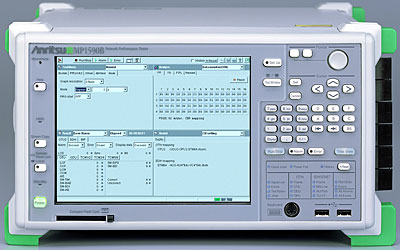
A network performance tester is a purpose-built instrument for proving that a network, circuit, optical module, or transport device performs within specification. Unlike a laptop speed test, a calibrated tester can generate controlled traffic, measure loss and latency precisely, decode protocol layers, inject errors, test optical interfaces, and produce repeatable acceptance reports. For Ethernet-specific service validation, see also Gigabit Ethernet test equipment.
The original version of this article focused on Anritsu's MP1590B Network Performance Tester and its Ethernet over SONET/SDH options. That was a key transition point in 2005: carriers were carrying Ethernet services over legacy transport networks, while 10 Gbit/s optics and XFP modules were becoming important. Today, field and lab testers still cover those legacy technologies, but they also test OTN, Carrier Ethernet, 25G, 100G, 400G, PAM4, FEC, coherent optics, and early 800G-class systems.
What Network Testers Measure
- Throughput: the maximum traffic rate a device, service, or link can pass without unacceptable loss.
- Frame loss: missing frames under load, congestion, policing, shaping, or physical-layer impairment.
- Latency and delay variation: one-way or round-trip delay, plus jitter that can affect voice, video, trading, radio access, and control systems.
- Bit errors: physical-layer errors on copper, optical, OTN, Ethernet, and high-speed serial interfaces.
- Jitter and wander: timing variation that can degrade synchronous transport, optics, clock recovery, and module interoperability.
- FEC behavior: pre-FEC and post-FEC error behavior, especially important for PAM4-based 100G, 200G, 400G, and 800G links.
- Protocol correctness: encapsulation, VLANs, GFP, VCAT, LCAS, OTN mapping, MAC behavior, TCP performance, and service activation profiles.
Field Testers and Lab Testers
Field testers are built for turn-up and troubleshooting. A technician may need to certify a business Ethernet service, verify an optical module, test a dark fiber path, run RFC 2544 or ITU-T Y.1564, check VLAN transparency, prove a service-level agreement, and hand a report to the customer before leaving the site. Fiber-specific failures may also require a reflectometer.
Lab testers are built for repeatability, scale, and deep visibility. They may emulate thousands of flows, stress a switch or router, test a new optical module, verify FEC margins, or reproduce an interoperability bug. Lab instruments often provide automation APIs, high-resolution timestamping, capture functions, impairment generation, and synchronized multi-port traffic generation.
Ethernet Over SONET/SDH
Ethernet over SONET/SDH, often shortened to EoS, was important because carriers already had large SONET and SDH transport networks. EoS allowed Ethernet frames to ride over those synchronous networks using encapsulation and bandwidth-mapping techniques such as GFP, virtual concatenation, and LCAS.
- GFP: Generic Framing Procedure, defined by ITU-T G.7041/Y.1303, maps variable-length client signals such as Ethernet into transport paths.
- VCAT: Virtual concatenation lets bandwidth be built from multiple smaller SONET/SDH paths rather than requiring one large contiguous path.
- LCAS: Link Capacity Adjustment Scheme, defined by ITU-T G.7042/Y.1305, allows the bandwidth of a virtually concatenated group to be adjusted and protected dynamically.
- Differential delay: the delay difference between VCAT members. A receiver must absorb this difference for the service to remain stable.
Much new build has moved toward packet, OTN, coherent transport, and Ethernet-native designs, but EoS testing still matters in networks with legacy transport, wholesale circuits, utility systems, government systems, and long-lived carrier infrastructure.
The 2005 Anritsu MP1590B Story
With the convergence of IP networks and optical/digital transmission, EoS technology for sending LAN-based Ethernet over WAN-based SONET/SDH became an important next-generation network technology. Anritsu enhanced the VCAT and LCAS options on its MP1590B EoS unit to help evaluate those transport circuits.
In the 10 Gbit/s transceiver module market, XFP modules were becoming mainstream because they were smaller and lower power than earlier 10G module formats. Anritsu developed 10G Electrical Differential Interface Units to support precise XFP module jitter measurements that had been difficult with conventional methods.
The EoS units were compatible with GFP, LEX, LAPS (X.86), PPP, and other encapsulation methods. Detailed EoS frame data could be checked in real time using more than 120 real-time counters, plus Ethernet frame and GFP frame capture and decode functions. VCAT, LCAS, and VCDD options made it possible to measure a wide range of EoS transmission circuits. A single MP1590B Network Performance Tester could evaluate EoS-compatible networks, transmission devices, and modules based on ITU-T standards.
An XFP module has an optical interface on the line side and an electrical differential interface called XFI on the equipment side. Both sides must be assessed when characterizing the module. The newly developed Electrical Differential Interface Unit made it possible to perform jitter tolerance, jitter transfer, and jitter generation measurements independently for transmission and reception.
For further verification, an MP1590B optical interface could be installed at the same time, allowing optical and electrical signals to be output simultaneously while electrical output level and input threshold values were adjusted.
What Changed Since 2005
The MP1590B is now a legacy product. Anritsu's current product page lists it as discontinued and points to replacement models such as the MT1000A and MT1100A. Anritsu's newer Network Master Pro MT1040A supports interfaces including 10M to 400G Ethernet, OTN from OTU1 to OTU4, CPRI/OBSAI, and field-portable commissioning and maintenance workflows.
The measurement problem also changed. A 2005 tester had to deal with SONET/SDH, OTN, 10G Ethernet, XFP, and jitter. A 2026 tester may need to deal with QSFP28, QSFP-DD, OSFP, 100G/400G PAM4 lanes, FEC correction margins, 400ZR coherent modules, 5G transport, time synchronization, and automated service activation. The tester is no longer only proving that bits move; it is proving that the service behaves under the same impairments and operational constraints it will see in production.
Common Test Methods
- RFC 2544: classic benchmarking for throughput, latency, frame loss, and back-to-back frames. Still common in labs and acceptance workflows.
- ITU-T Y.1564: Ethernet service activation methodology designed for multi-service SLA validation.
- RFC 6349: TCP throughput testing methodology that helps distinguish raw network capacity from host, window, and TCP-layer limits.
- BERT: bit error rate testing using known patterns to prove physical-layer quality.
- Jitter testing: jitter generation, jitter tolerance, and jitter transfer measurements for transport equipment and optical modules.
- FEC analysis: pre-FEC and post-FEC error monitoring to identify margin problems before a link fails hard.
Choosing a Tester
- Match supported rates and form factors to the network: 1G, 10G, 25G, 100G, 400G, 800G, SFP, SFP+, SFP28, QSFP28, QSFP-DD, or OSFP.
- Check whether the tester supports the actual protocols in use: Ethernet, OTN, SONET/SDH, CPRI/eCPRI, Fibre Channel, PTP, or coherent pluggables.
- For service turn-up, require repeatable RFC 2544 and Y.1564 reporting, VLAN/Q-in-Q awareness, MTU testing, and loopback options.
- For optics, verify DOM/DDM access, optical power measurement, lane diagnostics, FEC visibility, PRBS patterns, and module thermal behavior.
- For lab automation, look for scripting APIs, remote control, synchronized multi-port testing, capture depth, and exportable results.
- For field work, value ruggedness, battery life, touchscreen workflow, calibration status, and the ability to generate customer-ready reports.
Broken-Link Cleanup
The old page linked only to the local XFP article and to Anritsu's homepage. The XFP link remains valid as a local supporting article. The generic Anritsu homepage link has been replaced with specific Anritsu product pages and standards references below so the article points to more useful material.
References
- Anritsu: Network Performance Tester MP1590B
- Anritsu: Network Master Pro MT1040A
- ITU-T G.7041/Y.1303: Generic Framing Procedure
- ITU-T G.7042/Y.1305: Link Capacity Adjustment Scheme
- ITU-T O.172: jitter and wander measuring equipment for SDH systems
- RFC 2544: benchmarking methodology for network interconnect devices
- ITU-T Y.1564: Ethernet service activation test methodology
- RFC 6349: framework for TCP throughput testing