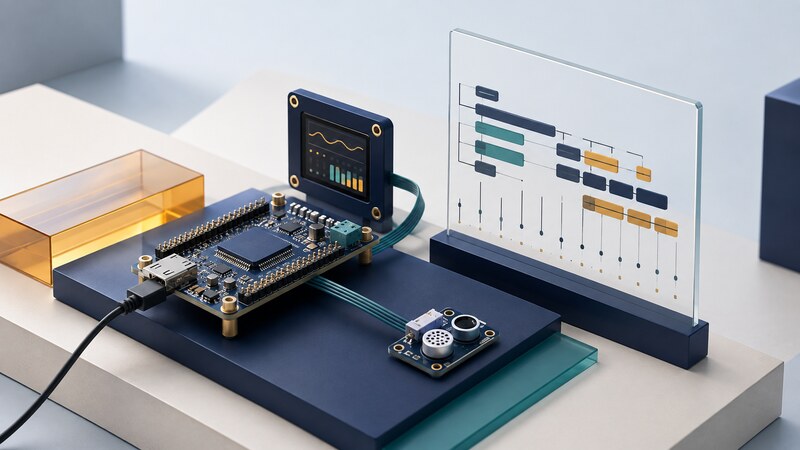
An embedded processor runs software as part of a device: reading sensors, controlling outputs, communicating, or presenting information. Choosing one means balancing the job's timing, memory, interfaces, power, and maintenance needs.
Clock speed alone is a weak selection rule. A modest processor with the right timer, converter, and sleep modes may fit better than a faster device that needs more external components. AI-assisted firmware development makes good requirements and reproducible tests especially valuable.
Choose the processing approach
| Approach | Often useful for | Tradeoff to examine |
|---|---|---|
| Microcontroller | Sensor nodes, appliances, and direct peripheral control. | On-chip memory and peripheral limits. |
| Application processor | Rich interfaces, networking services, and operating systems such as Linux. | Memory, startup, power, and software maintenance. |
| DSP or specialized accelerator | Repeated signal-processing or inference workloads. | Supported operations, data movement, and development tools. |
| Processor with FPGA fabric | Software combined with custom parallel hardware. | Hardware verification and integration complexity. |
These categories overlap. Start with the required functions and measure a representative workload on a candidate development board. Include peripheral transfers and communication, not just the central algorithm.
Write down memory and timing budgets
List the required interfaces and their electrical levels, speeds, and pin assignments. Check conflicts in the pin multiplexer: a device may advertise several functions that cannot all use the desired pins simultaneously.
Budget program storage, working memory, stacks, buffers, and update space. A model file that fits in flash may need much more RAM during execution. For edge AI, measure preprocessing, inference, and output handling with representative inputs, then check accuracy after any quantization.
Define deadlines and the behavior when work takes too long. A sensor sample every 10 milliseconds needs a schedule that accounts for interrupts, bus delays, and other tasks. Avoid making a critical response depend on a long blocking network request.
Worked example: estimate average current
This is not a battery-life forecast. Actual usable capacity, temperature, self-discharge, regulator losses, sensor startup, radio retries, and leakage can change the result. A development board's power LED or debugger may dominate the sleep current.
Measure the full current waveform and include infrequent events such as reconnection and firmware updates. Compare energy at a consistent boundary; currents on different voltage rails cannot simply be added to estimate battery drain.
Test software and hardware separately, then together
Keep calculations, parsers, and state transitions separate from direct hardware access where practical. Test those functions with known inputs, including malformed data, empty buffers, and values near numeric limits.
Use peripheral fakes for repeatable software tests, then check actual bus behavior and timing on the board. A fake sensor can return a timeout on demand; the physical test reveals whether the driver and wiring behave correctly when the sensor is disconnected.
Zephyr's test framework documentation describes facilities for embedded software testing, including unit tests and simulated environments. Simulation is one layer of evidence alongside measurements on the target.
Exercise reset, brownout recovery, interrupted updates, and unavailable peripherals. Define a known startup state for outputs. Record board revision, firmware build, configuration, and test conditions so a reported fault can be reproduced.
Review generated firmware against the device
Using this exact microcontroller reference manual and SDK version, review the synthetic sensor driver. Check register fields, timeouts, buffer bounds, and error paths. Cite the documentation and identify assumptions that require a hardware test.
Generated code can use a real-looking API from another SDK release or assume a peripheral feature that the selected part lacks. Compile with appropriate warnings, inspect configuration changes, and test the failure paths as well as the normal read.
Does an embedded device need an RTOS?
A simple event loop may be sufficient. An RTOS can help organize concurrent work, but it introduces scheduling and synchronization decisions. Choose it for the application's requirements and support needs, then measure the resulting behavior.
For analog sensors, pair firmware testing with an understanding of the ADC and its signal chain.