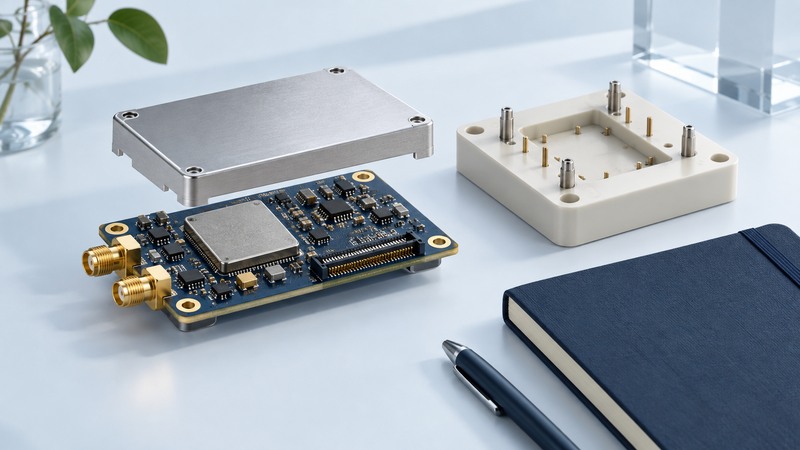
A custom electronic module packages a function for use inside a larger system. It may combine RF, analog, power, processing and firmware in a board assembly, shielded module or multi-chip package. The best starting point is a boundary: what the module receives, what it delivers and what the host system must provide.
Choose customization when a documented requirement justifies the development and lifecycle commitment. Before requesting quotations, compare an existing module, an existing module with an adapter, and a fully custom design against the same acceptance criteria.
Describe the function and the boundary
Write the use case in plain language, then list the interfaces. For an RF module, define frequency bands, impedance, signal levels, gain/noise/linearity requirements and the relevant operating conditions. For a sensor module, define input types, ranges, sampling and measurement errors. Add power sequencing, control protocols and physical mounting.
Analog Devices’ custom-module overview illustrates the breadth of integration from chips and packages to replaceable subsystems. Specify the level you need and the work your team will own. A supplier’s broad capability statement is a reason to investigate, not acceptance evidence for a particular module.
Identify what sits outside the supplier’s scope: host software, antennas, calibration fixtures, cable assemblies, enclosure thermal paths or regulatory testing. Put an owner against each interface so missing work is discovered while it can still be planned.
Write requirements that can be checked
On a narrow screen, scroll the table horizontally. Keyboard users can focus the table region and use the arrow keys.
| Area | Define in the brief | Evidence to agree |
|---|---|---|
| Signal performance | Ranges, bandwidth, noise/error limits and operating conditions. | Measured results with setup, uncertainty and pass/fail limits. |
| Power and thermal | Input range, sequencing, modes, peak demand and heat-removal boundary. | Startup traces, power measurements and temperature evidence. |
| Digital interface | Pinout, voltage levels, protocol, timing, units and error behavior. | Interface specification, reference host and fault/recovery tests. |
| Mechanical/environment | Envelope, connector location, mounting, exposures and duty cycle. | Controlled drawings and agreed qualification results. |
| Production/service | Serialization, test coverage, configuration and replaceability. | Manufacturing test record, revision identity and service procedure. |
State minimum, maximum and typical quantities separately. Include the conditions under which a requirement applies. “Low noise” needs a bandwidth and a measurement method; “fast startup” needs a start event, ready condition and maximum time.
The ADI product-development description places manufacturing, reliability and test considerations early in development. Apply that principle to the brief: reserve test access and a reproducible acceptance method before the mechanical design becomes fixed.
A small acquisition-module brief
For acceptance, identify test inputs and conditions that exercise the specified range and timing. Define how timestamps are generated and what happens after a reset or disconnection. Request raw results as well as a summary report, so a later software change can be compared with the same evidence.
This fictional acquisition example shows the structure of a requirement. The same discipline applies to RF or microwave modules, where the conditions might include frequency, drive level, bandwidth, temperature and load.
Compare development and lifecycle costs
Request quotations with explicit deliverables and assumptions: development milestones, prototype quantity, production minimums, component substitutions, test-fixture ownership, lead-time dependencies and change charges. Compare the schedule against the need for integration and qualification, not only the date of the first powered board.
Agree who owns or can access schematics, layout, firmware source, build tools, calibration data and production-test software. Define what happens when a part becomes unavailable or a tool license expires. For long-lived systems, a supportable replacement route may be more valuable than a small unit-price reduction.
Separate development evidence from production release
- Requirements review: agree the numbered requirements, interfaces, test methods, responsibilities and unresolved assumptions.
- Prototype review: demonstrate the major functions on representative hardware and record limitations that still need resolution.
- Design verification and qualification: evaluate the complete requirements and intended operating/environmental conditions with traceable configurations.
- Pilot production: build through the intended manufacturing process, inspect yield and confirm that the production tests find the targeted defects.
- Acceptance and release: receive the agreed documentation, test results, serial/configuration records, known issues and support arrangements.
A production test usually checks a practical subset of behavior on every unit; qualification explores broader conditions on a defined sample and design revision. Keep those purposes separate in the contract and coverage record. A passing factory test should state what it exercised.
Use the downloadable brief to record a requirement, its verification method and its owner on the same line. During supplier discussions, keep changes versioned and resolve ambiguities with an updated requirement rather than an informal promise.
Keep a working record
Download the custom electronic modules worksheet (editable text). Save a copy for each comparison or test. It includes the example assumptions, fields for source references and space for your results.