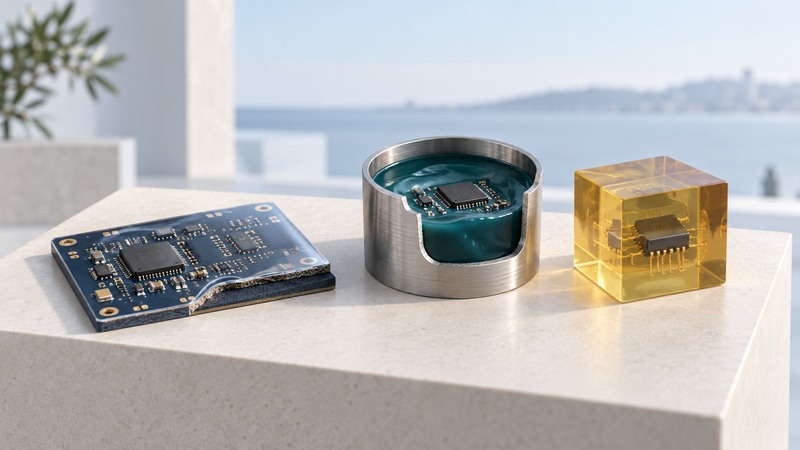
Electronics encapsulation surrounds components with a protective material. Potting commonly fills a housing around an assembly; conformal coating applies a thinner protective film over selected board surfaces. Both can help control environmental exposure, but they change heat transfer, access and mechanical behavior in different ways.
Choose the protection method around the failure you are trying to prevent. Condensation on an indoor sensor, repeated chemical washing and continuous immersion impose different demands. Define exposure and service needs before selecting a resin family.
Select the protection approach first
On a narrow screen, scroll the table horizontally. Keyboard users can focus the table region and use the arrow keys.
| Approach | What it adds | What to plan |
|---|---|---|
| Enclosure and seals | A controlled physical boundary around a serviceable assembly. | Cable entries, condensation paths, seal maintenance and enclosure testing. |
| Conformal coating | A thin film over selected circuitry. | Cleanliness, coverage, masking, thickness, cure and access for connectors or repair. |
| Potting | Material filling an enclosure around components. | Voids, cure heat, mechanical stress, thermal path, mass and replacement strategy. |
| Molded encapsulation | A defined material body formed around the electronics. | Tooling, process pressure/temperature, shrinkage, interfaces and production control. |
A combination can be appropriate. For example, an enclosure can protect connectors while a coating addresses board-surface exposure. MG Chemicals’ conformal-coating information describes available chemistries and application considerations. Use the selected product’s technical data and application instructions for the real thickness and cure requirements.
Identify features that must remain accessible or exposed: pressure ports, acoustic openings, optical paths, test pads, adjustable parts and mating contacts. Include those boundaries in the process drawing.
Compare the exact formulation
Epoxies often provide a firm protective body, silicones can provide low-stress flexibility, and polyurethanes offer another range of mechanical and moisture-resistance properties. Formulations vary widely within each family. Compare specific products under the exposure and temperature cycle your assembly will see.
MG Chemicals’ potting-compound overview identifies epoxy, silicone and polyurethane offerings with different modulus, conductivity and application properties. Treat family descriptions as a shortlist aid. A product’s technical data sheet and compatibility trial supply the useful decision evidence.
- Mechanical: modulus, expansion, adhesion and the stress tolerated by delicate components.
- Environmental: actual fluids, humidity/immersion conditions, temperature range and cycling.
- Thermal: conductivity, fill thickness, contact with a heat-spreading surface and any operating hot spots.
- Process: viscosity, mix-ratio basis, working time, cure schedule, maximum pour size and degassing requirements.
- Service: whether the board can be reworked, how failure is diagnosed and whether the complete module will be replaced.
Keep recognition or flammability claims connected to the tested material, thickness and conditions. A resin label by itself does not establish the finished product’s ingress, electrical insulation or regulatory performance.
Check the heat path, not just conductivity
A material can conduct heat better than air while still leaving an inadequate path to the surroundings. Decide where heat enters the fill and where it leaves. Compare temperatures on representative assemblies before and after the protection process under the same operating conditions.
Curing also generates heat in many two-part systems. The mass and shape of the pour influence the peak temperature. A small successful sample does not establish that a much larger pour will cure without overheating or stressing the assembly.
Control the process as carefully as the material
Use the exact technical data sheet and safety data sheet. They define preparation, handling, protective measures, ventilation, mixing, cure and disposal requirements for the formulation. Work within those instructions; this guide supplies no universal cure temperature or chemical-handling recipe.
The MG Chemicals potting application guide addresses preparation, mixing, trapped air and curing. Check the actual product for details such as whether the ratio is by mass or volume. Those ratios can differ when the two parts have different densities.
Record material lot, storage history, assembly preparation, batch size, mixing and dispensing conditions, cure record and inspection results. Contamination, incomplete mixing or trapped air can defeat an otherwise appropriate choice. Retain a representative process sample where the quality plan calls for it.
Validate a representative assembly
- Measure and photograph the functional baseline before coating or encapsulation, including electrical behavior and relevant temperatures.
- Apply the proposed process to representative geometry and materials, including connectors, tall components and intended masking.
- Inspect coverage, voids, adhesion and cure using a method appropriate to the material; repeat the functional measurements.
- Expose trial units to the specified service-relevant conditioning with a documented method, then inspect and measure again.
- Investigate failures by location and mechanism. Adjust one material or process variable at a time and repeat the relevant checks.
- Release the material, process limits, inspection and service strategy together.
Include repair economics in the decision. If encapsulation makes board repair impractical, plan a replaceable module, traceable spares and a way to diagnose failure without dismantling the protected assembly. The worksheet preserves these decisions alongside the material trial.
Keep a working record
Download the electronics encapsulation worksheet (editable text). Save a copy for each comparison or test. It includes the example assumptions, fields for source references and space for your results.