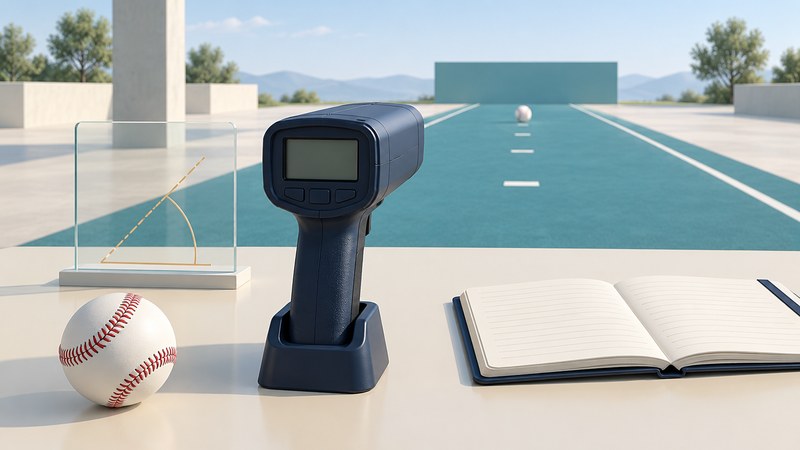
A useful speed record includes the gun model, the measurement position and the displayed units. Start there before interpreting a number as a change in pitching or serving performance.
Bushnell's Speedster name spans different products. Match the label on your unit to its manual; an older Speedster, a Speedster III and a Velocity should each be treated as their own device.
Identify the model before using its specifications
The Bushnell speed-gun manual directory lists Speedster III model 101921 and Velocity model 101911 separately. Save the matching manual and photograph the label for your own equipment record. If the label is missing, use Bushnell support to resolve identification before relying on a model-specific range or control sequence.
| Model | Ball-speed specification | What to keep separate |
|---|---|---|
| Speedster III 101921 | 10–110 mph, up to 90 feet; stated accuracy ±1 mph. | Its manual describes a tripod socket and an optional SpeedScreen. |
| Velocity 101911 | 10–110 mph at 90 feet; stated accuracy ±1 mph. | Use the Velocity instructions for trigger operation and unit selection. |
These figures come from the Speedster III manual (PDF) and Velocity 101911 manual (PDF). They describe the named models, not every Bushnell gun or every field result. Published maximum-distance figures are limits to interpret with the target and conditions.
A Speedster III documentation detail: its “How to Use” section describes pressing and releasing the trigger to start and stop; “Target Speed Acquisition” describes holding and releasing it. Check the behavior and matching instructions for your unit with Bushnell support if needed. Keep a record of how your device starts a reading and retains its result.
For the documented Velocity 101911, holding the trigger activates measurement; releasing it retains the fastest speed in that series. Its manual also explains switching mph/kph and the battery indication. Check those settings before recording a session.
Understand the angle between motion and the radar
A Doppler speed gun responds to the component of movement along its line of sight. Bushnell's manuals describe the resulting cosine effect: moving the observation point farther to the side reduces the measured component. Safe positioning and a clear view of the intended target come first; keep the operator protected from the ball's path.
Keep three ideas separate: resolution is the display step; repeatability is how closely repeated observations agree under a consistent procedure; accuracy concerns agreement with a suitable reference. A cluster of similar readings can still share the same positioning error.
Make practice sessions comparable
- Define what you are recording. Choose the activity, target and units. Decide whether the retained value is the session's maximum or one value per attempt.
- Record the setup. Sketch the gun's position relative to the target path, note approximate distances, and keep protective arrangements consistent. Treat a changed location as a new setup.
- Check operation. Confirm the correct units, a usable battery indication and the intended measurement mode. Observe a practice attempt before starting the record.
- Write down every attempt. Include missed readings and observations such as an obstructed view or an unintended moving target. Use “no reading” rather than a fabricated zero.
- Compare like with like. Summarize valid readings using a range and a median as well as any maximum. Explain exclusions and compare sessions only after checking setup differences.
Download the plain-text speed-session log. It includes a setup record, blank attempts and a worked example. Save a new copy per session.
Investigate missing or surprising readings
- No number appears: check battery indication, active measurement mode, supported target speed and distance, and whether the intended target has a clear path to the sensor.
- Readings changed after moving: compare position and target direction first. Repeat with the earlier documented setup if safe and practical.
- An unexpectedly high retained value: check what moved during the measurement interval and how the device retains a peak. Repeat one clearly identified target at a time.
- Two guns disagree: record both models, locations, units and measurement timing. Agreement with another consumer device is a comparison, not an independent calibration.
If a problem persists, send the manufacturer the exact model, control behavior and a concise description of the repeatable fault. That is more useful than a claim that the gun is “off” without the conditions under which the reading occurred.