
WiMAX is the name associated with broadband wireless systems based on the IEEE 802.16 family and the WiMAX Forum's interoperability work. Use these guides to understand the radio technology, evaluate a connection, or place a historical device and announcement in context.
Start with the question you need to answer. A standard describes technical behavior, a certification program tests defined requirements, and an operator supplies a service using approved equipment. A useful broadband decision brings all three into view.
Understand WiMAX

Mobile WiMAX: 802.16e, Mobility, and Today’s Service Names
Understand fixed, nomadic and mobile WiMAX, the role of 802.16e, and how to identify the network behind a modern service name.

OFDM and OFDMA in WiMAX: Subcarriers, Multipath, and Capacity
Learn how OFDM subcarriers, the cyclic prefix and OFDMA resource allocation work, and how to interpret wireless rate and range claims.
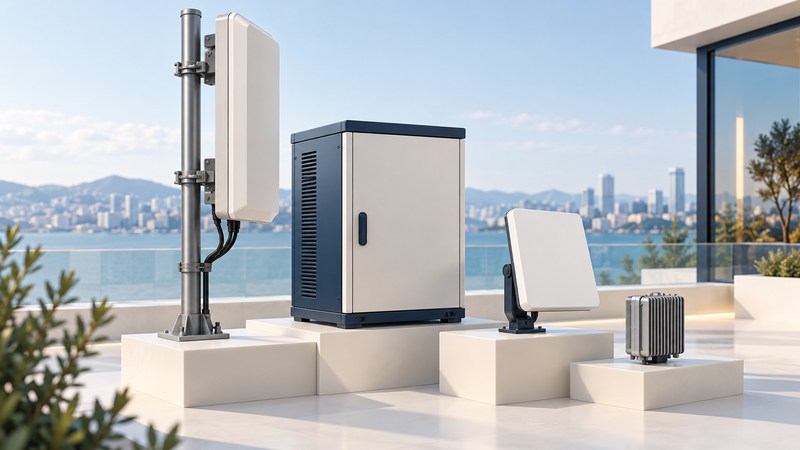
WiMAX Base Stations: Coverage, Capacity, and Compatibility
Understand WiMAX base-station components, shared sector capacity, backhaul limits and the evidence needed to check subscriber compatibility.
Evaluate broadband connections

Fixed Wireless Broadband: Coverage, Performance, and Provider Questions
Compare fixed wireless internet offers using address eligibility, upload speed, latency, installation, service terms and a repeatable trial.

Seamless Broadband Access: Handover, Failover, and Session Continuity
Distinguish radio handover, Wi-Fi roaming and WAN failover, and test whether calls, VPNs and transfers survive a connection change.

Satellite Backhaul and WiMAX: How Hybrid Broadband Networks Work
Trace satellite transport and terrestrial wireless access as separate stages, then assess bottlenecks, delay and service requirements.
Explore applications and history

Train Wi-Fi Explained: Backhaul, Coverage Gaps, and Working on Board
Understand the two parts of onboard internet, check route-specific Wi-Fi guidance, and prepare practical fallbacks for working on a train.

Intel and WiMAX: The 5116 Chip, Laptop Adapters, and Their Legacy
Trace Intel’s WiMAX modem silicon and later laptop adapters, distinguish hardware roles, and identify appropriate legacy support evidence.
Put the name in context
WiMAX has a specific standards history. The IEEE 802.16 inventory records the base standards and amendments; the working group entered hibernation in March 2018. Present-day service availability is a separate operator-specific question.
The technology also has specialized applications. The WiMAX Forum describes AeroMACS as an 802.16e-based airport-surface communications system. Meanwhile, in Japan, UQ's WiMAX +5G page lists multiple network families under one service name. Check the exact service and equipment instead of inferring their radio technology from branding alone.
Service examples checked in October 2026. Use the linked operator and standards sources for subsequent changes.