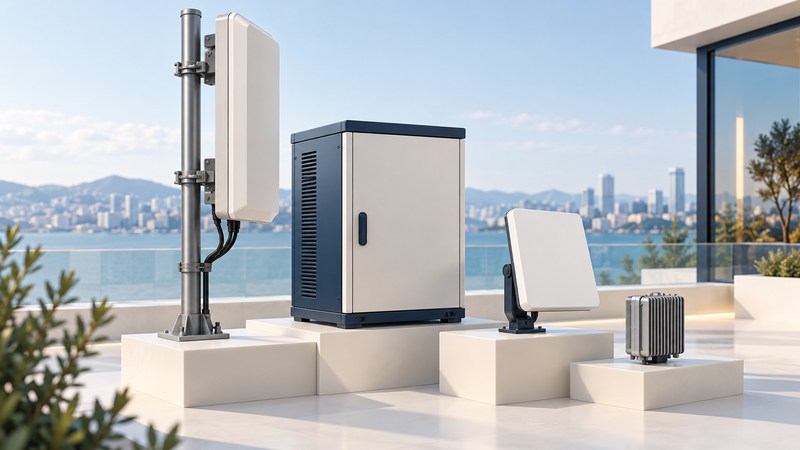
A WiMAX base station coordinates the radio connection to subscriber equipment. Its usefulness depends on a complete path: the radio link, the resources shared by users, the backhaul leaving the site and the network services beyond it.
For an existing network or a used-equipment evaluation, start with exact model and configuration records. A certification badge and a maximum range number each answer a narrower question than “will this work here?”
Follow the components from premises to internet
- 1. Subscriber equipmentA receiver/transmitter at the premises or in a mobile terminal.
- 2. Base-station sectorRadio resources and scheduling shared across the terminals it serves.
- 3. BackhaulThe connection carrying site traffic to the wider network.
- 4. Network servicesAuthentication, addressing, routing and access to applications.
A physical tower can hold multiple sectors. A sector antenna shapes the area served, while the scheduler assigns transmission opportunities. The backhaul may use fiber, microwave or another transport. Evaluate each stage separately: an excellent subscriber signal cannot repair a congested upstream connection.
IEEE 802.16 defines the air-interface family; the WiMAX Forum describes its role in certification and interoperability. Equipment implementation, selected profile and operator configuration determine the usable system.
Build a compatibility evidence record
On a narrow screen, scroll the table horizontally. Keyboard users can focus the table region and use the arrow keys.
| Item | What to record | Decision it supports |
|---|---|---|
| Identity | Full base-station and subscriber model, hardware revision and firmware. | Whether the documentation describes these exact units. |
| Radio match | Frequency band, channel width, duplex mode and supported system profile. | Whether there is a compatible operating configuration. |
| Certification | Certificate/product record, profile and tested configuration. | What interoperability evidence actually covers. |
| Network integration | Authentication, provisioning, addressing and operator acceptance. | Whether the radio can become a usable subscriber service. |
| Lifecycle | Vendor support, software availability, replacement parts and operator migration plans. | Whether the network can be maintained for the intended period. |
The Forum's certification FAQ describes conformance and interoperability testing and points to the applicable requirements. Ask for the record corresponding to the actual product and profile. Keep evidence of current support separate from historical certification.
If a seller cannot identify the band, profile or firmware, mark compatibility as unresolved. An Ethernet port or a matching enclosure is insufficient evidence for a radio pairing. For deployment, spectrum use and installation must follow the operator's applicable authorization and equipment instructions.
Separate coverage from capacity
Coverage asks whether a terminal can sustain a useful radio link at a location. Capacity asks how much traffic the system can carry while serving its active users. Antenna patterns, obstructions, interference, channel bandwidth and the chosen modulation/coding all influence the result. A receiver near the edge may require a more robust, lower-rate mode.
Request the conditions behind a quoted rate: direction, channel width, antenna configuration, radio mode, overhead treatment, number of active users and backhaul load. A laboratory peak, aggregate sector throughput and one customer's file-transfer rate are different quantities.
Use symptoms to choose the next check
Compare observations from the subscriber and the network side. Repeated loss of the radio link calls for signal-quality, obstruction and interference evidence. Stable radio status with slow evening transfers calls for investigation of shared sector and backhaul loading. A device that attaches but receives no usable service calls for provisioning and network checks.
These are investigation directions, not a diagnosis from a single symptom. Record timestamps, both traffic directions, exact error/status messages and a baseline taken when service works. Ask the operator to correlate those records with its own telemetry.
For choosing a retail connection rather than maintaining infrastructure, use the fixed wireless provider comparison guide. It translates these network questions into service terms and a practical trial.