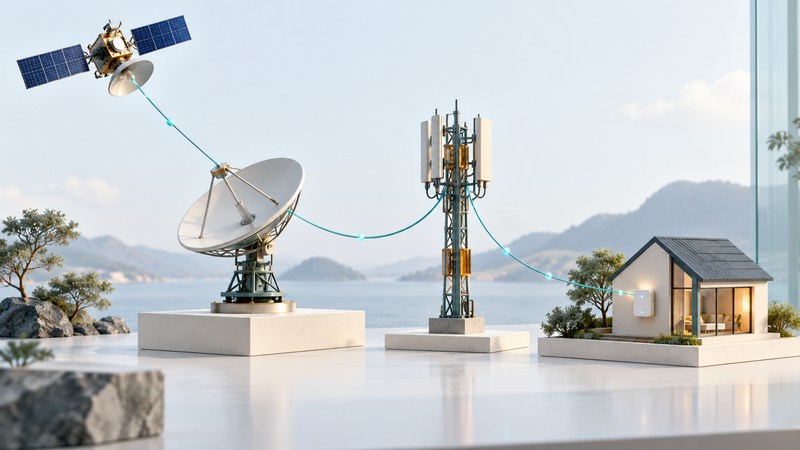
A satellite link can carry traffic to a remote site, where a terrestrial wireless system distributes it to nearby users. In a satellite-and-WiMAX design, the satellite is part of the transport path and WiMAX supplies the local access link. Each stage has its own equipment, capacity and operating conditions.
This is a useful architecture to understand when evaluating remote broadband or interpreting a demonstration that delivers satellite-originated content to handheld devices. Follow the whole path before deciding which radio actually reaches the user.
Trace the service end to end
- 1. Upstream gatewayConnects the satellite transport to the wider network or content source.
- 2. Satellite and ground terminalCarry traffic to and from the remote site, subject to the service design.
- 3. Local gateway and base stationRoute traffic into the terrestrial access network.
- 4. Subscriber and local networkDeliver the connection to the premises and its devices.
A laptop may connect by Wi-Fi to a premises router while the premises uses WiMAX for access and the community site uses satellite backhaul. These names describe different segments of one journey. Troubleshooting improves when the operator identifies where a fault or queue occurs.
Bidirectional internet service needs usable upstream and downstream paths. A one-way video-distribution system needs a separate return path for interactive requests.
A documented example of the broader architecture
In October 2023, ESA reported a University of Surrey demonstration of 5G backhaul over low-Earth-orbit satellites. It is a useful example of satellite transport supporting a separate terrestrial mobile system.
That project used 5G, so its results should be read within that design. For a WiMAX installation, request the equivalent end-to-end architecture and measurements for its own equipment and service. The transferable idea is the separation of backhaul from access.
Distinguish three satellite-related arrangements
On a narrow screen, scroll the table horizontally. Keyboard users can focus the table region and use the arrow keys.
| Arrangement | User-side access | What to ask |
|---|---|---|
| Satellite backhaul plus WiMAX | A terrestrial WiMAX subscriber radio reaches a local base station. | Where does shared satellite capacity enter the network, and how is the return path provided? |
| Direct satellite terminal at premises | A dedicated satellite terminal connects the premises; local devices may use Wi-Fi. | Which terminal, sky view, plan and installation are required? |
| Direct-to-device service | A supported device uses a specifically designed satellite service. | Which devices, places and functions are supported by the actual operator? |
Keep these arrangements separate when reading a headline about “satellite to smartphones.” The origin of content and the final radio hop are different facts. Verify direct-to-device capabilities from the particular service rather than extending a backhaul example into a claim about ordinary WiMAX handsets.
Separate distance, transfer time and waiting time
Propagation delay is the time a signal takes to travel. Transmission time depends on the amount of data and the link rate. Queueing adds waiting when traffic competes for capacity. A fast local wireless hop can coexist with substantial delay elsewhere on the route.
RFC 2488's discussion of satellite-channel characteristics explains why geostationary paths incur a large propagation delay and why satellite-link properties matter to TCP. It is a 1999 technical reference, not a current performance promise for every satellite service. Lower orbits shorten part of the physical path, while gateways, routing, load and implementation still influence measured end-to-end results.
Budget the narrowest shared stage
Ask how traffic is prioritized, where congestion is monitored, what happens during a satellite interruption, and whether a backup path shares the same power or upstream dependency. A service-level statement should identify the complete managed path.
Request evidence for the application
For calls or remote work, request measurements of round-trip delay, variation, loss and recovery during the intended operating hours. For media distribution, identify whether content is live or cached and whether many viewers share one delivered stream or request separate copies. For interactive access, establish how requests travel back.
A useful trial records the terminal/service, local access equipment, path direction, time, active traffic and application outcome. Compare that evidence with the job you need done. The fixed wireless comparison guide helps organize offers, while the continuity guide covers switching between paths.