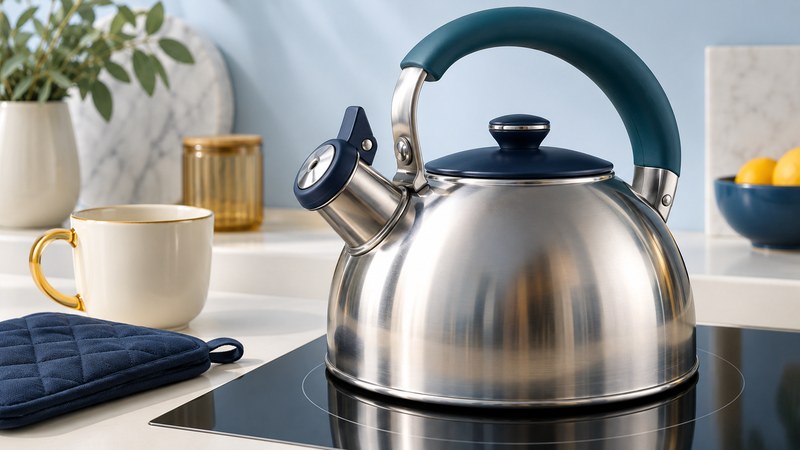
A whistling kettle heats water on a cooktop and uses steam passing through its whistle to make a sound. Choose one that fits your burner, gives you a comfortable grip, and has clear instructions for filling and opening the spout.
The sound is a useful cue within an attended routine. The cooktop keeps supplying heat until you turn it off, and a quiet whistle should prompt attention rather than a longer wait.
Choose around the cooktop and your hands
- Heat source: confirm the exact model's approved cooktops, including induction where relevant.
- Working capacity: use the permitted fill level, not the volume to the rim. Compare it with the servings you prepare.
- Handle: check grip clearance, its required position while heating, and whether an oven mitt can fit comfortably.
- Spout control: establish whether the whistle flips, lifts off, or opens through a handle mechanism. Choose an action you can operate confidently.
- Care and support: find the cleaning instructions and a manufacturer route for replacement parts before they are needed.
The Le Creuset Stainless Steel Classic is one documented example of a kettle with a flip-open whistle and stated cooktop compatibility. Use the same questions for other models; similar silhouettes can hide different operating instructions.
Make heating and pouring a continuous task
- Fill the cool kettle within its stated limits and seat the lid and whistle as instructed.
- Position it correctly on a compatible burner. Keep a folding handle in the required heating position.
- Stay nearby while it heats. Prepare the cup and an appropriate hand protector before the water is ready.
- Turn off the heat when the water is ready. Follow the model's directions for the pause before opening the whistle.
- Keep the spout directed away from people, open it as instructed, and pour at a controlled rate.
Le Creuset’s kettle care guide says gas flames should stay beneath the base, recommends oven mitts, and specifies a brief pause after removing the kettle from heat before opening the whistle. It also warns against relying on the whistle as a safety device. Follow your model's own details rather than transferring a timing instruction between brands.
When the whistle is weak or silent
If the kettle appears to be boiling without its usual sound, turn off the burner and let it cool before investigating. Waiting for a louder signal can leave water boiling away. Once cool, compare the lid, whistle position, and visible condition with the manual.
| Question | Useful observation | Next step |
|---|---|---|
| Was the lid seated as instructed? | A misplaced lid changes where steam can escape. | Refit only as the manual directs. |
| Was the whistle in its operating position? | Some models require closing a flip cap before heating. | Confirm the model-specific position and mechanism. |
| Are there deposits or obvious damage? | Record where buildup, distortion, or a missing part appears. | Use the approved cleaning procedure or contact support. |
| Has the behavior changed after a drop or dry boil? | The event matters even when the exterior looks familiar. | Seek a manufacturer assessment before reuse. |
Chantal’s kettle FAQ discusses lid fit and mineral deposits among reasons a whistle may fail to sound, and directs unresolved cases to customer service. Its guidance concerns Chantal mechanisms. Avoid bending, drilling, or modifying another kettle's whistle to imitate it.
Care for the whistle as well as the vessel
Check the manual for descaling and removable-part instructions. Keep the spout and whistle in the maintenance routine, and use only the procedure specified for the model. A cleaner suitable for a plain metal interior may have different restrictions around coatings, seals, or a whistle assembly.
Chantal’s stainless steel care sheet specifies hand washing and emptying the kettle when it is out of use. Its warning about a kettle heated dry calls for shutting off the heat and allowing it to cool before handling. If the appliance is damaged, obtain support rather than trying to restore operation through another boil.
The stainless steel kettle guide explains how to separate construction, compatibility, and cleaning questions. Keep the manufacturer's sheet available for exact cleaner quantities and times.
Decide whether a whistle suits your routine
Temperature control is a separate choice. A stovetop whistle signals boiling behavior; for drinks that call for a specific lower temperature, consider how you will measure or control the water temperature during preparation.
Continue exploring
- Kettle Safety: Filling, Steam, Pouring, and When to Stop
- Automatic Kettles: Shutoff, Temperature Control, and Keep-Warm
- Electric Tea Kettles: Capacity, Temperature, and Everyday Use
- Explore the tea kettle guides
Manufacturer documents describe the models named in them. Match your own model and market before applying operating or care instructions.