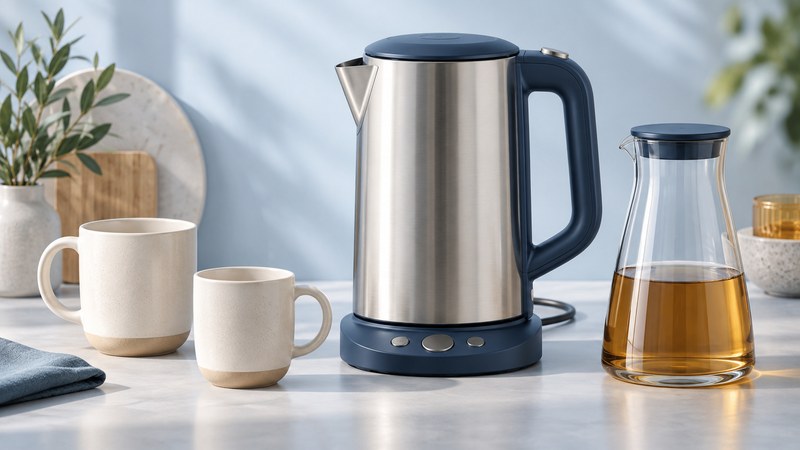
A useful electric kettle fits your everyday water needs and feels straightforward to operate. Start with the amount you normally heat, decide whether you need temperatures below boiling, and check how easily you can read the water level, close the lid, and pour.
Make a short list of requirements before comparing models. A larger capacity, more presets, or a higher wattage only helps when it supports the way you actually prepare drinks.
Measure the water you actually use
Measure your normal serving in milliliters with a measuring jug. Multiply by the number of drinks prepared together, then include water used for a teapot or another preparation step. Compare that amount with both the kettle's minimum and maximum fill limits. A listed number of “cups” is less useful until you know the size of the cup behind it.
Record empty weight as well as capacity. One liter of water adds roughly one kilogram to the load you lift. A compact kettle can therefore be a practical choice when pouring a large full vessel is uncomfortable.
Choose controls for your drinks
| Your routine | Useful feature | What to establish |
|---|---|---|
| Heat water to boiling | Simple on/off operation with automatic shutoff | How completion is indicated and how to cancel heating. |
| Prepare drinks at different temperatures | Selectable temperature or useful presets | Whether the available settings match the instructions on your tea or coffee. |
| Return for another serving | An optional keep-warm mode | Its duration, default behavior, and cancellation control. |
| Use the kettle in different orientations | Readable level marks and accessible controls | Whether the handle or your usual grip obscures the display. |
A concrete feature example is the Cuisinart CPK-17P1 specification page, which lists six temperature presets and a 30-minute keep-warm option. Those are separate capabilities. Use such specifications to compare functions; they do not establish that one kettle is the best choice for everyone.
Use the beverage maker's instructions as your starting temperature and steeping time. A preset name is a convenience label; compare its actual temperature with the drink you are making. Temperature selection also does not time the steep after you pour.
Look beyond the feature list
- Filling: check the lid opening, your faucet clearance, and the visibility of the fill marks.
- Handling: try the grip on an unheated display model if available. Check room for your fingers and how much wrist rotation pouring appears to require.
- Controls: look for clear start, cancel, and ready indications. Decide whether a visual signal, audible signal, or both suits your household.
- Cleaning: inspect access through the lid and ask whether the spout filter can be removed and replaced.
- Counter space: include the base and the space needed to lift the kettle, not just its body dimensions.
Appearance cannot establish the materials of every water-contact component. If this matters to you, ask about the interior, lid underside, level window, filter, and seals individually.
Match the model to its location
Buy a model rated for the electrical supply where it will be used, and follow its outlet and cord instructions. A “cordless” kettle normally lifts off a powered base for pouring. That term describes serving, not battery operation.
The Hamilton Beach 40852 instructions specify water-only use and the supplied base. Treat an invitation to make instant soup or oatmeal as heating water to add to a separate bowl unless the exact appliance manual permits cooking inside it.
Before first use, read the complete manual, follow its initial cleaning procedure, and learn the stop control. Keep the manual or a saved official link with the model number. The kettle safety guide covers placement and handling, while automatic kettle controls explains shutoff and keep-warm behavior.
Make a shortlist you can explain
Choose two or three candidates that meet your required capacity, electrical rating, and temperature range. Then compare handling, cleaning access, warranty terms, and support for the exact model. Leave a field marked “unknown” when a listing does not answer it, and ask the manufacturer before treating it as a feature.
Download the kettle selection worksheet (plain text) to record serving calculations, model evidence, and your final choice. It includes a worked example and space for three candidates.
Continue exploring
- Automatic Kettles: Shutoff, Temperature Control, and Keep-Warm
- Kettle Safety: Filling, Steam, Pouring, and When to Stop
- Stainless Steel Kettles: Construction, Compatibility, and Care
- Explore the tea kettle guides
Manufacturer documents describe the models named in them. Match your own model and market before applying operating or care instructions.