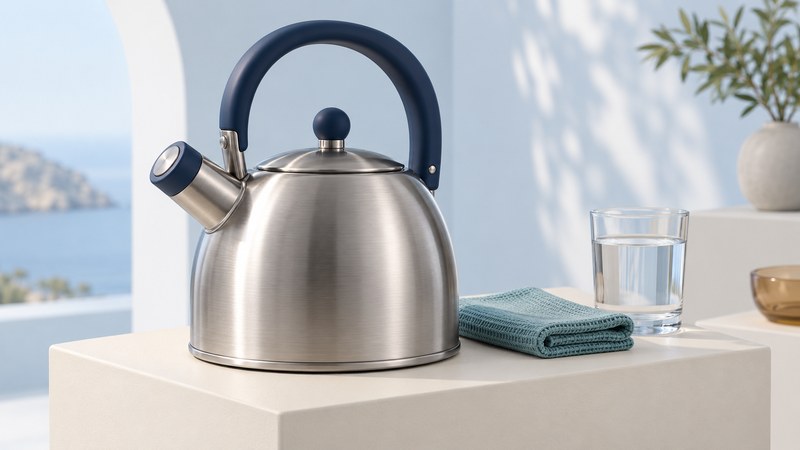
A stainless steel kettle is best understood as a complete assembly: the vessel holding water, the heating base, the lid and spout, and the parts you touch. The description “stainless steel” alone leaves several of those details open.
Start by establishing whether the kettle is electric or stovetop. Then use its exact specifications to answer two practical questions: will it work with your heat source, and can you maintain it as instructed?
Read the construction description in parts
| Part | Question to ask | Why it matters |
|---|---|---|
| Water-contact interior | What materials line the body and underside of the lid? | An exterior finish does not describe every surface touching water or steam. |
| Heating base | Is this an electric base, a stovetop base, or a layered base? | The heating arrangement determines where and how it can be used. |
| Handle and lid | What handling instructions and replacement options apply? | Metal appearance alone says little about grip or serviceability. |
| Spout and filter | Is there a removable screen, whistle, or both? | Each has different cleaning and refitting instructions. |
Ask for a material description when it matters to your choice. A grade stated for the body need not describe the base or every small fitting. A bright finish also cannot establish the grade, thickness, or construction underneath it.
Confirm induction and other heat-source compatibility
Induction heating depends on a suitable magnetic base. The U.S. Department of Energy explanation of induction cooking describes the connection between the cooktop's field and compatible cookware. A magnet adhering to the base is a useful preliminary clue; also confirm the kettle manufacturer's compatibility statement and your cooktop's requirements for base size and contact.
As a specific example, Le Creuset lists its Stainless Steel Classic Whistling Kettle for induction and other listed cooktops. That statement applies to that product, rather than to every kettle with a stainless exterior.
An electric kettle belongs on its supplied electrical base unless its manufacturer explicitly provides another arrangement. A stainless body does not make an electric model a stovetop kettle. For an older unmarked stovetop model, ask the maker about compatibility before buying it for an induction hob.
Separate mineral deposits from questions about damage
Water hardness largely reflects dissolved calcium and magnesium, as explained by the USGS Water Science School. Heating hard water can leave mineral deposits. The amount of buildup depends on the water and how the kettle is used, so a fixed cleaning interval copied from another household may be a poor fit.
A pale deposit, a colored mark, and a damaged metal surface require different questions. Record when the mark appeared, whether there was a dry-boiling event, and what the manual says about cleaning. Avoid diagnosing corrosion or declaring a kettle safe from its color alone.
The Hamilton Beach 40852 manual notes that discoloration of that model's stainless heating element can occur without affecting performance, and distinguishes a removable scale filter from cleaning the kettle. That is useful model-specific context, not a blanket explanation for every stain.
Build a care routine from the right manual
- Identify the instructions. Match the model and distinguish daily washing, removable-part cleaning, and descaling.
- Prepare the appliance. Let it cool and disconnect an electric model before cleaning. Follow the manual's restrictions on immersing parts.
- Use the specified method. Record the cleaner, dilution, water quantity, temperature, and contact time. Keep the stated fill limits in view.
- Finish the procedure. Complete the required rinses, dry or store as directed, and refit any removable screen correctly.
- Reassess. If residue or a performance problem remains after the approved procedure, send the maker the model and photos instead of escalating to stronger chemicals.
Chantal provides separate care sheets for stainless steel, enamel, copper, and electric kettles. This is why identifying the construction comes before choosing a cleaning recipe.
Do not assume dishwasher permission from the word stainless. Le Creuset's cited stainless kettle is hand-wash only. Use a soft, manufacturer-approved cleaning method and keep abrasive treatment out of a routine unless the exact instructions permit it.
A practical owner’s decision
For daily operation, continue with the whistling-kettle guide or the electric-kettle selection guide, depending on your appliance.
Continue exploring
Manufacturer documents describe the models named in them. Match your own model and market before applying operating or care instructions.