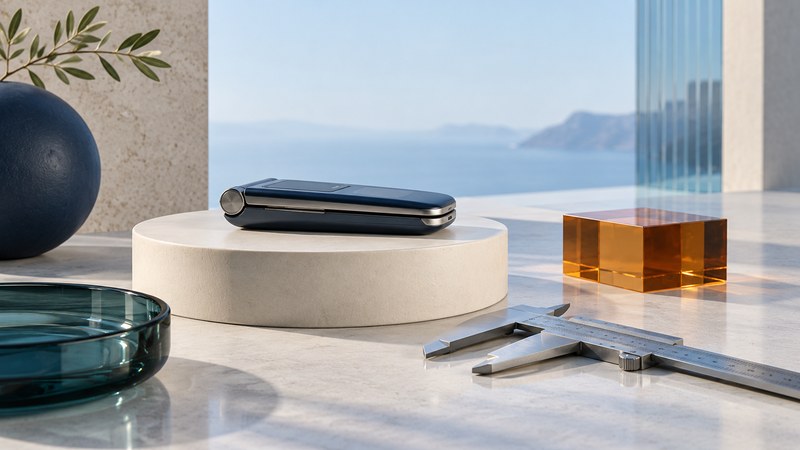
Hop-on's The Blade appeared in January 2005 publicity as a slim clamshell combining a camera, color display, messaging, and games. It offers a useful case study in reading a product announcement: a feature list tells you what was being promoted, while dimensions, shipping records, and repeatable tests establish different facts.
The Blade's announced design
The January 6, 2005 announcement described a GSM/GPRS clamshell for the 900 and 1800 MHz bands, a 1.3-megapixel camera, a color TFT display, MMS, a WAP browser, Java games, and polyphonic ringtones. Its emphasis was on fitting an attractive collection of functions into a small phone.
These are historical promotional claims. This guide has not established a matching production manual, measured body thickness, verified shipping history, or controlled battery test for The Blade. Preserve those uncertainties when describing the model. A later phone with a similar name or another Hop-on model's specifications cannot fill those gaps reliably.
The most interesting question is therefore specific: what would let a reader move from an appealing design description to a defensible statement about the actual hardware?
Match each claim with the evidence it needs
| Claim | Evidence that would help establish it | Limit of the announcement |
|---|---|---|
| Thin body | Dimensions for the exact revision, including the closed state and measurement locations. | An adjective supplies no comparable thickness value. |
| Camera capability | A matching manual and original sample files with dimensions and settings. | A megapixel figure leaves image quality and video behavior unresolved. |
| Long battery life | Battery identification, workload, radio conditions, and timed results. | A general endurance phrase supplies no test conditions or result. |
| Commercial availability | Dated sales or shipment records tied to a clearly identified product. | A launch statement alone leaves delivery unconfirmed. |
| Network operation | Model-specific radio documentation and evidence for the relevant operator and service. | A band list leaves provisioning and service availability unresolved. |
Each record has a scope. A photograph can establish appearance. A manual documents intended operation. An invoice can establish a transaction. A test can establish observed behavior under stated conditions. Strong historical work connects those records through a model identifier and date.
Turn “thin” into a reproducible comparison
For a clamshell, start with the closed phone. Record whether the measurement includes the hinge, raised camera area, battery cover, and any fitted accessory. Measure comparable locations and state the units. A photograph taken at a shallow angle can communicate style while concealing the thickest part.
Fictional example: the comparison changes at the hinge
Suppose Phone A measures 14 mm across its main closed body and 17 mm at the hinge. Phone B measures 15 mm across its body and 16 mm at its thickest point. A comparison of body thickness favors A by 1 mm; a comparison of maximum thickness favors B by 1 mm. These invented numbers illustrate a measurement convention and are not Blade specifications.
For an object in a collection, keep a side-view photograph with the measurement notes and identify the instrument used. Record sensible precision: a display with extra decimal places does not by itself establish accuracy. If only a brochure survives, label its dimensions as manufacturer figures and retain its stated measurement convention.
Battery endurance needs the same discipline. A useful result identifies what the phone was doing throughout the test. Standby, calls, picture capture, and screen use represent different workloads. An old battery's present behavior also belongs to that particular battery and condition.
Research the model before filling in missing specifications
Look first for the exact product name, company, date, and any model or regulatory identifier on the device or packaging. Use that identity to evaluate a candidate manual. Shared styling, an identical marketing phrase, or a matching name is weaker evidence than matching identifiers and documented hardware.
Hop-on's current newsroom points readers toward company news and disclosures. It is a starting place for further company research, not evidence that a particular 2005 handset shipped. Keep an announcement, a production record, and a later recollection labeled separately.
If stronger Blade documentation emerges, the useful additions are concrete: the matching model identity, dated availability evidence, measured dimensions, and supported functions. Until then, the announcement is best understood as a record of a proposed design and its marketing claims.
For choosing a phone today, continue with slim phones: size, grip, endurance, and usability. For interpreting period web and application features, see WAP 2.0 and Java-enabled phones, or return to the Telephone guides.