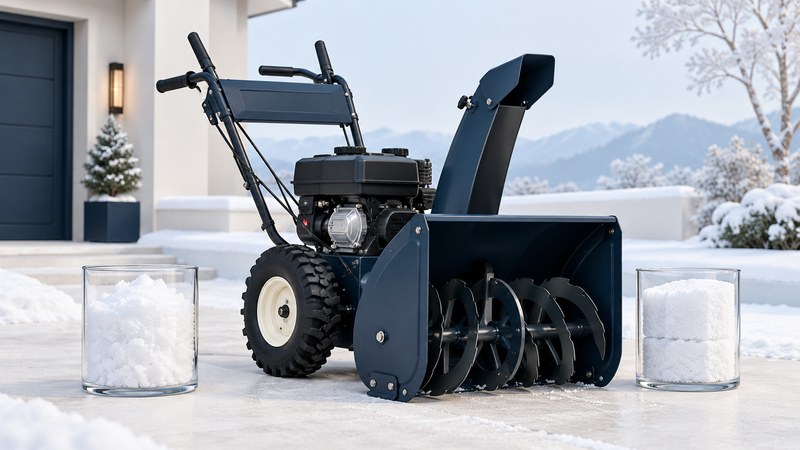
Choose a snow blower around the area you must clear and the hardest part of the job: wet accumulation, an end-of-driveway plow berm, a tight turn or a gravel surface. Record those constraints before comparing specifications. The names “blower” and “thrower” overlap; the mechanism and model instructions tell you what the machine can do.
Describe your actual clearing job
Measure the driveway and walks, the narrowest passage and the storage doorway. Note slope, surface material, steps and places with little room to turn. Identify where discharged snow can land without reaching people, traffic, windows or neighboring property.
Describe typical snow and the difficult exceptions separately. A powdery fall and a compacted roadside berm present different loads even at the same depth. Use local experience and ask a dealer how a candidate handles the difficult section. Advertised maximum throw distance is a specification to investigate, not a promise for every storm.
Use the downloadable equipment-comparison worksheet to record a shortlist with the exact model, manual and unresolved questions. It includes an option to compare arranging a clearing service.
Understand stages and surface compatibility
In a conventional single-stage machine, a rotating auger or paddle collects and discharges the snow. A two-stage machine uses an auger to feed a separate impeller. Designs vary, including models marketed with additional stages or hybrid features. Toro’s snow-blower range illustrates why stage and power source should be checked separately.
| Criterion | What to establish | Why it matters |
|---|---|---|
| Surface | Does the exact manual permit your paving or gravel, and what clearance adjustment is required? | Many surface-contact single-stage designs are intended for paved areas. A stage label alone does not authorize gravel use. |
| Handling | Can you turn, reverse and store it comfortably? Is traction powered? | A large intake may save passes while making a narrow route awkward. |
| Controls | Can you reach drive, discharge and stop controls wearing gloves? | Try the controls with the machine safely off and a dealer present. |
| Support | Who supplies parts and service for this model? | Wear parts, batteries and repair access affect long-term usefulness. |
Ask for a manual-supported answer about slopes and rough ground. Snow can conceal stones and objects that become projectiles; surface compatibility belongs near the top of the shortlist.
Compare power sources as complete systems
- Battery: compare the included packs, compatible chargers, charging location, manufacturer temperature limits and how a second clearing session would work. Runtime varies with snow and load; compare the stated test conditions.
- Corded electric: check permitted outdoor extension-cord type and length, electrical protection and a route that keeps the cord clear of the machine. Confirm that the farthest part of the job is within the manual’s limits.
- Gasoline: plan fuel handling, engine maintenance and appropriate storage. Electric start on a gasoline machine describes its starting system, not its source of operating power.
The CPSC snow-thrower safety alert warns against engine operation in enclosed spaces and refueling a hot or running engine. A garage is a storage location, not an indoor place to run a combustion engine.
Turn the shortlist into a decision
Record the model number, included equipment, delivery setup, warranty terms and service contact before ordering. Avoid paying for capabilities your property cannot use. If handling, exertion or storage remains a problem, include professional clearing in the comparison.
After choosing equipment, use the snow-thrower operation and seasonal-care guide to build a checklist from its manual. This selection guide deliberately avoids current prices and model rankings that would quickly age.
Sources checked October 11, 2026. Use current local information and the instructions for your actual equipment when planning an activity.