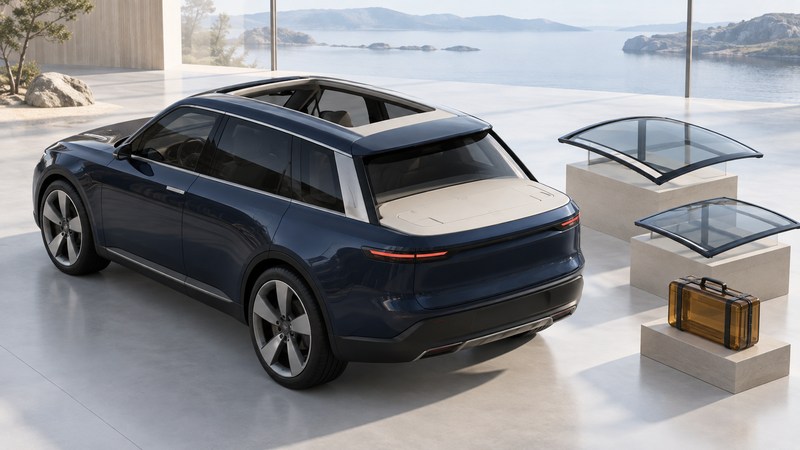
Saab 9X asked whether one compact sports-car shape could serve four different roles. Its useful design question is what must move, fold or be stored each time the role changes. Read the coupe, roadster, wagon and pickup ideas as configurations to examine, with separate questions about passenger space, roof storage and usable cargo room.
The 2001 9X, not a later similarly named concept
A September 19, 2001 Haldex announcement identifies Saab 9X as the concept presented at Frankfurt and confirms Haldex’s all-wheel-drive involvement. The 2001 Tokyo Motor Show listing provides a contemporary four-seat description. Those records place the design before Yenra’s original March 2002 report of a later appearance.
Saab’s 2011 Brand and Range brochure (PDF, history spread) lists the 2001 9X separately from the 2008 9-X BioHybrid and 9-X Air. Include the year and full name when searching an archive. A similar badge or shared design theme is not enough to transfer a later concept’s technology to the earlier one.
Follow the roof, seats and load floor
The 2001 Saab Automobile brochure (PDF, pages 6 and 9; third-party scan) describes detachable glass roof panels, storage behind the rear seats, folding seating and an extending rear load arrangement. Its four-role proposal can be read as follows. The questions in the final column are Yenra’s interpretation, not published test findings.
| Role | Configuration described by Saab | Question to investigate |
|---|---|---|
| Coupe | Enclosed four-seat sports-car layout | How much passenger and luggage space remains with every seat occupied? |
| Roadster | Open roof, with removable panels stowed behind the rear seats | Can the panels be handled and secured easily, and what storage do they occupy? |
| Wagon | Rear seats folded for more enclosed load space | Which items fit through the opening as well as within the compartment? |
| Pickup | Extended rear floor and lowered tailgate | What load is supported, how is it secured, and what is exposed to weather? |
Configuration matters more than a single maximum dimension. A long load path obtained by folding a passenger seat describes a different journey from one with four people aboard. Similarly, an open roof is a change to the vehicle’s use, while the removed panels remain physical objects that need somewhere to go.
Projected performance is not a road-test result
The brochure specifies a turbocharged 3.0-liter V6 and four-wheel drive, but labels its 300 bhp output, 1,330 kg kerb weight and 5.9-second 0–100 km/h figure projected. Preserve that qualification if repeating those numbers. The Tokyo listing supplies dimensions of 4,156 × 1,820 × 1,365 mm; these describe the concept’s external size, not its capacity in every mode.
A brochure is primary evidence of what the manufacturer presented. It does not independently demonstrate acceleration, payload, weather sealing or repeated conversion reliability. It also does not, on its own, establish that every proposed roof movement was implemented in the exhibited car. To make a stronger claim, seek a dated demonstration or technical account describing the exact mechanism and configuration.
Compare two trips instead of four labels
A configuration exercise
Imagine two adults taking a weekend trip with the roof open. Make a list of the roof pieces, their storage positions and both occupants’ luggage. Then imagine carrying a long boxed item with the roof closed. Record which seats would have to fold and whether the box could pass through the opening. These are hypothetical planning exercises; without measured clearances and load limits, neither is a verified capability of the show car.
For each scenario, sketch the occupied seats, the load path and every removed part. Put a question mark where the source is silent. This makes conflicts visible: storage assigned to a roof panel cannot automatically be counted again as free luggage space. A dimension measured along the floor also does not describe the height or narrowest part of the opening.
The useful comparison is how much reconfiguration a particular task demands. List the actions in order, the place needed to perform them and the evidence that each action is possible. That produces a clearer design discussion than ranking the concept as a better wagon or pickup without a defined use.
Use original imagery with a precise caption
Begin with the brochure’s photographs and diagrams, retaining the document’s 2001 date. The Saab Car Museum concept-car media archive is another place to look for identified imagery. The museum’s archive is not evidence that the car is currently on public display; confirm display arrangements separately before planning a visit.
A sound caption identifies the concept and year, names the visible configuration and distinguishes an illustration from a photograph. Claims about influence on later production cars require a source connecting those designs. The broader automotive design guide provides a method for keeping intent, physical evidence and engineering questions distinct.
Save your design notes
Download the Saab 9X configuration record (plain text). Use one record per imagined trip to account for seats, roof components, cargo and the evidence behind each proposed change.