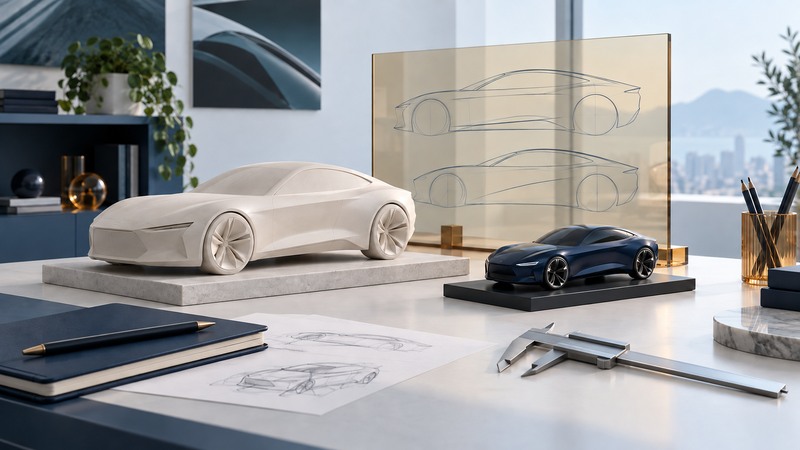
Read a concept car as a proposal about how a vehicle could be used. Start with its intended occupants and task, then ask what the available evidence demonstrates. A rendering, a full-size model, a running prototype and a production vehicle let you answer different questions.
Recover the problem the design is solving
Write a one-sentence brief using the designer’s original description where available: who uses the vehicle, where, and for what purpose. Then separate stated requirements from your interpretation. A compact urban commuter, a touring car and a delivery vehicle should not be judged against the same packaging priorities.
Gather the original release, drawings, dimensions and photographs, noting their date and whether they show the same revision. Identify the evidence type beside each item. A dramatic image may omit mirrors, door structure or ordinary cargo because it is showing an idea rather than documenting a finished package.
BMW’s 2009 account of its design process describes work through sketches, virtual renderings and clay models, followed by interaction between design and series development. It is a historical manufacturer example of several representations being used together, not a universal timetable for every studio.
Read the spaces inside the shape
Find the wheelbase, overall dimensions, seating layout and location of major components when documented. Ask how people enter, sit, see out and leave. Trace the luggage or cargo path from the opening to the usable space. Where no dimension is provided, record a question rather than measuring from a perspective image as though it were a scale drawing.
On a narrow screen, scroll the table horizontally. Keyboard users can focus its region and use the arrow keys.
| Design choice | Question to investigate | Useful evidence |
|---|---|---|
| Low roof or high beltline | How are headroom, sight lines and entry affected? | Sections, seating reference positions and physical trials |
| Unusual door | Where does it move, and what clearance does it need? | Mechanism drawings and a working demonstration |
| Large wheels or short overhangs | Where do suspension travel and occupants fit? | Package drawings and component envelopes |
| Transparent or novel body material | What supports the claimed function and durability? | Material details, joints and relevant test evidence |
| Smooth exterior | What happens with cooling, sensors and production equipment? | Documented aerodynamic and thermal evaluation |
Use these questions to expose tradeoffs rather than award points for appearance. A feature may serve one user well while imposing costs elsewhere. The task is to identify which compromise the designer chose and whether the evidence explains it.
Separate claims from demonstrated properties
For an aerodynamic claim, seek the measured quantity, configuration and test method. For a material claim, ask which part uses the material and what load or exposure it must withstand. For a range or performance claim, distinguish a target from a result obtained by a running vehicle under stated conditions.
Production brings additional questions: repeatable manufacturing, assembly, inspection, sealing, repair access and replacement parts. These can change the final form without making the earlier concept meaningless. They reveal how an idea develops when more constraints are included.
Avoid treating a clean drawing as evidence of crash performance, homologation or durability. Those conclusions require the appropriate engineering and regulatory evidence for the actual design. A concept analysis can remain useful while openly leaving such questions unanswered.
Work through one visible tradeoff
Next, consider alternatives that preserve the brief: a different seat position, roof profile or cargo arrangement. Describe what each alternative would need to demonstrate. This is a design discussion grounded in the task, rather than a list of features you personally prefer.
Keep a short evidence table: claim, source, representation, demonstrated result and open question. When later photographs or a prototype appear, update the affected entries instead of rewriting the entire judgment from memory.
Write a fair interpretation
Finish with three connected observations: the problem the concept addresses, the most persuasive design decision, and the largest unresolved constraint. Label your interpretation as such and link to the original evidence. Preserve historical dates when explaining a past concept’s ambitions.
If a production car is later associated with the concept, compare documented features and statements before claiming influence. Similar shapes alone cannot establish the development history. A well-supported interpretation can explain what an idea contributed even when it never became a saleable vehicle.
Save a practical worksheet
Download the automotive design worksheet (plain text). Open it in any text editor, save a private copy, and fill in the prompts while you work. It includes the article link and supporting references. Record “unknown” when a question still needs evidence.