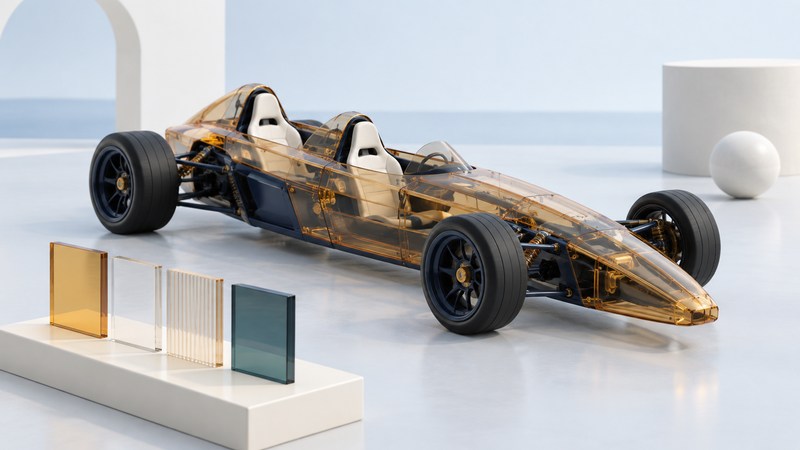
Rinspeed’s eXasis is a useful case study in separating a striking material demonstration from a complete engineering or environmental assessment. Its transparent body invites you to look through the car, but appearance alone cannot tell you how every component carries load, ages or performs in service. Read the project through clearly identified evidence.
What was being demonstrated in 2007
Rinspeed’s eXasis project archive describes the Geneva 2007 concept, developed with Bayer MaterialScience and built by Esoro. The body and floor used transparent Makrolon polycarbonate. Calling it a “glass car” describes the visual impression, not the material. The archive includes original photographs and contemporary project information.
Transparency changes what a designer can reveal: occupants, supporting structure and otherwise hidden relationships become part of the visible composition. That creates questions about optical quality, surface finish, cleaning, weathering and repair as well as weight. Those questions are an interpretation framework; they are not claims that the prototype passed a particular durability program.
Read the technical sheet with its qualifiers
The manufacturer’s eXasis technical sheet (PDF) distinguishes an aluminum chassis from a plastic body. It lists a 750 cc two-cylinder turbocharged engine, rear-wheel drive and a six-speed sequential manual gearbox. Empty weight is stated as approximately 750 kg. The published specifications identify the manufacturer’s description of the prototype; the sheet does not provide a full independent test report.
Scroll horizontally on a narrow screen. Keyboard users can focus the table region and use the arrow keys.
| Record | Supported statement | Further evidence needed |
|---|---|---|
| Material description | Transparent polycarbonate was used for the body and floor | Material grades, coatings, component tests and service-life evidence for broader claims. |
| Technical sheet | The maker states approximate weight and performance figures | Test configuration, measurement method and independent results. |
| Project photographs | Visible form, tandem seating and component presentation | Hidden structure, exact dimensions or compliance inferred from appearance. |
| Fuel description | The project discusses ethanol fuel | Fuel composition, consumption test and lifecycle boundaries for emissions comparisons. |
Do not merge inconsistent figures into a more precise-looking specification. For example, the old Yenra article used a rounded pound figure while the manufacturer sheet says approximately 750 kg. The latter converts to about 1,650 lb, still approximately; conversion does not improve the precision of the original estimate.
Separate the jobs of the materials
A transparent surface, a load-bearing chassis and a soft contact surface answer different design needs. The Rinspeed archive describes transparent seat elements and soft polyurethane gel at occupant-contact areas. Read each material in relation to its component: what must it transmit, support, resist or feel like? The presence of plastic bodywork does not mean that every structural part is plastic.
A useful comparison with glass would need a defined component, thickness, geometry, coating and test method. Without those, statements such as “lighter” or “stronger” leave the comparison incomplete. A concept can demonstrate an attractive application without establishing that the same substitution works in every production vehicle.
Give environmental claims a boundary
The original promotion connected ethanol with very low carbon emissions. The U.S. Department of Energy’s ethanol-emissions explanation distinguishes lifecycle greenhouse-gas analysis from tailpipe effects. Feedstock, production and other parts of the fuel pathway matter. A fuel name alone does not establish that a particular vehicle is carbon-neutral.
The DOE’s E85 guidance also explains that ethanol content varies and that the blend contains less energy per gallon than gasoline. A volume-consumption comparison therefore needs the actual fuel and test conditions. For eXasis, a robust environmental comparison would specify fuel pathway, driving cycle, vehicle configuration and whether vehicle manufacture is included.
Write a fair conclusion about the concept
Use three columns in your notes: demonstrated or documented feature, manufacturer-stated figure, and unresolved question. Add the exact source and its date. That makes it possible to appreciate the design without turning every launch claim into an established outcome.
The enduring interest of eXasis is the way it exposes materials and packaging as part of the car’s visual identity. Its documentary record supports a focused design and materials discussion. Production suitability, long-term durability and lifecycle superiority need additional evidence beyond the original reveal.
Save a working record
Download the working record (plain text). Open it in a text editor and save a private copy. Fill in the prompts, write “unknown” where evidence is missing, and attach the documents behind each conclusion. It includes this article’s address and source links.