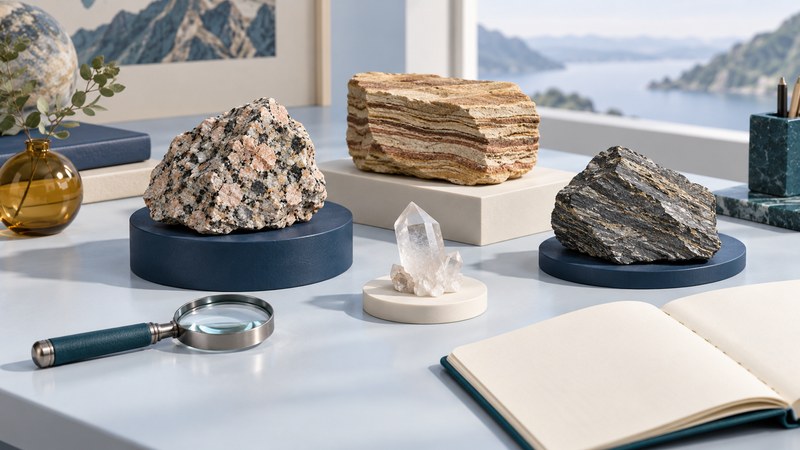
A rock becomes more interesting when you can describe what is in it, how its grains fit together, and where it was found. Those observations connect a small specimen to a much larger story: cooling magma, moving water, burial, deformation, or the recycling of Earth's crust.
Start with a description you can defend. A notebook, photographs and careful looking often tell you more than a quick match to a colorful picture. This guide introduces the building blocks, the main rock families, and a repeatable way to examine an unfamiliar specimen.
Rock, mineral, and crystal
A mineral is a naturally occurring inorganic substance with an ordered atomic structure and a characteristic chemical composition. A rock is a natural aggregate of minerals or other mineral matter. Quartz is a mineral; a piece of granite is a rock containing several minerals. Some rocks consist mainly of one mineral. These distinctions follow the USGS explanation of rocks and minerals.
A crystal describes ordered internal structure. A mineral grain squeezed between neighboring grains can be crystalline even when it lacks the tidy external faces of a display specimen. “Crystal” therefore tells you something different from a rock's name or its geological origin.
- Quartz: a mineral that can occur as an individual crystal or as grains within many rocks.
- Calcite and limestone: calcite is a mineral; limestone is a sedimentary rock commonly composed largely of calcite.
- Granite: a rock whose mineral ingredients and their proportions help define its name.
Three rock families, many possible journeys
On a small screen, scroll the table sideways. Keyboard users can focus it and use the arrow keys.
| Family | How it forms | Examples and clues |
|---|---|---|
| Igneous | Molten material cools and solidifies. | Granite may show interlocking visible crystals; basalt is commonly much finer grained. Cooling history and composition both matter. |
| Sedimentary | Sediment accumulates and becomes rock, or dissolved material precipitates; biological remains can contribute. | Sandstone may show sand-sized grains; limestone may contain shell fragments. Bedding can record successive deposits. |
| Metamorphic | Existing rock changes through heat, pressure and fluids while remaining largely solid. | Schist may show aligned mica; marble records recrystallization of carbonate rock. Some metamorphic rocks have little obvious banding. |
Use these clues together. A striped surface by itself leaves several possibilities: deposited layers, aligned minerals, veins, or weathering. The National Park Service rock guide links the three families to their formation processes.
The rock cycle describes connections, with several routes available. An igneous rock can weather into sediment or undergo metamorphism. A metamorphic rock can be exposed and eroded, or melt and later crystallize. Each specimen records the processes it actually experienced; it need not have visited every stage.
A useful first look: record before naming
- Write down the context. Record the date, locality and whether the material is attached to an outcrop, loose on a beach, in a stream, or part of imported landscaping. A loose pebble may have traveled far from its source.
- Photograph the whole object and its surroundings. Add a ruler or another stated scale. Take several sharp views in ordinary light, including a close view of an existing clean surface. Keep the same specimen identifier in the photo filenames and notes.
- Describe grain size and arrangement. Can you see separate grains? Are they interlocking, rounded, aligned, or too small to distinguish? Record approximate grain sizes in millimeters where possible.
- Separate the visible components. Note pale, dark, glassy or flaky grains without forcing a mineral name. Describe any holes, veins, fossils, layers or bands.
- Compare evidence with a reference. Check a regional geological map and its legend alongside a rock guide. Use the map as context: transported material and small features may differ from the mapped bedrock.
- Keep the uncertainty visible. Write a broad description first, a candidate name second, and the observation that would most help to test it.
The USGS guide to studying a rock collection explains the value of labels and geological maps. Its older shopping and collecting details should be checked against current local information. A useful record can describe a photographed rock left in place just as well as a legally collected specimen.
What mineral properties can tell you
Observe individual grains when possible: a mixed rock can give different results at different points. The NPS mineral reference explains the standard physical properties.
On a small screen, scroll the table sideways. Keyboard users can focus it and use the arrow keys.
| Property | Meaning | Useful limit |
|---|---|---|
| Luster | How a surface reflects light: glassy, metallic, pearly or dull. | Weathering can mask the original appearance. |
| Hardness | Resistance to scratching. | It is different from resistance to breaking; a scratch test also marks the specimen. |
| Cleavage | Repeated breaking along particular planes in a mineral. | Look for repeated flat surfaces and their relationships. |
| Fracture | Breakage away from cleavage planes, such as uneven or curved surfaces. | A single broken face may be ambiguous. |
| Streak | The color of a mineral in powdered form. | Producing a streak removes material; use an appropriate known specimen and method. |
Begin with observation of existing surfaces. Save destructive tests for situations where the specimen, permission and method are understood. Color is useful in combination with other features: several minerals share a color, and one mineral can occur in several colors.
Worked example: from a speckled rock to a useful question
That progression is useful even before an exact identification. It turns “a gray stone” into a description someone else can evaluate. The tonalite guide below follows the mineral-proportion question through a worked example.
Keep a record, leave a place intact, and ask a focused question
Photographing a specimen in place preserves its setting. Before removing or testing material, check the landowner's permission and the site's current rules. National Park Service units generally prohibit recreational collecting, with specific exceptions described in the NPS collecting guidance. Other land managers have their own rules.
Download the rock observation notes (plain text). Save a copy for each specimen or observation site. It includes fields for photographs, measurements, context, a candidate identification and the evidence still needed.
When asking for help, send the location or geological setting, scale, several photographs and your actual observations. Say whether the object is loose or attached to bedrock. A regional geological survey, museum or geology group may offer identification resources; check its current submission arrangements first. Keep precise locations of sensitive or private sites out of public posts.
Explore a rock, then explore the evidence beneath it
These two guides develop different questions. Tonalite examines how mineral ingredients define a rock. The interior guide follows what rocks can reveal about places far below the surface.
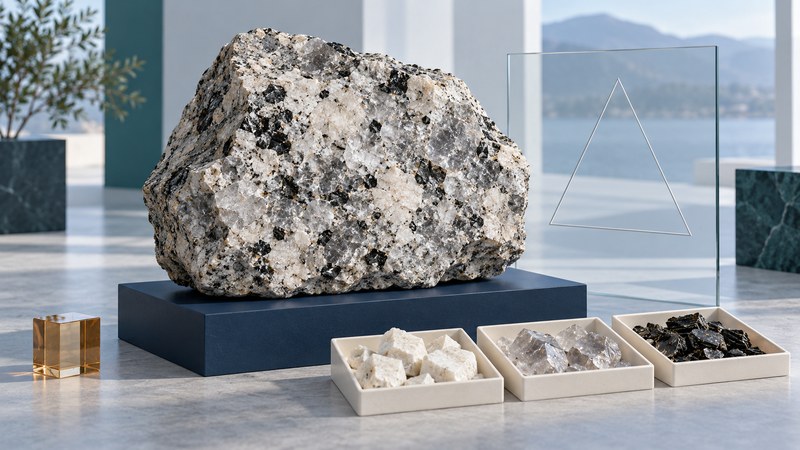
Tonalite: Composition, Formation, and Comparison with Granite
Understand the role of quartz and feldspar, compare related intrusive rocks, and follow a calculated classification example.

What Rocks Reveal About Earth's Interior
Connect surface samples, seismic waves and isotope measurements while separating observations from geological interpretations.
Questions that come up while looking
Can a photograph establish an exact rock name?
A good photograph can support a broad description and reveal distinctive features. Closely related rocks may require mineral proportions, microscopy or other analysis. Record what the image establishes and what additional evidence would resolve the remaining candidates.
Why does the outside look different from the inside?
Weathering can alter minerals and stain or soften surfaces. Compare existing exposed surfaces and describe their condition. A weathered exterior may hide the texture that a reference photograph shows.
Does an unusual appearance mean a rock is rare or valuable?
Appearance starts an identification question. Rarity, provenance and value require separate evidence. Keep those claims apart in your notes.