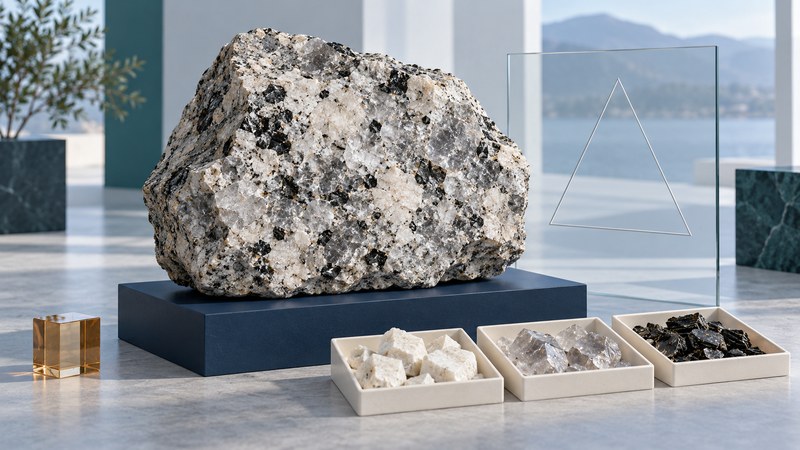
Tonalite is a coarse-grained igneous rock rich in quartz and plagioclase feldspar, with relatively little alkali feldspar. It belongs to the broad family of granitic rocks. The name describes a mineral mixture; recognizing that mixture is more useful than looking for one particular shade of gray.
Use this guide to understand the composition, compare nearby rock names, and decide what a hand specimen can establish. For basic terms and an observation record, start with the rocks and minerals guide.
The minerals behind the name
The British Geological Survey definition of tonalite places it among coarse-grained intrusive rocks classified by mineral proportions. Quartz and the balance between the two feldspar groups provide the key distinctions. Dark minerals contribute to texture and appearance.
- Quartz commonly appears as glassy gray or translucent grains between neighboring crystals.
- Plagioclase feldspar is the dominant feldspar group in tonalite. Pale blocky grains are a useful place to start looking, although color alone is insufficient.
- Alkali feldspar occurs in a much smaller proportion than plagioclase. Distinguishing feldspars may require a thin section and microscope.
- Biotite and amphibole can contribute dark flakes or prismatic grains. Their amounts vary; an equal biotite-to-hornblende ratio is not a naming requirement.
The NPS illustrated mineral reference provides examples of quartz, feldspars, mica and amphibole. Use it to learn the components before trying to estimate their proportions.
From magma to a visible crystalline texture
Tonalite crystallizes from magma below the surface. Cooling in an intrusive body gives mineral grains time to grow; later uplift and erosion can expose the rock. The USGS explanation of igneous rock classification connects intrusive texture with mineral composition.
Texture and composition answer different questions. Visible interlocking grains help describe crystallization, while the mineral mixture determines the compositional name. Grain size alone cannot supply an exact cooling time, depth or age. Those interpretations require further geological evidence.
Inspect relationships as well as ingredients. A vein cutting the main rock records a different event from the growth of the surrounding grains. Aligned minerals may record movement during crystallization or later deformation; the surrounding outcrop helps distinguish those histories. Keep a description of the feature separate from your proposed explanation.
Tonalite, granodiorite, granite, and quartz diorite
For these quartz-bearing rocks, geologists compare the volume proportions of Q (quartz), A (alkali feldspar) and P (plagioclase). These are part of the QAPF classification; F denotes feldspathoids in other compositional fields. The comparison below concerns rocks with measurable mineral modes, not a chemical-analysis shortcut.
On a small screen, scroll the table sideways. Keyboard users can focus it and use the arrow keys.
| Rock | Quartz within Q + A + P | Feldspar balance |
|---|---|---|
| Tonalite | 20–60% | More than 90% of the feldspar is plagioclase. |
| Granodiorite | 20–60% | Plagioclase forms about 65–90% of the feldspar. |
| Granite (field 3) | 20–60% | Alkali feldspar forms about 35–90% of the feldspar. |
| Quartz diorite | 5–20% | Plagioclase strongly dominates; plagioclase composition and dark-mineral content also distinguish it from quartz gabbro and quartz anorthosite. |
Sources: BGS entries for granodiorite, granite, and quartz diorite. Boundary values mark adjoining classification fields; near a boundary, measurement uncertainty deserves explicit attention. Alkali-feldspar granite has its own neighboring field.
Notice the two denominators: the quartz percentage uses Q + A + P, while the feldspar balance uses A + P alone. Dark minerals remain part of the rock but are excluded from these normalized ratios. Applying the thresholds to the whole rock would answer a different question.
Worked example: calculate before choosing a name
If the same total feldspar were instead split into 50% plagioclase and 18% alkali feldspar, plagioclase would be 73.5% of the feldspar. With quartz unchanged, that example would fall in the granodiorite field. The change in name comes from the measured composition, even if the two specimens look broadly similar.
A photograph does not automatically provide such an analysis. Lighting, grain overlap, alteration and the choice of surface all affect a visual estimate. A defensible classification reports the method and any uncertainty along with the result.
What to record from a hand specimen
- Record the locality and whether the specimen came from bedrock or loose material.
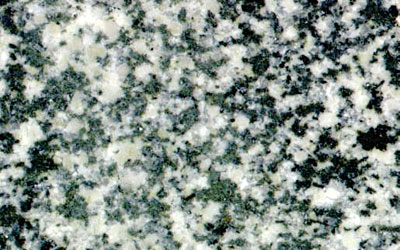
- Describe grain size, interlocking texture, visible quartz and feldspar, dark grains and weathering.
- Note evidence that could complicate the name: strong foliation, alteration, veins, or markedly different textures in one sample.
- Use a provisional name where appropriate, and identify what needs checking: usually mineral identity, representative proportions, or geological context.
BGS explicitly allows granitic rock as a field description when an accurate mineral mode is unavailable. That broad description can be the most useful result of an initial inspection.
For example: “Coarse-grained granitic rock with visible quartz, abundant pale feldspar and scattered dark grains; feldspar proportions unconfirmed.” It communicates evidence, leaves room for revision, and gives the next observer a specific question to resolve.
Continue with what rocks reveal about Earth's interior to see how measurements become geological interpretations at a much larger scale.