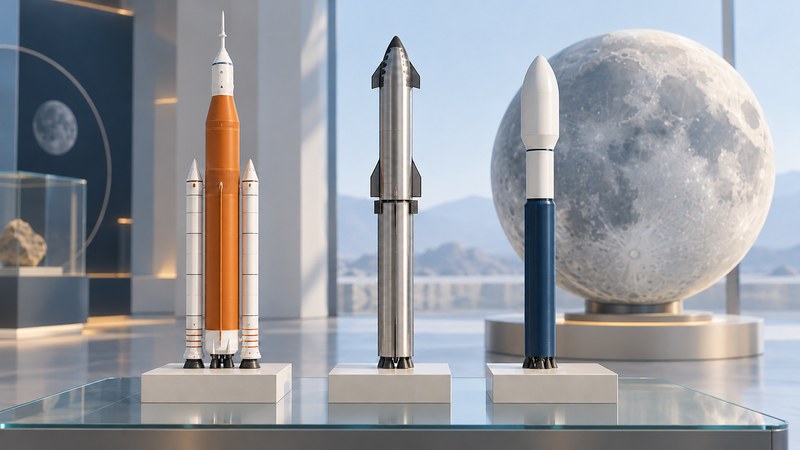
NASA’s next steps toward the Moon depend on several rockets doing different jobs. SLS launches astronauts in Orion. SpaceX’s Starship system and Blue Origin’s New Glenn support separately launched commercial landers. Understanding that division makes the mission plans much easier to follow.
Which rocket does what?
A launch vehicle supplies the thrust to leave Earth. A spacecraft operates after launch. A lunar lander handles descent to the Moon and, for a crewed expedition, the astronauts’ return to lunar orbit. One mission can use several launches and more than one kind of spacecraft.
On a narrow screen, scroll the table sideways. Keyboard users can focus the table region and use the arrow keys.
| Launch system | Organization and role | Spacecraft connection |
|---|---|---|
| Space Launch System (SLS) | NASA-led heavy-lift rocket built through industry contracts. | Launches Orion and its crew; Orion provides the crew’s flight home. |
| Starship / Super Heavy | SpaceX’s two-stage launch system and related spacecraft family. | Supports the Starship Human Landing System (HLS), including lander and propellant-delivery operations. |
| New Glenn | Blue Origin’s commercial heavy-lift launch vehicle. | Launches Blue Origin lunar hardware, including Blue Moon vehicles. |
NASA’s July 2026 Artemis III mission explanation describes a coordinated campaign involving NASA and both commercial lander providers. The rocket, its payload, and the particular test objective each need their own name when reading a launch announcement.
SLS carries the astronauts’ Orion spacecraft
SLS combines a liquid-propellant core stage with two solid rocket boosters. Four RS-25 engines burn liquid hydrogen and liquid oxygen in the core. The boosters provide additional thrust during the first part of ascent. NASA’s June 2026 SLS technical paper (PDF) reports the April 1 launch and April 10 return of Artemis II, establishing crewed flight experience for the SLS–Orion combination.
Orion sits above the rocket. Its crew module is the astronauts’ cabin; its European-built service module supplies propulsion and other support in space. NASA’s Artemis III configuration plan calls for a nonpropulsive spacer in place of the usual interim upper stage, because this mission stays in Earth orbit. Orion’s service module will circularize the orbit after separation.
Future lunar flights require a different mission configuration. The June SLS paper describes a transition toward ULA’s Centaur V upper stage. Treat its adaptation to SLS and its flight assignment as mission-specific development work. An upper stage’s role is to accelerate the payload after the lower stages finish; it is a component of the launch system.
For background on why hydrogen, methane, and kerosene lead to different vehicle designs, see the rocket-fuel comparison. Fuel choice makes more sense alongside tank size, engine performance, and the mission’s destination.
Starship connects launch, refueling, and lunar landing
SpaceX uses Super Heavy for the booster and Starship for the upper spacecraft. Starship HLS is the lunar-landing version being developed for NASA. The Raptor engine family uses liquid methane and liquid oxygen.
The lunar architecture includes flights that move propellant into Earth orbit before the lander travels onward. NASA’s March 2026 inspector-general report (PDF, printed pages 5–7) describes Starship tanker, storage-depot, and lander roles. Those supporting launches are part of the transportation campaign, even though the astronauts depart Earth separately in Orion.
The number of supporting flights depends on the vehicle version, delivered propellant, storage losses, and final mission plan. A useful progress report therefore identifies which capability was tested: launch, recovery, docking, propellant transfer, or lunar operations. Each supplies evidence for one part of the larger system.
Artemis III uses a Starship test article in Earth orbit. NASA’s July plan specifies docking tests with Orion and says astronauts will remain outside the Starship test article. A flight demonstrating those interfaces is a distinct milestone on the path to a crewed lunar lander.
New Glenn launches Blue Origin’s lunar hardware
New Glenn is the Earth-launch rocket; Blue Moon is the lunar-lander family. NASA’s New Glenn vehicle description from the 2025 ESCAPADE launch identifies a methane-fueled BE-4 first stage and a hydrogen-fueled BE-3U upper stage, both using oxygen as oxidizer. This is a useful reminder that a single rocket can use different fuels in different stages.
Blue Moon Mark 1 serves robotic cargo and technology demonstrations. Mark 2 is the crew-lander development line. For Artemis III, Blue Origin’s test article will exercise crew-cabin and spacecraft systems in Earth orbit; NASA’s July plan allows up to two astronauts to enter it. Read the model name and test configuration together.
NASA’s July 2026 New Glenn test-support agreement covers second-stage testing at Stennis Space Center and connects that work to upcoming lunar missions. It describes practical work on rocket readiness: test facilities, stage operation, and coordination between the agency and the company.
For the upcoming robotic flight, NASA’s Blue Moon Mark 1 schedule page currently lists January 2027 and a delivery to the lunar South Pole region. That schedule entry is the place to check before relying on a date from an earlier announcement.
Follow the next missions by their purpose
On a narrow screen, scroll the table sideways. Keyboard users can focus the table region and use the arrow keys.
| Mission | NASA planning target | What it is intended to establish |
|---|---|---|
| Blue Moon Mark 1 | January 2027 | Robotic delivery of science and technology, with landing demonstrations supporting later crewed exploration. |
| Artemis III | 2027 | Crewed Earth-orbit demonstrations involving Orion and commercial lander test articles. |
| Artemis IV | Early 2028 | First Artemis crewed lunar landing; provider selection depends on lander readiness. |
NASA’s July Artemis III sequence starts with Blue Origin’s test article, followed by SLS and Orion. SpaceX’s test article follows the Blue Origin docking phase. This lets teams practice coordinated launches and spacecraft operations close to Earth before attempting the lunar expedition.
For a landing mission, the crew and lander meet in lunar orbit, astronauts transfer to the lander for the surface journey, and they return to Orion for the trip home. Readiness spans that entire chain: reaching orbit, transferring crew, operating on the surface, ascending, and returning safely.
Robotic deliveries also support exploration between crewed flights. NASA’s Commercial Lunar Payload Services initiative purchases deliveries of science and technology payloads from commercial providers. Each delivery has its own lander, launch arrangement, and schedule; this selected list focuses on the systems central to the next crewed campaign.
What NASA is commissioning
NASA combines purchases of rocket hardware with commercial mission services. Its 2022 SLS production agreement with Boeing included core stages for Artemis III and IV. Commercial HLS contracts cover development and demonstration of lunar-landing capability. A contractor’s name can therefore refer to a stage manufacturer, a launch provider, or the company delivering the landing system.
Follow progress with four useful questions
Start with the NASA Artemis news feed, then open the dated mission or hardware update behind the headline. For each significant change, record:
- Which vehicle and version? Name the launch rocket, spacecraft, and lander separately.
- What happened? Separate a proposed target from hardware delivered, a completed test, or a flight result.
- What did it demonstrate? Identify the conditions and capability exercised.
- What still depends on it? Look for the next integration, qualification, or operational milestone.
The inspector general’s March 2026 review identified lander development and integration challenges. Use that dated assessment to understand the kinds of dependencies involved, and newer mission updates to track subsequent progress. Schedules become more informative when paired with evidence about the hardware and operations needed to meet them.