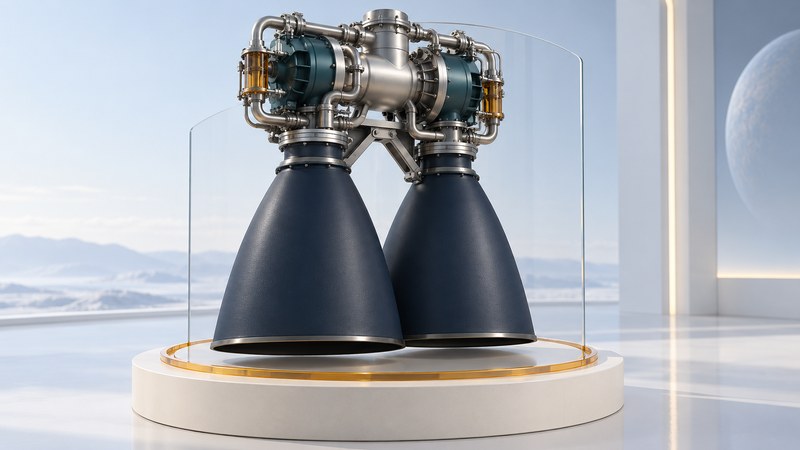
The RD-180 is one liquid rocket engine with two thrust chambers. Its defining feature is oxygen-rich staged combustion: hot gas that drives the turbine continues into the main chambers, where the remaining fuel burns.
One engine, two thrust chambers
ULA identifies the RD-180 as the liquid oxygen/kerosene main engine of the Atlas V booster, designed and manufactured by NPO Energomash. A shared turbopump assembly supplies its two chambers. Each chamber and nozzle produces thrust, while the machinery, controls, and supporting frame form a single propulsion unit. See ULA’s Atlas V reference and the Atlas V User’s Guide, Appendix A.
Three terms help keep the drawing straight. The preburner produces hot gas to power a turbine. The turbopump raises propellant pressure. The main combustion chambers release the energy that drives the exhaust through the two nozzles.
Follow the oxygen-rich cycle
- Pressurize the propellants. The pump system delivers fuel and oxygen at the pressures needed by the engine.
- Generate turbine-driving gas. In the RD-180, oxygen passes through a preburner with a smaller fuel flow. The resulting hot gas remains oxygen-rich.
- Drive the pumps. That gas turns the turbine connected to the pump machinery.
- Complete combustion. Turbine exhaust enters the main chambers and reacts with additional fuel. The expanding gases leave through the nozzles.
This is a conceptual steady-running sequence. Actual startup, shutdown, cooling, and control involve additional paths and timed events. ULA’s 2011 RD-180 technical paper explains the oxygen-rich cycle and the materials work needed to operate with hot, reactive oxygen-bearing gas.
“Closed cycle” describes the return of turbine exhaust to the main combustion process. It offers a way to use that flow in the main thrust-producing exhaust, while requiring the turbine discharge to remain at a pressure high enough to enter the chambers. This pressure requirement connects pump design, combustion, materials, and controls.
Read an engine specification carefully
On a narrow screen, scroll the table sideways. Keyboard users can focus the table region and use the arrow keys.
| Figure | What it tells you | What else to record |
|---|---|---|
| Thrust | Force produced at a stated operating condition. | Sea level or vacuum; throttle setting; one engine or the entire vehicle. |
| Specific impulse | Impulse per unit propellant weight under stated conditions. | Ambient pressure and operating point; compare like conditions. |
| Throttle range | The supported range of engine operation. | Which nominal level defines 100 percent and which flight phase uses it. |
| Chamber count | The number of main combustion chambers. | Shared pumps and controls determine how chambers form an engine. |
For orientation, ULA’s Atlas V page lists approximately 860,300 pounds-force at sea level for the RD-180. That is the engine total across both chambers. Multiplying it by two would double-count the chambers; adding solid-booster thrust requires the actual vehicle configuration and matching conditions.
NASA’s thrust and specific-impulse explanation shows where ambient pressure enters the thrust equation.
Place the engine within Atlas
The RD-180 powers the booster; Atlas V’s Centaur upper stage uses RL10 propulsion and a different propellant combination. Optional solid rocket boosters add another distinct source of thrust. When reading a launch description, identify the stage before attributing a fuel, engine count, or restart capability to the entire vehicle.
The RD-180 also flew on Atlas III. ULA’s 2011 paper dates its first Atlas flight to May 2000 and describes its relationship to the four-chamber RD-170 family. These are useful historical anchors; flight counts printed in that paper belong to its 2011 reporting date.
Separate production plans from production history
Technical-data transfers, component manufacture, complete engine manufacture, integration, and launch support are different activities. A proposal to establish a domestic manufacturing capability should be read as a proposal unless later evidence documents the completed capability.
ULA’s December 2015 RD-180 order announcement describes buying additional engines as a bridge toward a new American engine solution. The current vehicle reference continues to identify NPO Energomash as the RD-180 manufacturer. Those sources support a more precise history than carrying forward an early production forecast as an accomplished fact.
For changing launch-program status, follow the provider’s dated mission information. For the underlying science, keep three questions separate: what propellants the engine uses, how it routes the turbine gas, and how the complete stage meets its mission.