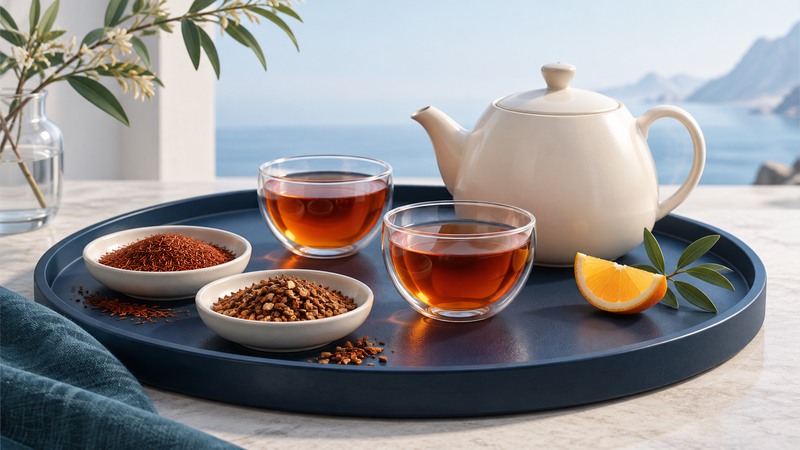
Rooibos and honeybush make flavorful herbal infusions that work hot or chilled. Start with a plain version of each, use the same water volume and record the amount and steep time. This makes it easier to choose the flavor you enjoy before adding vanilla, fruit, milk or sweetener.
Identify which red tea is in the package
Rooibos comes from Aspalathus linearis; honeybush comes from plants in the genus Cyclopia. They are South African herbal drinks, distinct from Camellia sinensis teas. “Red tea” can be used differently by sellers and in different tea traditions, so the ingredient name is more useful than color alone.
Plain rooibos and honeybush are caffeine-free. A laboratory investigation using targeted analytical methods examined that caffeine-free status. For a blend, check every ingredient: black or green tea, maté, guarana or added caffeine changes the question. “Rooibos blend” on the front does not describe every ingredient.
The South African Honeybush Tea Association describes honeybush as having a gently sweet character and explains that the name refers to the flowers' honey-like aroma. Honey flavor in a description does not mean actual honey has been added. The ingredient list settles that question.
Compare plain infusions first
On narrow screens, scroll the table sideways. Keyboard: focus the table and use the arrow keys.
| Choice | What to look for | First tasting approach |
|---|---|---|
| Plain rooibos | Rooibos as the sole ingredient | Taste for woody, nutty or rounded notes |
| Plain honeybush | Honeybush as the sole ingredient | Look for the sweet-aroma character you prefer |
| Green rooibos | The producer's processing and flavor description | Compare separately from conventional red rooibos |
| Flavored blend | Base herb, added flavors, spices and other tea | Taste plain before adding your own extras |
Flavor vocabulary is a way to describe your experience, not a promise that every batch tastes the same. Try small packages if you are learning your preferences. Keep dry tea closed, dry and away from strong smells, following package instructions.
Brew a measured hot cup
Use a heat-safe mug or pot, a fine infuser, a timer and a scale. These finely cut herbs can escape a coarse strainer. The following is an adjustable editorial starting point, not a kitchen-tested universal recipe; follow the product's instructions when they differ.
- Measure 2 g of plain rooibos or honeybush.
- Add 250 mL of freshly boiled water in a suitable heat-safe vessel.
- Steep 5 minutes, then strain completely.
- Allow the drink to cool to a comfortable sipping temperature and taste it plain.
- Record the result before adding anything.
For a documented producer example, Harney & Sons' Pure Wild Honeybush specifies 212°F water and a five-minute steep. Its instructions describe that product; your own package may suggest a different amount or time.
If the cup is weak, try 2.5 g next time while keeping water and time fixed. If it is stronger than you like, reduce the herb amount or add a measured splash of water. If particles bother you, improve filtration rather than interpreting sediment as a flavor defect.
Make an immediate iced serving
For an initial iced experiment, steep 4 g in 250 mL hot water using the product's brewing directions. Strain into a heat-safe measuring vessel, then add cold drinking water to reach 500 mL total. Divide between two glasses and add ice to taste. The concentrate begins at twice the hot-cup herb-to-water ratio; topping up restores the starting ratio before ice melts.
Taste before sweetening. If adding sugar, measure the amount and stir it into the warm infusion; that makes the next glass reproducible. For a cold milk addition, test a small portion first so you can decide whether it suits the herb's flavor. This method is for immediate serving; it supplies no claim about extended storage life.
Build a flavor comparison you can repeat
Try three small portions from one brew: plain, with a measured milk addition, and with a small amount of sweetener. Write which you prefer and why. On a later batch, try an orange slice or a spice separately. Changing one addition at a time makes the result easier to understand.
The tea brewing record has space for grams, milliliters, minutes and tasting notes. For a spiced milk-tea method, see chai latte. For organic ingredients and packaging, see organic tea. Choose these herbal drinks for a cup you enjoy; disease-treatment claims require their own human evidence.