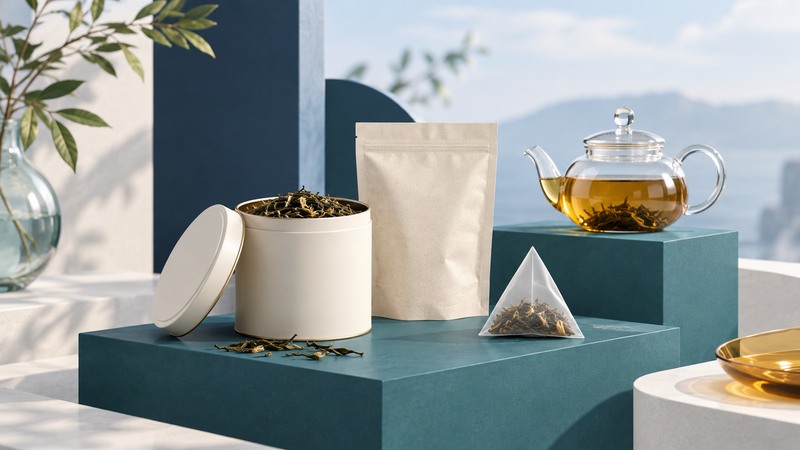
An organic tea purchase involves several separate choices: how the ingredients were produced, which tea or herbs are in the blend, how you will brew them and what to do with the packaging. Read each claim in its own context. A certification seal answers a production question; your ingredient list, tasting and local disposal instructions answer the others.
Read the U.S. organic wording
For packaged tea sold in the United States, the USDA's organic-labeling guide distinguishes three common categories. Water and salt are excluded from the organic-percentage calculation.
On narrow screens, scroll the table sideways. Keyboard: focus the table and use the arrow keys.
| Label category | Organic-content threshold | USDA organic seal |
|---|---|---|
| 100% organic | All ingredients organic, with applicable processing requirements | Permitted |
| Organic | At least 95%; remaining ingredients subject to restrictions | Permitted |
| Made with organic [named ingredients] | At least 70%; additional restrictions apply | Not permitted |
Look for the statement identifying the certifier and for organic ingredients marked in the ingredient list. “Made with organic” wording names specified ingredients or food groups; it is different from a product labeled simply “organic.” A green package or a botanical picture supplies no substitute for this information.
Use certification to assess the production claim it covers. Flavor, caffeine quantity and a clinical health benefit require their own information. For example, an organic Earl Grey can still be a caffeinated black-tea blend, while an organic rooibos infusion is a different plant preparation.
Identify what you will actually brew
Start with the ingredient list rather than the blend's evocative name. Identify the base: black, green, white or oolong tea, or an herbal infusion. Then note fruit pieces, spices, flavors and sweetening ingredients. If avoiding an ingredient matters to you, resolve ambiguous wording with the manufacturer before purchasing.
Compare like with like. A plain green tea, a vanilla rooibos and a white-tea chai differ in more than certification. Choose the drink style first, then compare organic options within it. The white-tea guide gives a measured tasting method; rooibos and honeybush explains the herbal choices.
Keep a small shopping note with four fields: base ingredient, other ingredients, organic wording and brewing directions. This prevents a prominent packaging claim from eclipsing the cup you actually want.
Choose loose leaves or bags for your routine
Loose leaves allow you to adjust the amount and use your own reusable strainer. Bags and sachets simplify portioning and cleanup. Judge the complete setup: whether leaves have room to expand, whether small particles escape, and whether you can remove the infusion at the desired time.
Compare cost by the portions you expect to brew. In a fictional price example, a 100 g pouch costing $12 provides 40 first infusions at 2.5 g each: $0.30 per cup. A $7.50 box of 20 bags costs $0.375, or about $0.38, per bag. These are arithmetic examples, not current prices or a quality ranking. Cup size, actual leaf dose and any enjoyable second infusions change the comparison.
For unfamiliar tea, a small trial package can answer a more useful question than the largest apparent discount: will you enjoy finishing it? Record the brewing method alongside your preference so a weak or oversteeped trial does not become a verdict on the entire tea.
Check the bag, wrapper and tin separately
The word “biodegradable” leaves important questions unanswered: which part, under what conditions and how long? A tea bag, string, tag, individual wrapper and outer package can need different disposal routes.
The FTC's environmental-claims guidance distinguishes compostability and recyclability claims and explains why qualifications about facilities matter. Ask whether a bag is intended for home or industrial composting, then check whether your local program accepts that exact material. Plant-derived plastic does not by itself establish a home-composting route. Follow the receiving program's instructions for wrappers and tins too.
Revolution Tea's 2005 organic range paired certified tea with pyramid-bag and reusable-tin claims. The enduring shopping lesson is to evaluate the tea and each packaging component separately using the package currently for sale.
Make a purchase you can evaluate
Choose a tea whose ingredients, certification wording and preparation instructions are clear. Brew a measured cup, record the result, and choose a disposal route supported by the packaging information and local service. For ready-to-drink products, the bottled-tea guide adds sugar, portion and storage comparisons.