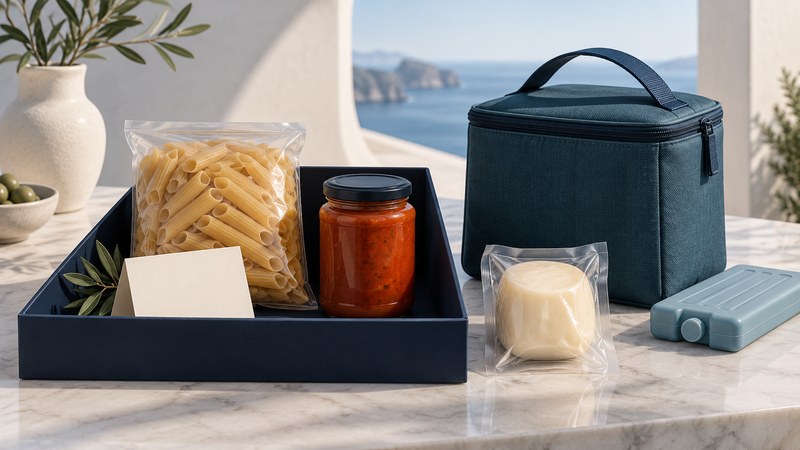
A useful cheese gift begins with the recipient’s next meal. Choose a provolone they will enjoy, pair it with a few foods they can use together, and arrange a handover that keeps cheese requiring refrigeration cold.
Ask four questions before shopping
- Do they prefer a mild slicing cheese or a stronger aged cheese?
- Are there milk allergies, other allergens or dietary requirements to accommodate?
- Will the gift become a snack, sandwiches or a cooked meal?
- When will they receive it, and will refrigeration be available immediately?
Check the actual ingredients of cheese, bread, crackers, sauces and accompaniments. For vegetarian requirements, look for a clear product statement or verified rennet information. For guests at increased risk of Listeria, use CDC’s safer food choices to choose suitable food. A known preference is more useful than a large basket selected only for appearance.
Choose one manageable gift
On a narrow screen, focus the table and use the arrow keys to scroll.
| Gift | Suggested contents | Intended use |
|---|---|---|
| Sandwich-and-snack gift | 150 g provolone, a small loaf or crackers, two whole apples, an unopened small jar of a preferred condiment | Four modest sandwiches at 25 g cheese each, plus 50 g for a shared snack |
| Cook-together gift | 200 g provolone, 250 g dried pasta, one unopened shelf-stable jar of tomato sauce, a complete recipe link | Select the recipe first; use its specified cheese quantity and plan the remainder |
These are shopping examples, not tested recipes or fixed meal sizes. The sandwich allocation totals 150 g: 4 × 25 g + 50 g. For the cooking gift, adjust the purchase to the recipe and appetites. Avoid implying that every item in a full-size pack must go into one dish.
Choose even slices for an easy sandwich gift or a manageable piece if the recipient prefers to cut their own. An aged provolone may be better as a smaller flavor accent. The provolone buying and melting guide helps select that role. Retain the maker’s wrapper and storage directions.
Separate presentation from refrigeration
- Keep cheese in its food-safe package and refrigerate it until departure.
- Arrange unopened pantry items in a reusable bowl or shallow box. Check that each is actually shelf-stable before opening.
- Transport cheese requiring refrigeration in an insulated container with enough frozen gel packs to maintain the required temperature. Check with a thermometer rather than estimating from the trip’s length.
- Give the chilled container directly to the recipient and point out what must go into the refrigerator.
FDA refrigerator guidance recommends 40°F (4°C) or below for refrigerated foods. Account for shopping, packing, travel and display time. FDA serving and time limits advises discarding perishables after more than two hours without temperature control, or one hour above 90°F. A decorative basket is not a temperature-controlled container.
Include a practical gift note
Copy and complete these details on a card: cheese name and producer; ingredients/allergen information attached; storage directions; date given; suggested first meal; recipe link; amount reserved for another use. Keep package dates legible. Tell the recipient which jar needs refrigeration after opening.
For a distant recipient, choose a seller that handles perishable shipping and coordinate the delivery date. USDA’s mail-order food guidance advises that refrigerated perishables arrive cold, with a cold source, and that the recipient check them promptly. It directs recipients not to consume or taste suspect warm arrivals and to contact the company. Follow the package’s requirements; vacuum sealing alone does not establish shelf stability.
If reliable chilled delivery or immediate receipt is unavailable, send the pantry items with a note inviting the recipient to choose cheese locally. For a gift meant to become a gathering, include the board planner and scale the quantities to that occasion.