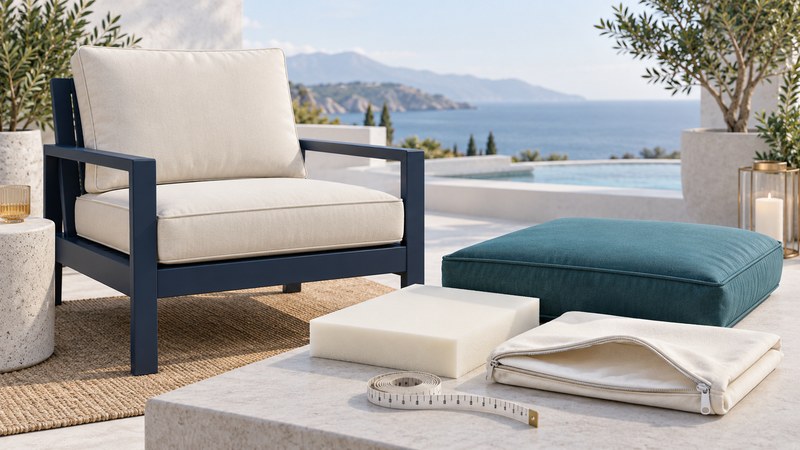
A replacement cushion needs to fit three things: the seat, the person using it, and the way it will be cared for. Begin with the furniture model and usable seat dimensions. Then choose the cover and filling together, with a realistic place to dry and store them.
Measure the furniture before ordering
Gather a tape measure, a phone for photographs, and the furniture label or receipt. Ask the manufacturer whether an original replacement exists. A model match is a useful starting point, especially for curved seats, attached cushions, and unusual backrests.
For a custom replacement, use the chosen supplier’s measuring method. Cushion Source’s measurement guides start from the furniture because old cushions can stretch and change shape; they also provide separate methods for deep seating, joined cushions, and chaises. A worn cushion is useful evidence of shape and attachment, but its dimensions may need correction.
- Record the usable seat. Measure inside the arms and between the front and rear boundaries. Record front and rear widths if the seat tapers. Note curves and obstructions.
- Record the back separately. Photograph how it meets the seat cushion. Establish whether the supplier measures the back from the frame or from the top of the seat cushion; that changes the required height.
- Specify thickness and attachment. Record the intended seat thickness, tie positions, zipper access, and any seat-to-back hinge. For a chaise, identify each bending section.
- Confirm the order drawing. Use one unit throughout and label width, depth, height, and thickness explicitly. Have the maker resolve unusual shapes and explain manufacturing tolerances before production.
Try the intended thickness with a suitable sample when possible. Check whether the resulting seat height, back support, and armrest position feel comfortable. A firmer or thicker replacement can change the sitting position even when its outline fits.
Choose what actually needs replacing
| Option | When to consider it | Confirm before ordering |
|---|---|---|
| Cover only | The filling is serviceable and the fabric is worn or a new color is wanted. | Finished shape, zipper opening, seam layout, and compatibility with the existing insert. |
| Insert only | The casing is sound but support or shape has deteriorated. | Specified filling, firmness, wrapping, dimensions, and whether removal is permitted. |
| Complete cushion | Both parts need replacement, or their compatibility is uncertain. | The assembled dimensions, attachment, care directions, and return terms. |
Ask how the complete cushion handles rain: the face fabric, seams, filling, and underside all belong in that answer. Request the manufacturer’s drying and storage instructions for that construction. A fabric brand name alone leaves the filling and assembly unspecified. Compare a fabric sample outdoors for color and feel, and save its exact code for future replacements.
Use the instructions for the complete cushion
Read the furniture label and fabric directions together. A zipper can provide manufacturing access without making the casing suitable for routine removal. If the label is missing, send the model, fabric code, and photographs to the supplier before machine washing or using a stronger cleaner.
Sunbrella’s upholstery instructions (PDF) distinguish removable and fixed fabric, call for thorough rinsing and air drying, and say to consult the furniture manufacturer before removing a casing. Apply that guidance to the covered Sunbrella application. Other fabrics, coatings, filling, and nearby frame finishes may need different treatment.
For a spill, identify what was spilled and follow the relevant stain instructions promptly. Protect adjacent materials, use the specified dilution and contact time, and follow cleaner labels. Keep a note of the product and method used so that a later treatment can be checked for compatibility.
Make drying part of the routine
Choose a sheltered place with airflow where the cushion can dry in its manufacturer-approved position. Allow time for the filling and seams as well as the visible fabric. Follow the assembly instructions before opening a casing or separating an insert; use the specified method for each component.
Inspect after rain and cleaning. If a cushion remains damp, smells musty, or has filling that has broken down, investigate its condition and the storage arrangement before putting it into an enclosed box. Ask the supplier how to assess internal moisture for the construction you own. A fixed number of hours is a poor substitute for that check.
Store only fully dry cushions in a suitable dry location. For the frame and outer cover, use the separate patio furniture cover and storage guide. Keep the label, cleaning directions, and supplier contact with the measurement record.
Take a measurement record to the supplier
Download the cushion measurement notes (plain text). The editable sheet records seat and back measurements, shape, attachment, care questions, and the supplier’s final confirmation. It is a specification aid; the cushion maker’s instructions determine the finished order.
Continue planning your patio
Explore all patio furniture guides and plan the occupied layout.
Manufacturer guidance linked above applies to the products and materials it identifies. Keep the current instructions for your exact model with your care record.