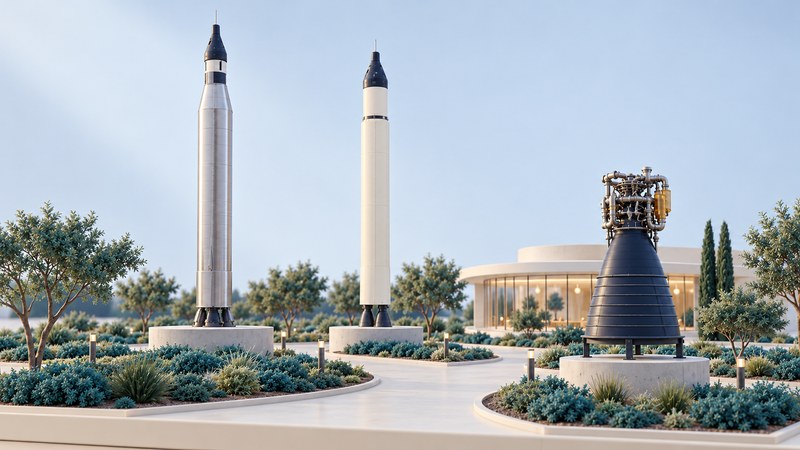
NYSCI’s Rocket Park makes the scale of early spaceflight visible at ground level. Begin with the small spacecraft at the top of each launch vehicle, then follow the body downward to the propulsion hardware that lifted it.
Check access before setting out
The New York Hall of Science is at 47-01 111th Street in Queens, New York. Its visitor-information page provides current hours, tickets, directions, parking notices, and an entrance map. Check those details for your visit date, particularly when events or construction affect the route.
As checked October 9, 2026, NYSCI’s exhibit directory lists Rocket Park with general admission. It lists Rocket Park Mini Golf separately, as a weather-dependent activity included with a Plus pass or available as an add-on. Select the experience you intend to visit and confirm its availability before buying.
For step-free access, sensory needs, group arrangements, or an uncertain outdoor opening, use the museum’s accessibility information and contact options. Plan enough flexibility to move the observation activity indoors if outdoor access changes.
Three objects, three ways to look
On a narrow screen, scroll the table sideways. Keyboard users can focus the table region and use the arrow keys.
| Exhibit | Look for | Question to take away |
|---|---|---|
| Mercury-Atlas D | The small capsule above the much larger launch vehicle. | How much of the visible assembly carried the astronaut, and how much helped it reach orbit? |
| Gemini-Titan II | The relationship between the Gemini spacecraft and the staged vehicle below. | What changed when the spacecraft carried two people instead of one? |
| Saturn V F-1 engine | The bell-shaped nozzle and the machinery above it. | Which parts belong to an engine, and which would belong to an entire launch vehicle? |
NYSCI’s current exhibit directory identifies all three. Its space-exhibit background describes the Mercury-Atlas “Friendship 7” capsule as a full-size replica and distinguishes it from a Mercury capsule used in a 1960 escape-system test. Read each object’s own label to establish whether it is flight hardware, a test article, a replica, or a restored assembly.
The F-1 was an engine used in the Saturn V first stage; five powered that stage. Seeing one engine up close is a useful way to imagine the scale of the larger vehicle. It also helps separate the nozzle you can readily recognize from the pumps, valves, and chamber that make it work.
Try a short observation activity
Allow about 20 minutes as a flexible activity plan, with extra time for reading and conversation. Bring paper or use the plain-text observation sheet on a phone.
- Choose one object. Record its displayed name and copy only the few label details needed to identify it.
- Sketch three shapes. Mark the spacecraft or payload, the main body, and any visible nozzle. Use a simple outline instead of trying to draw every pipe.
- Separate seeing from learning. Write one thing you can directly observe, one fact supplied by the label, and one question that still needs a source.
- Compare another object. Look for one similarity and one difference. Explain how each might relate to the object’s purpose.
- Check an inference. Ask an Explainer or consult an official reference before treating your guess as a fact.
Connect the garden to the World’s Fair
The rocket exhibits belong to the space-age story of the 1964–1965 New York World’s Fair. NYSCI places the Rocket Park artifacts in that context, when Mercury, Gemini, and Apollo made spaceflight a highly visible public undertaking. NYC Parks’ World’s Fair history describes Space Park’s role alongside the Hall of Science.
Outdoor museum objects also have a preservation history. Weathering, restoration, replacement surfaces, and display supports affect what visitors see. A painted name or familiar shape identifies a story to investigate; an object label provides the stronger basis for deciding what the particular artifact actually did.
Turn the visit into a useful comparison
Afterward, pick one question from your notes and follow it to an authoritative source. For propulsion, compare kerosene and oxygen with other propellant choices. For a later generation of launch hardware, read the Delta II guide and identify its strap-on boosters, stages, and payload fairing.
For students, the best finished record is a small set of well-supported observations: an object name, a sketch, two verified facts, and a remaining question. That makes the museum visit a starting point for understanding how a complete space mission fits together.