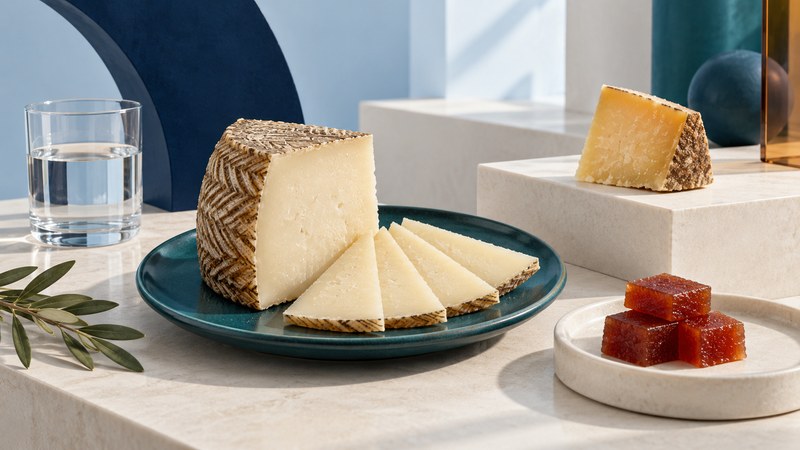
When you want Spanish Manchego, look for the full product identity and origin marks before comparing age or price. Then choose a wedge for its use: slices for a snack, a contrasting cheese on a board or a small tasting of two ages.
Identify the cheese behind the name
The Manchego PDO product description defines a pressed cheese made from the milk of Manchega sheep. Its current minimum maturation is 30 days for pasteurized cheeses weighing 1.5 kg or less, and 60 days for other sizes; the maximum is 24 months. Those limits describe the PDO product, rather than a universal rule for everything sold as Manchego-style cheese.
Use the Manchego PDO identification guide to recognize the commercial label, numbered certification back label and PDO mark. Whole wheels also carry a numbered casein plate. For a counter-cut wedge, ask to see the original wheel’s label. The familiar basket-pattern rind is a useful visual cue, but the documentation is what establishes the product’s identity.
Compare age within a clear context
Terms such as semi-curado, curado and viejo are useful shop descriptions. Record any stated maturation in months and ask the seller about the actual wedge’s firmness and flavor. If you are comparing two producers, both production choices and age can affect what you taste.
On a narrow screen, focus the table and use the arrow keys to scroll.
| Your priority | Ask or check | Why it matters |
|---|---|---|
| A softer bite for slicing | Which available wedge is less firm? | Texture determines how thinly and neatly you can cut it |
| An intense tasting accent | Can I sample the more mature choice? | A small sample is more useful than an age-based quality ranking |
| A specific Spanish origin | Can I see the PDO and original label? | Confirms the product you intended to buy |
| A manageable purchase | What is the smallest practical wedge? | Lets you finish it while enjoying its texture |
Compare the price per unit weight and the portion you will actually eat. For a small tasting, spending more per gram on two modest wedges may suit the task better than buying one large wheel. This is a purchasing method, not a claim that one age or producer is better.
A two-age tasting for four
Illustrative plan: buy 80 g of each of two ages, providing 20 g of each per person. The total is 4 × 2 × 20 = 160 g. Use two cheeses from the same producer if you want age to be the main comparison, and keep their labels with your notes.
- Cut similar thin pieces with a suitable firm-cheese knife. Remove wax or coating identified as inedible by the producer.
- Taste the less intense example first. Record firmness, crumbliness, saltiness and the flavor that remains after swallowing.
- Repeat with plain bread, then a little quince paste or pear. These are suggested tasting partners; try the cheese plain before deciding what improves it.
- Choose which wedge you would buy for snacking and which you would use in smaller amounts on a board.
Build a meal around the portion
Use slices beside bread and a simple vegetable dish, or shave a firmer piece over a finished salad. Taste before adding other salty ingredients. For a cooked recipe that names Manchego, preserve the specified cheese form and amount on the first attempt; changing maturity can alter texture as well as flavor.
On a three-cheese board, Manchego can provide the firm slicing component. Pair it with a soft cheese and a different flavor profile rather than buying three similar wedges solely because their countries differ.
Keep the label with the cheese
Retain the maker’s storage and rind instructions, wrap the cut face and mark when you opened it. Keep refrigerated cheese at 40°F (4°C) or below; FDA refrigerator guidance explains temperature control. Check the milk-treatment statement when shopping for someone who needs to avoid raw-milk cheese. Origin and maturity are useful facts, but each household’s food requirements still determine the choice.