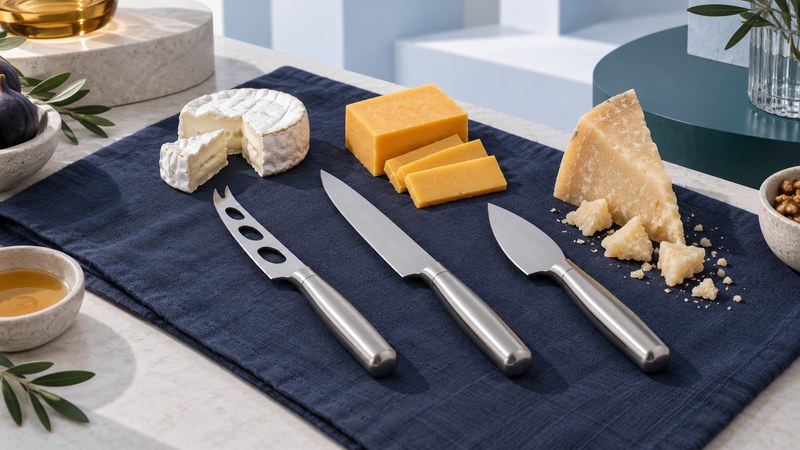
Choose a cheese knife by what the cheese does under the blade. Soft cheese sticks, a springy block needs a clean slice, and very hard cheese may break into pieces more readily than it cuts. Start with the tools you own and add a specialist tool when a recurring task calls for it.
Match the blade to the texture
On a narrow screen, focus the table and use the arrow keys to scroll.
| Cheese texture | Tool to consider | What the shape does |
|---|---|---|
| Spreadable | Small spreader | A broad rounded blade transfers a soft portion to bread |
| Soft and sticky | Thin blade or knife with openings | Less blade surface means less cheese can cling to it |
| Firm and sliceable | Sharp straight kitchen or cheese knife | A controlled cut makes even sandwich or board slices |
| Soft and fragile | Cheese wire on a suitable board | A fine wire passes through with little displacement |
| Very hard and granular | Short rigid hard-cheese knife | A stout tip helps separate small pieces |
BOSKA’s guide to knife shapes and cheese textures connects blade shapes to these cheese textures. Use the manufacturer’s instructions for a particular wire cutter or specialist knife. Product names and decorative shapes are less useful than the stiffness, contact area and control a tool provides.
Check what you already own
For an occasional board, a clean sharp kitchen knife for firm cheese and a small spreader for very soft cheese may cover your needs. Test a cut before guests arrive. If a soft wedge collapses or clings to the blade, wipe the blade clean between cuts or use a narrower tool. If a hard block demands excessive force, choose a more suitable tool or ask the counter to portion it.
A forked tip can lift a cut piece, but it does not explain how the blade cuts. A broad mini-cleaver can work for a firm cheese, while a flexible spreading blade is suited to spreading. Avoid using a delicate blade to lever a hard piece apart.
Make the serving cut easy to repeat
- A small wheel: cut radial wedges so portions include center and edge. Start with one or two wedges and leave the rest intact.
- A firm rectangular block: set it on a flat face and slice at a consistent thickness. Cut those slices into manageable pieces if serving with crackers.
- A triangular wedge: take slices that include the desired balance of interior and rind, removing wax or inedible coating first.
- A very crumbly cheese: portion modest pieces ahead of time into a dish so guests can serve them without chasing fragments around the board.
Keep the cutting board stable, hold the food away from the cutting path and use a tool that you can control comfortably. A large wheel is a different job from a small retail wedge; professional portioning at the counter can be the simplest solution.
Arrange tools around the food
Example: for cheddar, Camembert and blue cheese, give the cheddar a straight slicing knife, the Camembert a thin blade and the blue a separate serving tool. Put handles toward the accessible edge and keep blade tips within the board’s working area. Leave room for a guest’s plate.
Separate tools prevent a strong blue from smearing into a milder cheese. For food allergies, plan a separate suitable serving arrangement; sharing a board and swapping knives is insufficient control. The board planner helps organize quantities and serving dishes as well as cheese.
Clean and store for the next use
Follow each tool’s cleaning instructions, especially for wood handles, moving parts and wire tension. Wash away cheese residue, dry thoroughly and store sharp tools so their edges are protected. Check wire cutters for damage before use. If a tool drags or slips, resolve its condition and suitability before increasing force.
Use the food as the final test: the tool should leave the portion in the shape you wanted while giving you control. Compare soft Camembert, sliceable cheddar and firmer Manchego to see why one blade may not serve every texture equally well.